| Table 1. Mean values and percentages of study participants, by selected characteristics, according to interview status, Cameroon, 1998-1999 | |||||
| Characteristic | Followed up | Lost to follow up | t- (or z-) statistic | p | |
| (N=571) | (N=796) | ||||
| Mean age (in years) | 27.4 | 27.0 | 0.874 | .382 | |
| % residing in rural area | 9.5 | 10.0 | -0.363 | .716 | |
| Mean no. of years of education | 7.1 | 7.3 | -0.809 | .419 | |
| Mean no. of children ever born* | 2.7 | 2.2 | 3.352 | .001 | |
| % single* | 28.2 | 34.2 | -2.334 | .019 | |
| % exposed to family planning information on the media during last 12 months | 56.4 | 52.8 | 1.328 | .184 | |
| % who knew four or more modern contraceptive methods* | 72.8 | 67.3 | 2.188 | .029 | |
| % currently using any contraceptive method | 37.1 | 36.0 | 0.406 | .685 | |
| % currently using a modern contraceptive method | 15.6 | 12.3 | 1.738 | .082 | |
| *Difference of means or percentages between groups is statistically significant at p=.05. | |||||

| Table 2. Percentage distribution of study participants and odds ratios showing likelihood of exposure to GO campaign, by social or demographic variable and prior family planning attitudes and practices | |||
| Variable | % | Odds ratio | z |
| SOCIAL/DEMOGRAPHIC CHARACTERISTICS | |||
| Education | |||
| None (ref) | 18.2 | 1.00 | na |
| Primary | 25.9 | 4.20*** | 3.099 |
| >=secondary | 55.9 | 5.82*** | 3.560 |
| Religion | |||
| Christian | 77.1 | 0.53 | -1.923 |
| Non-Christian (ref) | 22.9 | 1.00 | na |
| Region of residence | |||
| Southwest (ref) | 18.6 | 1.00 | na |
| North | 27.1 | 1.60 | 1.292 |
| West/Littoral | 19.3 | 1.18 | 0.517 |
| Center | 35.0 | 2.12** | 2.589 |
| Age-group | |||
| <25 years (ref) | 41.3 | 1.00 | na |
| 25-34 | 28.9 | 0.77 | -1.086 |
| >=35 | 29.8 | 0.57* | -2.075 |
| Residence status | |||
| City/large town | 53.1 | 1.20 | -0.871 |
| Small town/village (ref) | 46.9 | 1.00 | na |
| Access to mass media | |||
| No. of communication media | 1.15 | 1.44*** | 3.496 |
| PRIOR IDEATION & CONTRACEPTIVE USE, 1998 | |||
| Prior contraceptive use | |||
| Modern | 15.6 | 1.70 | 1.526 |
| Traditional | 22.2 | 1.33 | 0.883 |
| None, intending to use modern | 32.0 | 1.55 | 1.518 |
| None, not intending to use modern (ref) | 30.2 | 1.00 | na |
| Prior overall ideation | |||
| Mean score | 2.31 | 1.11 | 1.208 |
| Pseudo-R2 | 13.99 | ||
| Hosmer-Lemeshow X2/prob. | 4.53/0.605 | ||
| % correctly classified | 68.3 | ||
| N | 571 | ||
| *p<.05. **p<.01. ***p<.001. Notes: ref=reference group. na=not applicable. | |||
| Table 3. Mean value or percentage of respondents reporting particular behavior, by baseline and follow-up values and percentage change, according to exposure to GO campaign (N=571) | |||
| Variable | Total | Exposed | Not exposed |
| Overall ideation score | |||
| Baseline | 2.31 | 2.66 | 2.11 |
| Follow-up | 2.59 | 3.16 | 2.27 |
| % change | 12.1 | 18.4 | 7.5 |
| t | 4.606 | 4.757 | 2.131 |
| p | .0001 | .0001 | .0338 |
| Mean no. of modern methods known | |||
| Baseline | 4.72 | 5.18 | 4.45 |
| Follow-up | 4.74 | 5.70 | 4.18 |
| % change | 0.4 | 10.0 | -5.8 |
| t | 0.284 | 4.042 | -2.63 |
| p | .776 | .0001 | .009 |
| % who approved of family planning | |||
| Baseline | 70.7 | 80.0 | 65.4 |
| Follow-up | 72.8 | 85.7 | 65.4 |
| % change | 3.0 | 7.1 | 0.0 |
| z | 0.789 | 1.554 | 0.000 |
| p | .430 | .120 | 1.000 |
| % who discussed family planning with spouse or partner | |||
| Baseline | 32.7 | 41.9 | 27.4 |
| Follow-up | 45.2 | 52.8 | 40.7 |
| % change | 38.2 | 26.5 | 48.5 |
| z | 4.308 | 2.248 | 3.789 |
| p | .0001 | .0246 | .0002 |
| % who discussed family planning with others | |||
| Baseline | 29.1 | 35.7 | 25.2 |
| Follow-up | 32.4 | 43.8 | 25.7 |
| % change | 11.3 | 22.7 | 2.0 |
| z | 1.219 | 1.695 | 0.171 |
| p | .223 | .090 | .864 |
| % whose spouse or partner approves of family planning | |||
| Baseline | 26.0 | 28.6 | 24.9 |
| Follow-up | 37.6 | 45.2 | 33.2 |
| % change | 43.8 | 58.0 | 33.3 |
| z | 4.125 | 3.539 | 2.458 |
| p | .0001 | .0004 | .014 |
| Table 4. Percentage distribution of study participants and regression coefficients estimating the impact of campaign exposure, selected characteristics and prior family planning related attitudes and practices on ideation (N=571) | |||
| Independent variable | % dist. | Model 1† | Model 2‡ |
| SOCIAL/DEMOGRAPHIC CHARACTERISTICS | |||
| Education | |||
| None (ref) | 18.2 | 0.00 | 0.00 |
| Primary | 25.9 | 0.74*** | 0.49* |
| >=secondary | 55.9 | 1.24*** | 0.83** |
| Religion | |||
| Christian | 77.1 | 0.15 | 0.24 |
| Non-Christian (ref) | 22.9 | 0.00 | 0.00 |
| Region of residence | |||
| Southwest (ref) | 18.6 | 0.00 | 0.00 |
| North | 27.1 | -0.53** | -0.66*** |
| West/Littoral | 19.3 | -0.47** | -0.50** |
| Center | 35.0 | -0.45** | -0.65*** |
| Age-group | |||
| <25 years (ref) | 41.3 | 0.00 | 0.00 |
| 25-34 | 28.9 | 0.06 | 0.15 |
| >=35 | 29.8 | 0.01 | 0.15 |
| Residence status | |||
| City/large town | 53.1 | -0.06 | -0.07 |
| Small town/village (ref) | 46.9 | 0.00 | 0.00 |
| Marital status | |||
| Single | 24.2 | -0.78*** | -0.74*** |
| Ever-married (ref) | 75.8 | 0.00 | 0.00 |
| Visited health facility within last 12 months | |||
| Yes | 73.2 | 0.33** | 0.35** |
| No (ref) | 26.8 | 0.00 | 0.00 |
| Exposure to other family planning interventions | |||
| Yes | 36.1 | 0.38*** | 0.38*** |
| No (ref) | 63.9 | 0.00 | 0.00 |
| PRIOR ATTITUDES AND PRACTICES, 1998 | |||
| Prior contraceptive use | |||
| Modern | 15.6 | 0.67*** | 0.53** |
| Traditional | 22.2 | 0.62*** | 0.54** |
| None, intending to use modern | 32.0 | 0.44** | 0.32* |
| None, not intending to use modern (ref) | 30.2 | 0.00 | 0.00 |
| Prior overall ideation | |||
| Mean score | 2.31 | 0.27*** | 0.23*** |
| PROGRAM EXPOSURE | |||
| Exposed to campaign | |||
| Yes | 36.8 | 0.27** | na |
| No (ref) | 65.2 | 0.00 | na |
| Predicted campaign exposure | na | na | 1.46* |
| R2 | na | .511 | .510 |
| Ramsey regression specification error test (RESET) F/Prob>F | na | 0.76/0.516 | 0.33/0.806 |
| Mean variance inflation factor | na | 1.99 | 2.84 |
| *p<.05. **p<.01. ***p<.001. †Model assumes that campaign exposure is exogenous. ‡Estimated error term from campaign exposure regression is used to test for exogeneity. Notes: ref=reference group. na=not applicable. | |||
| Table 5. Percentage of women using modern contraceptives at Waves 1 and 2, and percentage change between waves, by campaign exposure status. | |||
| Variable | Total | Exposed | Not exposed |
| (N=571) | (N=210) | (N=361) | |
| Wave 1 (1998) | 15.6 | 19.5 | 13.3 |
| Wave 2 (1999) | 18.7 | 27.1 | 13.8 |
| % change | 20.2 | 39.0 | 3.7 |
| z-statistic | 1.413 | 1.846 | 0.217 |
| p | .0789 | .0325 | .4140 |
| Table 6. Percentage distribution and selected mean values of study participants by selected characteristics, and odds ratios showing likelihood of modern contraceptive use, according to model (N=571) | ||||
| Characteristic | %/mean | Odds ratio | ||
| Model 1† | Model 2‡ | Model 3§ | ||
| IDEATION/PRIOR METHOD USE | ||||
| Prior contraceptive use | ||||
| Modern | 15.6 | 5.76*** | 5.58*** | 7.40*** |
| Traditional | 22.2 | 1.27 | 1.18 | 1.48 |
| None, intending to use modern | 32.0 | 1.49 | 1.46 | 1.83 |
| None, not intending to use modern (ref) | 30.2 | 1.00 | 1.00 | 1.00 |
| Current ideation | ||||
| Mean | 2.6 | 1.41*** | na | 1.04 |
| Estimated error | na | na | na | 1.41 |
| No. of modern methods known | 4.7 | na | 3.11** | na |
| Approves of family planning | ||||
| Yes | 72.8 | na | 1.48 | na |
| No (ref) | 18.2 | na | 1.00 | na |
| Partner/spouse approves of family planning | ||||
| Yes | 37.6 | na | 1.10 | na |
| No (ref) | 62.4 | na | 1.00 | na |
| Discusses family planning with partner/spouse | ||||
| Yes | 45.2 | na | 1.34 | na |
| No | 54.8 | na | 1.00 | na |
| Discusses family planning with other people | ||||
| Yes | 32.4 | na | 1.42 | na |
| No | 67.6 | na | 1.00 | na |
| SOCIAL/DEMOGRAPHIC CHARACTERISTICS | ||||
| Education | ||||
| No education (ref) | 18.2 | 1.00 | 1.00 | 1.00 |
| Primary | 25.9 | 0.87 | 0.85 | 1.07 |
| >=secondary | 55.9 | 0.73 | 0.63 | 1.06 |
| Religion | ||||
| Christian | 77.1 | 4.11** | 4.18** | 4.37** |
| Non-Christian (ref) | 22.9 | 1.00 | 1.00 | 1.00 |
| Region of residence | ||||
| Southwest (ref) | 18.6 | 1.00 | 1.00 | 1.00 |
| North | 27.1 | 0.59 | 0.65 | 0.46 |
| West/Littoral | 19.3 | 0.81 | 0.73 | 0.69 |
| Center | 35.0 | 0.82 | 0.84 | 0.67 |
| Age-group | ||||
| <25 years (ref) | 41.3 | 1.00 | 1.00 | 1.00 |
| 25-34 | 28.9 | 0.99 | 0.95 | 1.11 |
| >=35 | 29.8 | 1.20 | 1.09 | 1.35 |
| Parity | ||||
| 0 (ref) | 26.4 | 1.00 | 1.00 | 1.00 |
| 1-3 | 37.1 | 0.75 | 0.68 | 0.88 |
| 4-6 | 22.1 | 0.85 | 0.77 | 1.04 |
| >=7 | 14.4 | 1.35 | 1.33 | 1.66 |
| Prior exposure to family planning messages | ||||
| Mean no. | 1.35 | 1.04 | 1.01 | 1.09 |
| % exposed to other messages in past 12 months | ||||
| Yes | 36.1 | 1.16 | 1.07 | 1.19 |
| No (ref) | 63.9 | 1.00 | 1.00 | 1.00 |
| CAMPAIGN | ||||
| Campaign exposure | ||||
| Exposed | 36.8 | 1.80* | 1.75* | 2.48 |
| Not exposed | 63.2 | 1.00 | 1.00 | 1.00 |
| Estimated error from campaign exposure | na | na | na | 0.89 |
| % of variance explained (pseudo-R2) | 20.1 | 21.3 | 20.3 | |
| Hosmer-Lemeshow X2 (8 groups) | 4.58 | 7.44 | 6.14 | |
| p of X2 | .599 | .282 | .407 | |
| % correctly classified | 82.5 | 83.2 | 82.7 | |
| *p<.05. **p<.01. ***p<.001. †Campaign exposure and ideation assumed exogenous; overall ideation score used. ‡Campaign exposure and ideation assumed exogenous; various components of ideation introduced individually. §Campaign exposure and ideation assumed endogenous. Notes: ref=reference group. na=not applicable. | ||||
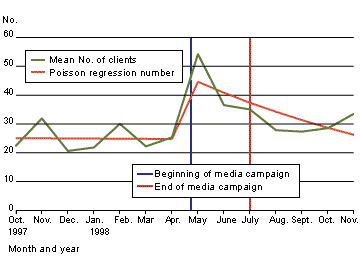
Figure 1. Mean number of clients and Poisson regression model for GO sites, Cameroon, 1998-1999 |
 |
|
| Table 7. Incidence rate ratio of mean number of new clients, by time, according to health service site | ||||||
| Variable | GO sites (N=8) | Non-GO sites (N=42) | ||||
| Rate ratio | z | 95% CI | Rate ratio | z | 95% CI | |
| GO campaign launched | 6.01* | 2.701 | 1.64-22.10 | 1.86 | 0.992 | 0.54-6.37 |
| Time in months | 0.99 | -0.052 | 0.93-1.07 | 1.04 | 0.686 | 0.94-1.15 |
| Interaction term | 0.92 | -1.736 | 0.83-1.01 | 0.92 | -1.151 | 0.80-1.06 |
| % of variance explained/pseudo-R2 | 18.4 | 2.3 | ||||
| Goodness of fit X2 | 10.76 | 2.24 | ||||
| Prob.>X2 | 0.377 | 0.994 | ||||
| df | 10 | 10 | ||||
| No. of months | 14 | 14 | ||||

 |
 |
© copyright 2001, The Alan Guttmacher Institute. |