
It Is Time to Take a New Approach to Measuring Contraceptive Need Globally: Adopting a Rights-Based Measure in Adding It Up 2024

Year
Elizabeth A. Sully, Guttmacher Institute, Jessica D. Rosenberg, Guttmacher Institute and Floriane Borel, Guttmacher Institute

The full realization of sexual and reproductive health and rights globally requires a deeper and more nuanced understanding of individuals’ contraceptive needs and desires, and the range of barriers that may impede their ability to act on these freely. Developing and refining measures that encompass the range of existing contraceptive needs is one critical step in this process. The time has come to better align our measurement practices with our values—ensuring that indicators of progress on sexual and reproductive health are increasingly grounded in the rights and autonomy they purport to advance.

Adding It Up 2024, a key Guttmacher Institute study, uses a new lens to estimate contraceptive need, aligning with broader changes across our field to move toward measurement approaches that directly capture each person’s sexual and reproductive health needs and experiences.

Expanding Measures of Contraceptive Need in Adding It Up

Adding It Up (AIU), a research initiative led by the Guttmacher Institute for more than two decades, has been a key resource for information on the need for, costs of and impacts of providing contraceptive care and other sexual and reproductive health services in low- and middle-income countries. Historically, contraceptive need analyses in AIU have focused on unmet need for modern contraceptive care. This key indicator has been central to driving increased financing and improved access to contraception by drawing attention to the critical gaps in meeting people’s contraceptive needs around the world. However, this indicator has at times been misused and misinterpreted, and there are growing calls to develop new measures of contraceptive need that are more rights based and person centered.1

The latest AIU release (with 2024 estimates)2 includes calculations based on three different measures of contraceptive need: unmet need for modern methods; unmet need for any method, which has been used in the field already for estimating service gaps; and a newer measure called “unmet demand,” which focuses on the most critical gaps in the need for contraceptive care and centers women’s own expressed needs and preferences.

In this explainer, we walk through the reasons for developing a new measure, how the new measure of unmet demand is defined and compares with other commonly used measures, and why this newest measure serves as a valuable addition to existing indicators of contraceptive need to support global family planning advocacy.

Why Use a New Measure of Unmet Need for Contraception?

Long-standing indicators of contraceptive need, such as unmet need for modern methods, have included assumptions about contraceptive need based solely on women’s pregnancy desires. The measure of unmet need for modern contraception assumes that if women say they want to avoid a pregnancy in the next two years or do not want any(more) children, they should be using a modern method of contraception. The measure does not consider whether women want or need contraception, if they intend to use contraception or if there is a modern contraceptive method available that they would find acceptable to use.

In addition, focusing on unmet need for modern methods centers modern contraception as the only acceptable means to successfully avoid pregnancy. Many people choose to use traditional methods of contraception—such as calendar rhythm or withdrawal—and may be satisfied with that choice.* Although modern methods are generally more effective at preventing pregnancy,3 traditional methods can still substantially reduce the chances of unintended pregnancy and some people are able to use these methods effectively.

The measure of unmet need for any method removes the assumption that modern contraceptive method use is the only way to meet an individual’s contraceptive needs and preferences.4 Metrics of unmet need can be useful for understanding how many people want to avoid pregnancy and are not using (modern or any) contraception, but they do not establish who wants to use contraception.

Person-centered measurement approaches strive to be rights based, centering bodily autonomy and developing indicators to capture a person’s own expressed preferences, needs and values, and whether they feel that their needs are being fulfilled.5 The family planning field needs new indicators that are more person centered to complement previous metrics and better reflect gaps in contraceptive need.
Comparing measures of unmet contraceptive need
Measure and who is includedFactors not considered by the measure
 Whether women want or intend to use contraception Whether women using traditional methods may already have their contraceptive needs met
 
Whether women using a modern method want to continue use of that method Whether women want to use contraception even though they do not want to avoid pregnancy in next two years 
Unmet need for modern methods
Women who want to avoid pregnancy; not using a modern contraceptive method
 
xxxx
Unmet need for any method
Women who want to avoid pregnancy; not using any contraceptive method
 
x xx
Unmet demand
Women who want to avoid pregnancy; not using any contraceptive method, and intend to use one in the future (or unsure and open to future use)
 
  xx

What Is the New Contraceptive Need Measure in Adding It Up 2024?

New measures of contraceptive need have been proposed that directly ask women what they want and if their preferences are being met.6–9 However, these recently proposed indicators have not yet been tested and implemented in national surveys. Until such measures become part of national surveys in low- and middle-income countries, the family planning field has to rely on existing data to advance more person-centered measures of contraceptive need. In AIU 2024, we included unmet demand10 for contraception as a measure, which estimates the number of women wanting to avoid a pregnancy who are not using any contraceptive method, and who also indicate that they intend to use contraception at some point or are open to the possibility of future use.

Using this measure focuses more narrowly on women who want to avoid a pregnancy and have expressed an intention to use contraception in the future, moving the indicator closer to a person-centered approach. Women are excluded from this measure’s estimates if they have expressed wanting to avoid pregnancy without any intention to use a contraceptive method in the future.

While estimates based on the unmet demand measure are better grounded in women’s own preferences than previous measures, there are limitations to its use. For instance, the measure does not specify how long into the future a woman with unmet demand may want to start using contraception. Also, women are excluded who do not currently want to avoid pregnancy, even if they may intend to use contraception for other reasons. For example, women may want to use contraception for medical reasons, such as managing painful menstrual cycles, that unmet demand does not include. Likewise, women and girls who are not yet sexually active may intend to use contraception in the future, particularly if they are planning to become sexually active soon. The unmet demand measure also does not fully capture the needs of current contraceptive users who may not want to be using their current method or who wish to use a different method.

Unmet demand is not the ultimate solution for a person-centered measure of contraceptive need. It is a useful option for the time being, as it is a measure that can be constructed with currently available, nationally representative data and incorporates some of women’s own stated intentions around their future contraceptive use rather than making assumptions about their needs.

What Are the Estimates of Contraceptive Need in Adding It Up 2024?

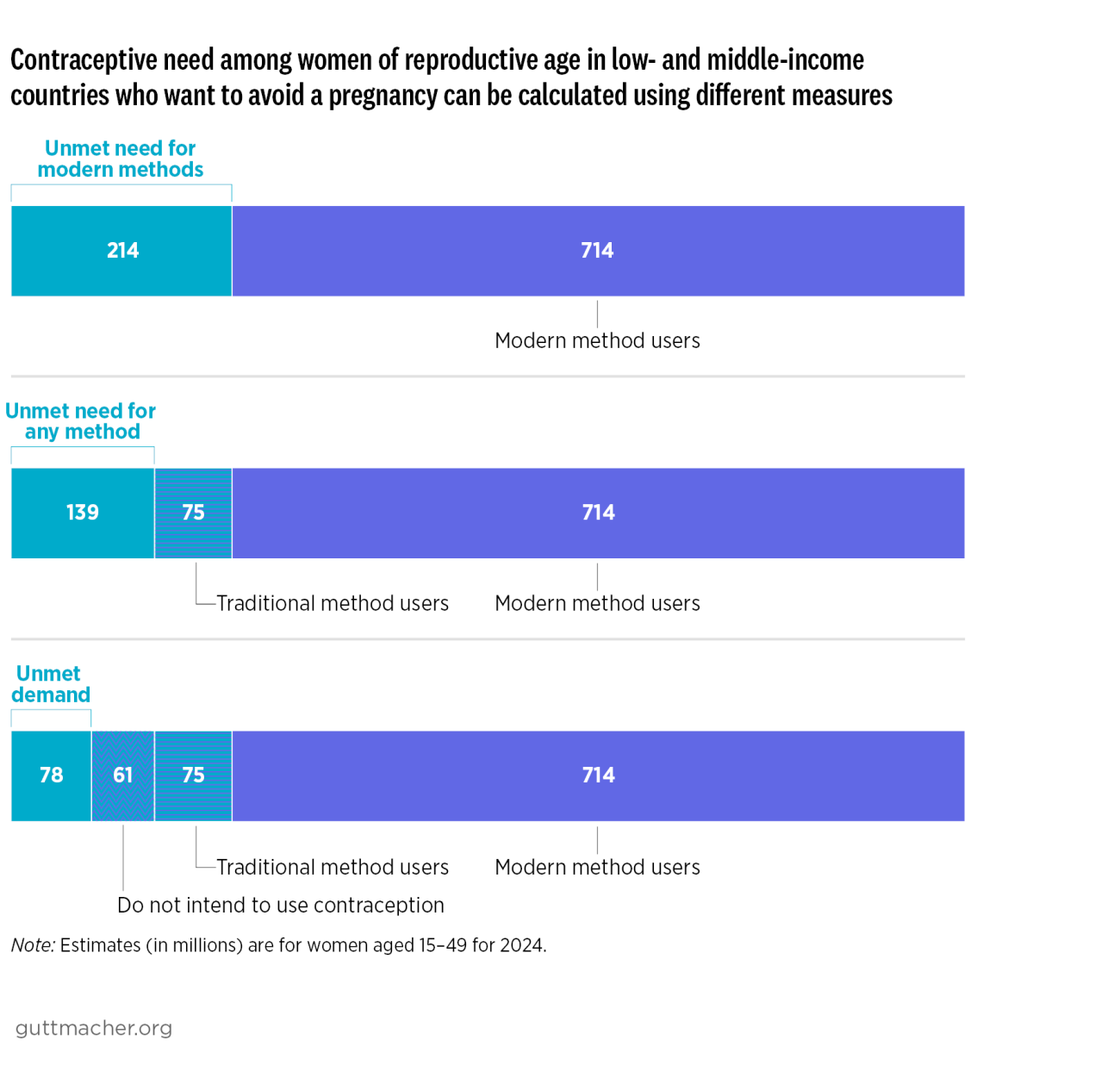
The AIU 2024 study estimated that there were 214 million women with an unmet need for modern contraceptive methods in 2024 across 128 low- and middle-income countries—139 million with unmet need for any contraceptive method and 75 million using traditional methods. Among the 139 million women with an unmet need for any method, 78 million had an unmet demand for contraception (because they reported intending to use contraception in the future or being open to use) and 61 million reported they did not intend to ever use contraception. National estimates for unmet need for modern methods, unmet need for any method and unmet demand for contraception (for all women aged 15–49 and for adolescent women aged 15–19) are available in Guttmacher’s data profiles for individual countries.

Contraceptive need among women of reproductive age in low- and middle-income countries who want to avoid a pregnancy can be calculated using different measures

How Can the New Unmet Demand Measure Be Used?

The global community came together in 2015 to develop the 2030 Agenda for Sustainable Development and its 17 Sustainable Development Goals (SDGs). The work to define the indicators for several SDGs related to sexual and reproductive health and gender equality was an important exercise in envisioning a future where everyone’s access to critical sexual and reproductive health services and information and right to bodily autonomy would be fulfilled. A decade later, indicators of sexual and reproductive health have evolved significantly, and we have an opportunity to refine how we measure and track progress, including on contraceptive need. This includes incorporating new person-centered measures into future surveys and data collection systems, as well as examining and starting to shift the measures in use today and how advocates, policymakers and government officials talk about these measures.

Building from previous measures of contraceptive need

The calculations underlying the indicator of unmet need for modern contraceptive methods are still relevant. When appropriately described and used, this measure provides useful estimates of women who want to avoid pregnancy but are not using modern contraception. This concept, however, is distinct from self-expressed contraceptive need.1

Although previous iterations of AIU used the long-standing definition of unmet need for modern contraception in constructing estimates, that does not mean estimates in those studies were incorrect or that unmet need was overestimated; rather, the way we estimated unmet need previously cannot be directly compared with our new unmet demand estimates.

Why the new measure matters now

It is a priority to identify gaps in access to sexual and reproductive health care to build from the vision of the 2030 Agenda and move toward a future where everyone’s sexual and reproductive health and rights are fully realized. Unmet demand can be an alternative measure to use for this purpose, prior to availability of global data with even more robust, person-centered measures.

Given the reality of shrinking funding for family planning globally, we also need realistic and attainable financing targets. Using the measure of unmet demand offers a way to focus on individuals with the most immediate need for contraceptive care, based on their own expressed interest or openness to use.

Looking ahead

As we seek to build more inclusive data ecosystems to shape what comes after the 2030 Agenda, it is our field’s responsibility to listen to what people expressly indicate they want and strive to help them achieve their sexual and reproductive health-related desires.

Alongside meeting the most pressing contraceptive needs, we must also confront the barriers embedded in laws, policies, the economy, and in social norms and values—especially those contributing to gender inequality—that prevent people from achieving the highest standard of sexual and reproductive health.

Acknowledgments

The authors thank our colleagues who provided feedback and review, including Chelsea Polis, Megan Kavanaugh, Onikepe Owolabi, Kirsten Sherk, Amy Friedrich-Karnik and Susheela Singh, all of the Guttmacher Institute, as well as Shiza Farid, FP2030, and Ilene Speizer, University of North Carolina at Chapel Hill. The analysis was edited by Chris Olah.

This policy analysis was supported by the Children’s Investment Fund Foundation, Gates Foundation, Global Affairs Canada and the Norwegian Agency for Development Cooperation. The findings and conclusions contained within are those of the authors and do not necessarily reflect the positions or policies of the donors.

Footnotes

*Traditional methods include methods such as calendar-rhythm, withdrawal and abstinence. In the AIU study, we followed the World Health Organization’s recommendation to classify use of herbs, charms and vaginal douching as using no method because there is no scientific basis for the efficacy of these methods in preventing pregnancy.

References

1. Speizer IS, Bremner J and Farid S, Language and measurement of contraceptive need and making these indicators more meaningful for measuring fertility intentions of women and girls, Global Health: Science and Practice, 2022, 10(1), https://doi.org/10.9745/GHSP-D-21-00450.

2. Sully EA et al., Adding It Up 2024: Investing in Sexual and Reproductive Health in Low- and Middle-Income Countries, New York: Guttmacher Institute, 2025, https://www.guttmacher.org/report/adding-it-up-2024-investing-sexual-and-reproductive-health-low-and-middle-income-countries.

3. Bradley SEK et al., Global contraceptive failure rates: Who is most at risk? Studies in Family Planning, 2019, 50(1):3–24, https://doi.org/10.1111/sifp.12085.

4. Johnson-Hanks J, On the modernity of traditional contraception: time and the social context of fertility, Population and Development Review, 2002, 28(2):229–249, https://doi.org/10.1111/j.1728-4457.2002.00229.x.

5. Rothschild CW et al., Person-centered measurement: ensuring prioritization of individuals’ values, needs, and preferences within the global contraceptive measurement ecosystem, Studies in Family Planning, 2025, 56(3):390–402, https://doi.org/10.1111/sifp.70023.

6. Bullington BW et al., Measuring misaligned contraceptive use among reproductive-aged women in Kisumu, Kenya: a cross-sectional, population-based study, BMJ Public Health, 2025, 3(1):e001671, https://doi.org/10.1136/bmjph-2024-001671.

7. Burke KL and Potter JE, Meeting preferences for specific contraceptive methods: an overdue indicator, Studies in Family Planning, 2023, 54(1):281–300, https://doi.org/10.1111/sifp.12218.

8. Holt K et al., Preference-aligned fertility management as a person-centered alternative to contraceptive use-focused measures, Studies in Family Planning, 2023, 54(1):301–308, https://doi.org/10.1111/sifp.12228.

9. Vincent S et al., Contraceptive concordance, Studies in Family Planning, 2025, 56(3):532–549, https://doi.org/10.1111/sifp.70018.

10. Moreau C et al., Measuring unmet need for contraception as a point prevalence, BMJ Global Health, 2019, 4(4):e001581, https://doi.org/10.1136/bmjgh-2019-001581.


Source URL: https://www.guttmacher.org/2025/10/adding-it-up-person-centered-approach-to-measuring-contraceptive-need