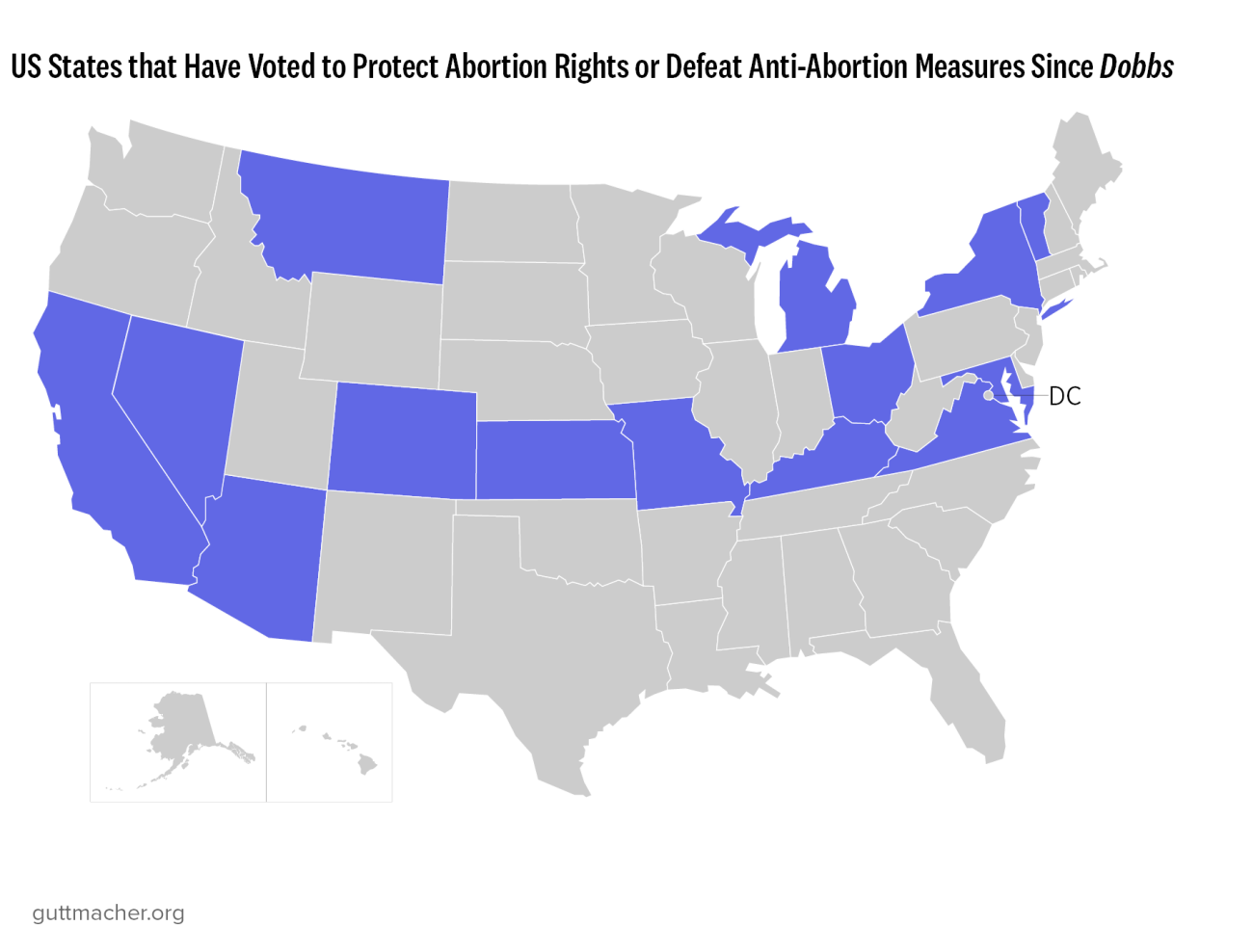
Abortion Rights Measures
Idaho
DID NOT PASS: Proposition 1 (Reproductive Freedom and Privacy Act Initiative)
Led by Idahoans United for Women and Families, this ballot measure would have created a legal avenue to challenge the state's total abortion ban through a state statute establishing a right to reproductive freedom and privacy. The statute would have prevented the state from restricting abortion before viability, at which point it could be restricted except in cases of medical emergency. The measure would have also protected people’s decision-making around pregnancy, childbirth, contraception, fertility treatments and pregnancy loss care from governmental interference.
Context:
- Abortion policies in Idaho are categorized on Guttmacher’s interactive state policy map as “Most Restrictive,” given the total abortion ban in effect, as well as numerous other restrictions.
- Despite the total ban, Idahoans have been able to access abortion via two main pathways: telehealth shield law provision and travel to other states.
Nevada
PASSED: Question 6 (Right to Abortion Initiative)
Led by Nevadans for Reproductive Freedom, this measure establishes a right to abortion in the state constitution but allows restrictions on abortion care after viability—except when necessary to protect the pregnant person’s life or physical health.
This is the second time Nevada voters have voted on this measure due to the state’s “two-election” requirement to amend the state constitution. The measure passed for the first time in 2024 and now that it has passed again, it will take effect following a vote by the state supreme court, which has previously been supportive of abortion rights.
Context:
- Abortion policies in Nevada are categorized on our interactive map as “Protective,” reflecting policies such as a statute that protects abortion rights, state Medicaid coverage of abortion when accompanied by a letter of medical necessity, and a shield law protecting abortion care from investigations by other states.
- 16,190 abortions were provided by clinicians in Nevada in 2025. While this was a slight decrease (6.3%) from 2024, it was a 47% increase compared to 2020, the last year with Guttmacher Institute abortion data from before Roe was overturned.
- 69% of clinician-provided abortions in Nevada were medication abortions in 2023, the most recent year with data on abortion methods.
- Some Nevadans sought care in other states in 2025, while Nevada also served as an access point for residents of other states:
- 720 Nevadans traveled out of state for abortion care in 2025, including to California (520) and other states (200).
- 890 people traveled into Nevada for abortion care, including from Texas (320), Arizona (220), Utah (140) and other states (210).
Virginia
PASSED: Question 1 (Right to Reproductive Freedom Amendment)
Led by Virginians for Reproductive Freedom, this ballot measure enshrines the right to reproductive freedom in the state constitution.
The measure specifically protects people’s freedom to make and carry out personal decisions about prenatal care, childbirth, postpartum care, birth control, abortion, pregnancy loss and fertility care. The measure also protects patients, doctors, and nurses from being punished for these personal decisions or helping others exercise their right to make such decisions. However, the measure allows for restrictions on access to abortion during the third trimester of pregnancy—except when the patient’s health is at risk or the pregnancy cannot survive.
Context:
- Abortion policies in Virginia are categorized as “Some Restrictions/Protections” on Guttmacher’s interactive map, due to policies such as an abortion ban in the third trimester, a state Medicaid coverage ban, and parental involvement laws that limit minors' access to abortion.
- 40,090 abortions were provided by clinicians in Virginia in 2025, approximately the same number as in 2024. The number of abortions provided in Virginia increased by nearly 114% from 2020 to 2025, in part because Virginia became a key point of access for those traveling from out of state.
- 66% of Virginia’s clinician-provided abortions in 2023 were medication abortions.
- Some Virginians sought care in other states in 2025, while the state also served as a critical point of access for people seeking abortion care in the Southeast.
- More than 8,500 people traveled to Virginia to access abortion care in 2025, primarily from states with more restrictive policies. The largest number of people came from North Carolina (2,180), Florida (1,770) and Georgia (1,240).
- Meanwhile, 2,920 people from Virginia traveled out of state for care, to Maryland (1,220), DC (860), North Carolina (680), and other states (160).
Anti-abortion Measures
Missouri
DID NOT PASS: Amendment 3 (Prohibit Abortion and Gender Transition Procedures for Minors Amendment)
Led by the anti-abortion PAC Her Health and Her Future, this measure would have overturned the right to reproductive freedom enshrined in the state constitution by Missouri voters in 2024. Amendment 3 would have prohibited abortion except in cases of medical emergency, fetal anomaly, rape or incest, and required parent or guardian consent for minors seeking an abortion. The measure would have barred public funding for abortion, and allowed the legislature to enact various unnecessary restrictions, known as targeted regulation of abortion providers (TRAP) laws, that are intended to increase scrutiny over clinics and make abortion care more costly and cumbersome to provide.
The amendment would have also prohibited gender-affirming care for minors, which is already banned by state statute.
Missouri voters’ 2024 affirmation of the right to reproductive freedom in the state constitution provided a legal avenue for overturning the state’s total abortion ban, allowing procedural abortion care to resume in the state in 2025. In June 2026, another ruling overturned restrictions that prevented clinics in the state from offering medication abortion care, allowing in-state clinical provision of this care method to resume for the first time since 2018. Voters’ rejection of Amendment 3 affirms these gains in access.
Context:
- Abortion policies in Missouri are categorized as “Restrictive” on Guttmacher’s interactive map due to numerous restrictions still in effect, such as a state Medicaid and private insurance coverage ban, an in-person requirement for medication abortion, and parental involvement laws that limit minors’ access to abortion care.
- 3,550 abortions were provided by clinicians in Missouri in 2025, a 53.5% increase from 2024.
- Due to the restrictive environment prior to the 2025 court decisions mentioned above, more than 11,500 people were forced to travel out of state for abortion care in 2025, including to Illinois (7,690), Kansas (3,940) and other states (60).