The Hyde Amendment: A Discriminatory Ban on Insurance Coverage of Abortion

Abortion is essential health care and should be affordable for everyone, regardless of income, zip code or source of insurance. But the Hyde Amendment prohibits federal funding for abortion, preventing people enrolled in Medicaid and other public programs in most states from using their health insurance to cover abortion care. For decades, Hyde has made abortion care difficult or impossible to access for many communities, and its harms have been severely compounded by the 2022 Dobbs v. Jackson Women’s Health Organization decision that overturned Roe v. Wade.

The Hyde Amendment disproportionately impacts people already facing systemic barriers to care, particularly Black, Indigenous and other people of color. As abortion bans came into effect after the Dobbs decision, access to care in many places became severely limited and forced more people to travel out-of-state for care, increasing costs associated with abortion care and pushing abortion out of reach for even more people. To ensure its affordability, abortion should be covered by health insurance—whether public or private and wherever a person lives—which means the Hyde Amendment and related abortion coverage bans must be eliminated.

How the Hyde Amendment Works

  • The Hyde Amendment prohibits federal funds from covering abortion services for people enrolled in Medicaid, Medicare and the Children’s Health Insurance Program (CHIP). It is a discriminatory policy that Congress has included in annual spending bills since 1976.
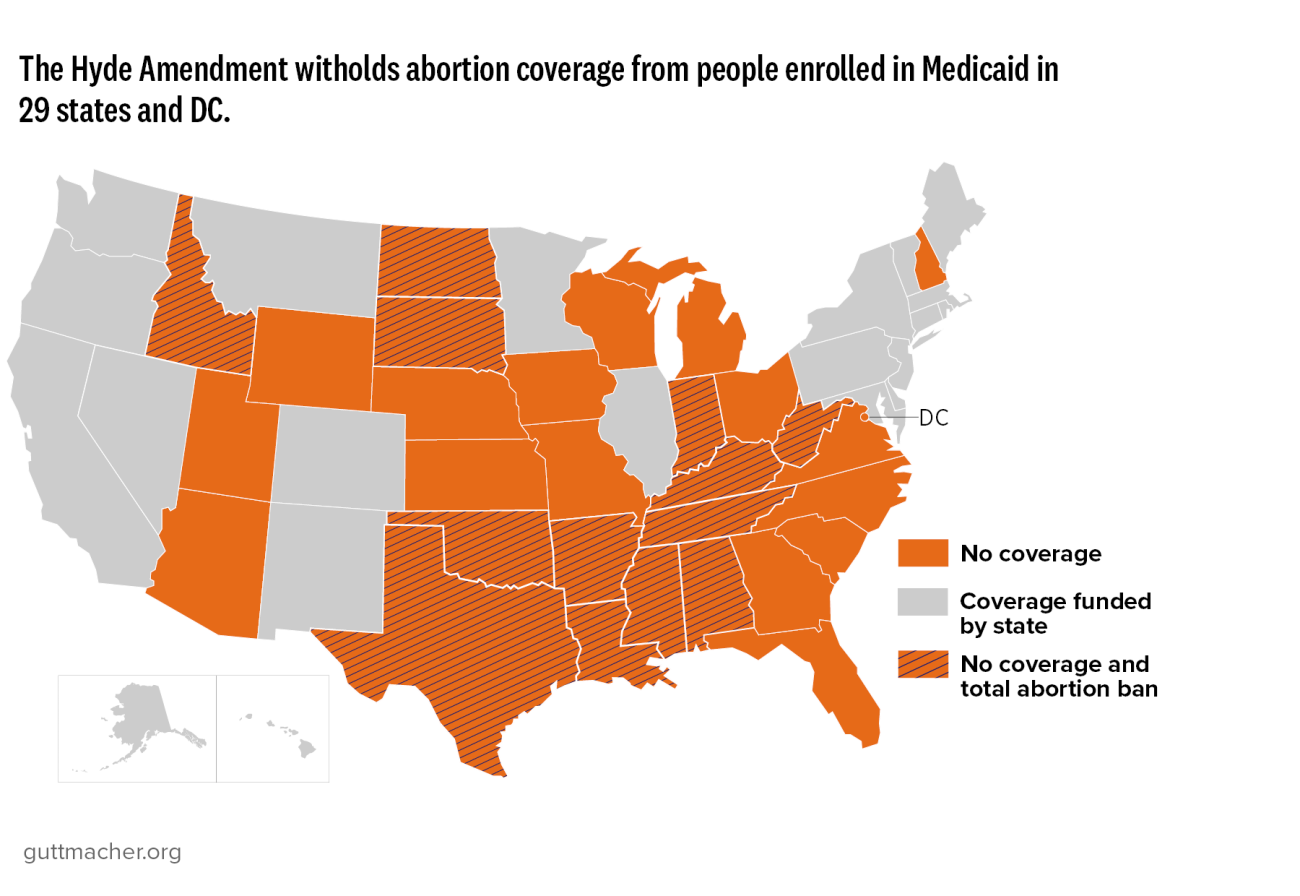
  • The Hyde Amendment currently affects people in 29 states and the District of Columbia. The remaining 21 states provide their own funding for abortion coverage for people enrolled in Medicaid.
  • One of the effects of systemic racism in the United States is that women of color are disproportionately more likely to have low incomes and to be insured through Medicaid. Among women aged 15–49, 32% of Black women and 28% of Hispanic women were enrolled in Medicaid in 2023, compared with 17% of White women and 14% of Asian women.
  • Over half (53%) of all women aged 15–49 with incomes below the federal poverty level were insured through Medicaid in 2023; for Black women in that group, the proportion was 63%.
  • Across the 29 states and the District of Columbia where state Medicaid does not cover abortion, the Hyde Amendment denies abortion coverage to 7.7 million women aged 15–49 with who are enrolled in Medicaid. Half of those affected are women of color.
  • In addition to the Hyde Amendment, there are related bans that withhold abortion coverage from millions of people who obtain their health coverage or care through other federal programs, including federal employees, military personnel and veterans, people imprisoned or detained by the federal government (including those detained by Immigration and Customs Enforcement), Native Americans, Peace Corps volunteers and people with low incomes living in the District of Columbia.
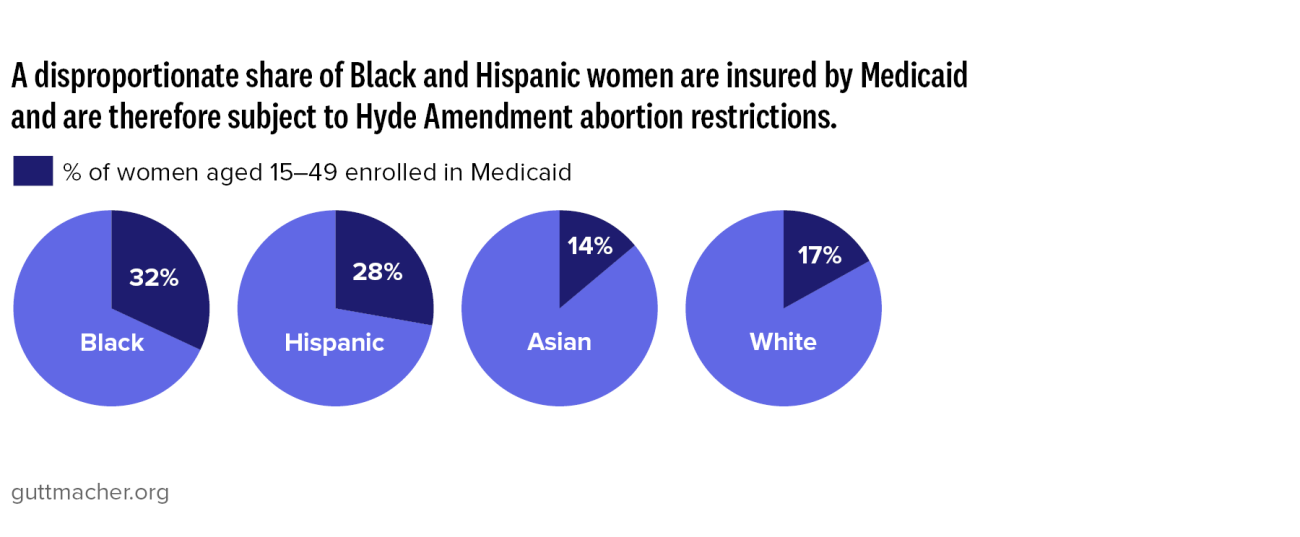
A disproportionate share of Black and Hispanic women are insured by Medicaid and are therefore subject to Hyde Amendment abortion restrictions.
The Hyde Amendment witholds abortion coverage from people enrolled in Medicaid in 29 states and DC.

Impact of the Hyde Amendment

  • In 2023, the median cost was $563 for medication abortion and $650 for first-trimester procedural abortion—and the cost increases as a pregnancy progresses.
  • To help mitigate the financial and logistical barriers to care, abortion funds and practical support networks have helped hundreds of thousands of abortion seekers afford care and other associated costs. But with increased travel for care and other urgent needs since Dobbs, those funds are increasingly overstretched. The result is that abortion access remains out of reach for people who cannot afford the mounting costs.
  • Many people living with low incomes experience delays obtaining abortion care because of time and effort spent to gather the necessary funds: Fifty-four percent of women in the University of California, San Francisco’s Turnaway Study  (which examined the consequences of continuing an unwanted pregnancy compared with receiving an abortion) reported that having to raise money for an abortion delayed their care.
  • People seeking an abortion can get caught in a cruel cycle, in which delays associated with raising the money can lead to additional costs and subsequent delays. With the current national landscape of bans based on gestational duration, these delays can require abortion seekers to travel further for care, compounding costs and other barriers.
  • Among women with Medicaid coverage subject to the Hyde Amendment, one in four who seek an abortion are forced to continue the pregnancy. 
  • Women who do not obtain an abortion they wanted have four times greater odds of subsequently living in poverty and three times greater odds of being unemployed six months later, compared with women who are able to obtain an abortion.

What Policymakers Can Do

The current patchwork of abortion bans and restrictions demands the protection of abortion access at all levels. This starts with a reimagined federal right to abortion that eliminates all restrictions, so that all people can realize that right in practice. Everyone deserves access throughout pregnancy to patient-centered abortion care in their community—including access to the method that best suits their needs.

For abortion care to truly be accessible, federal policymakers must ensure it is affordable for everyone who wants to end a pregnancy. This requires a number of steps, including:

  • Removing the Hyde Amendment and related coverage bans from annual spending bills.
  • Passing the Equal Access to Abortion Coverage in Health Insurance (EACH) Act to ensure people can obtain insurance coverage of abortion whether they get their coverage or care through Medicaid, Medicare, CHIP or other public programs. The EACH Act would also lift federal restrictions that interfere with private insurance coverage of abortion under the Affordable Care Act and ensure that the federal government does not interfere with insurance coverage of abortion by states, local governments or private health plans.
  • Passing the Health Equity and Access under the Law (HEAL) for Immigrant Families Act, which, among other things, would restore the right of all lawfully present immigrants and Deferred Action for Childhood Arrivals (DACA) recipients to enroll in Medicaid and CHIP if they are otherwise eligible.
  • Restoring access to Medicaid coverage and expanding comprehensive health insurance coverage to those who are uninsured. With the devastating cuts from HR 1, the so-called One Big Beautiful Bill Act, threatening to kick millions of people off Medicaid, those restrictions must be overturned and access to comprehensive insurance should be expanded to reach those who are under- or uninsured.

Acknowledgments

This fact sheet was updated by Anna Bernstein and edited by Ian Lague.


Source URL: https://www.guttmacher.org/fact-sheet/hyde-amendment