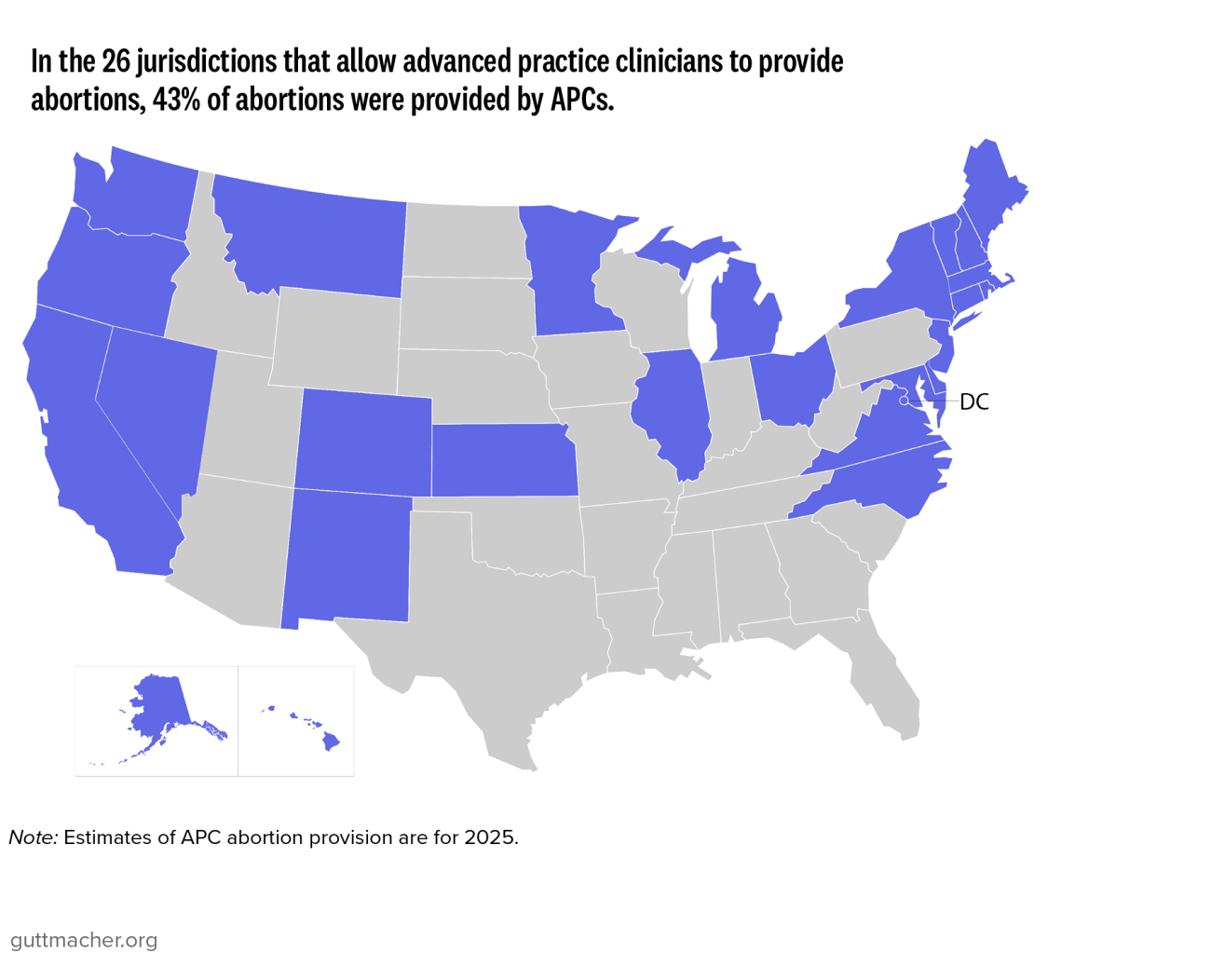
Legal and Regulatory Frameworks Impacting APC Provision
Authorization for advanced practice clinicians to provide abortion care is determined by a complex web of state laws, policies and other considerations. Many states have laws directly addressing APC care provision and 25 states and Washington, DC permit APCs to provide abortion care. Among those, some states place limits on the types of abortion care that may be provided by APCs. For example, some states limit APCs to providing only medication abortion, limit the gestational duration at which they can provide care, or require certain types of specialized training. Some states also specify which types of APCs (e.g., physician associates or nurse practitioners) can provide abortion care.
Twenty-five states bar APCs from providing abortion care, limiting the practice only to physicians through state law. (Thirteen of those states also have total bans on abortion provision.) Given the extensive literature on the safety and efficacy of APC provision of abortion care, these restrictions are not based on evidence; they restrict access to abortion care rather than enhance patient safety.
The care that APCs can provide is also determined by the professional societies and regulatory boards that establish their scope of practice, and by restrictions placed on that scope by state laws regarding medical practice in general. Such laws regulate the types of care that clinicians, including APCs, can offer, such as administering or prescribing certain medications, performing certain procedures and more. These laws can also determine whether APCs can practice independently, or if they are required to provide care under the supervision of a physician—policies that can impact APC abortion care, depending on the state. For example, some states do not permit APCs to provide outpatient surgical care, which could limit their ability to provide procedural abortion care. Other states do not permit APCs to prescribe medication without physician supervision, meaning that APCs in those states can only provide medication abortion in certain practice environments.
Lastly, APCs’ ability to provide abortion care may be limited by the logistics of their particular practice environment. For example, an APC who lives in a state where they are not allowed to administer the sedatives sometimes used during procedural abortion may not be able to provide care at some clinics—not because they are legally prohibited from doing so, but because it does not make sense for clinic staffing. Similarly, in states where APCs cannot practice independently, some hospitals and clinics providing abortion care may opt not to employ them for reasons of clinical efficiency.
Recent Changes to APC Provision Laws and Ongoing Litigation
Since the 2022 Dobbs decision rescinded the US constitutional right to abortion, APC provision has become more critical than ever in efforts to protect abortion access for patients facing bans and restrictions—and several states have changed their APC abortion provision laws in the years since Dobbs. For example, in August 2024, an Ohio Common Pleas Court issued a temporary injunction against a state law limiting abortion provision to physicians, based on Ohio’s 2023 constitutional amendment protecting abortion rights. In 2025, an Ohio court further clarified that other sections of the state’s code do not bar APCs from providing care. While litigation is ongoing and encompasses more than just the physician-only law, the change has thus far legally permitted APCs to provide medication abortion care in the state.
Similar to the Ohio rulings, recent decisions in Michigan and North Carolina struck down laws limiting abortion provision to physicians. In both of these cases, the decisions permitting APC abortion provision were rooted in the scientific evidence—that APCs providing abortion care is both common and safe, and that restricting APC-provided care only serves as a barrier to access. Ongoing litigation in other states has the potential to reform limits on APC provision. For example, in February 2026, a group of advanced practice nurses in Arizona filed a lawsuit challenging the state’s physician-only law. Similarly, a case was filed in September 2026 challenging a physician-only law in Wisconsin.
While most states that have reformed their APC provision laws since Dobbs have done so through the courts, in 2026 California changed its law through legislation. Previously, APCs in California have been permitted to provide abortion care only within the first trimester of pregnancy. When the new law goes into effect, however, APCs will be permitted to provide care at later gestational durations, as long as the care provided conforms to other laws and regulations regarding their scope of practice.
Advanced Practice Clinicians Are an Integral Part of Abortion Care
As the data summarized here suggest, APCs already play an integral role in abortion provision in the United States, and recent policy developments have expanded the number of states in which they can provide care. Abortion care provided by APCs is safe and effective for both procedural and medication methods, and for both in-person and telehealth settings. Since US APCs are geographically well-distributed and many already provide care to underserved and rural patients in a broad range of settings, allowing APCs to provide abortion can help address critical gaps in access to care. By removing medically unnecessary legal and regulatory barriers that prevent APCs from providing abortion, states can make abortion care more accessible and allow patients greater autonomy in determining the model of care they receive.
Methodology
Data on the share of abortions provided by advanced practice clinicians in 2025 are from Guttmacher’s Monthly Abortion Provision Study, a project estimating the number of clinician-provided abortions in each US state since January 2023. It collects data on procedural and medication abortions provided at brick-and-mortar health facilities (such as clinics or doctor’s offices), as well as medication abortions provided by US telehealth providers (including those provided to residents of states with total bans on abortion provision). Abortions are counted as having been provided in the state in which a patient had a procedure or where pills were received; a detailed methodology for the Monthly Abortion Provision Study is available at osf.io/k4x7t.
To collect data on the share of abortions provided by advanced practice clinicians, sampled providers were asked, “In the last [month/year] approximately how many abortions at this facility were provided by an advanced practice clinician (APC) (e.g., nurse practitioner, nurse midwife, or physician assistant)?” with the question wording differing slightly for telehealth providers; this question was fielded to samples of providers four times over the course of 2025 and early 2026. Facilities that did not provide data were estimated using a Bayesian hierarchical model incorporating facility-level metadata, including whether the facility had previously reported having any APCs providing abortion care in 2020 or 2014. The uncertainty intervals associated with each estimate quantify our confidence that the true value falls within a particular range.