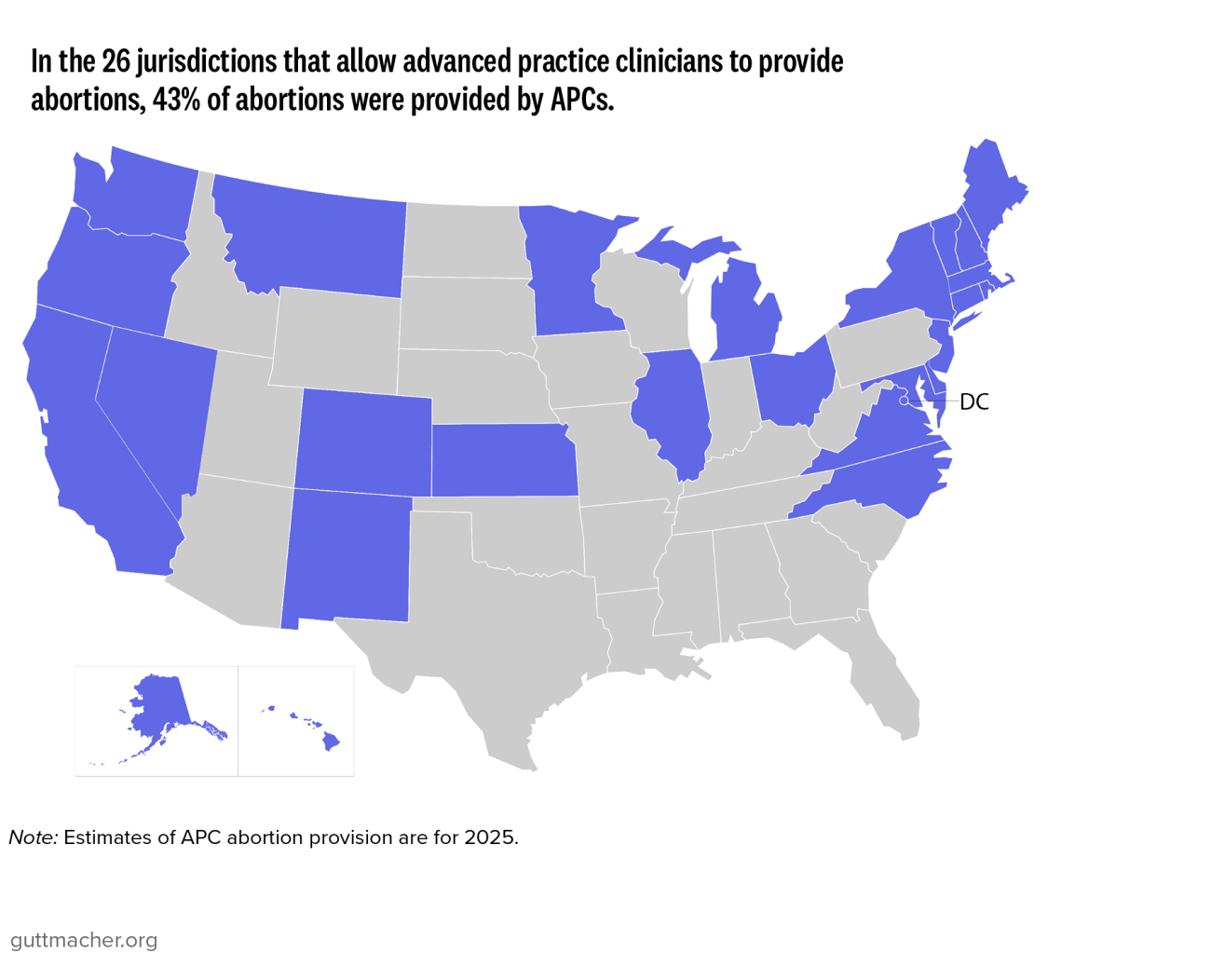
Advanced practice clinicians—which include physician associates (also known as physician assistants), advanced practice registered nurses, nurse practitioners, certified midwives and certified nurse midwives—play critical roles in many health care settings across the United States. In abortion care settings, advanced practice clinicians (APCs) have long provided abortions directly as well as wraparound care such as pre- and post-abortion counseling. Decades of research have shown that advanced practice clinicians can provide both medication and procedural abortions safely and effectively; the risk of complications from an abortion (regardless of method) is very low, and multiple randomized controlled trials have found no differences in complication rates between APCs and physicians. Despite this, many states still restrict APCs’ ability to provide abortion care.
Data from Guttmacher’s Monthly Abortion Provision Study show that the provision of abortions by APCs is common in a range of medical settings:
- In 2025, APCs provided more than 360,000 abortions (90% uncertainty interval, 349,300–380,200) in the United States. This includes both procedural and medication abortion and both in-person and telehealth provision (see Methodology).
- Abortions provided by APCs represent almost a third of clinician-provided abortions nationwide.
- In the 26 states and jurisdictions where APC provision was permitted under state law in 2025, 43% (90% UI 41–45%) of all clinician-provided abortions were provided by APCs.
- These estimates understate the role of APCs as it only counts abortions directly provided by APCs and does not include APCs’ involvement in other critical aspects of care (such as counseling or follow-up care), including in states where they cannot directly provide.