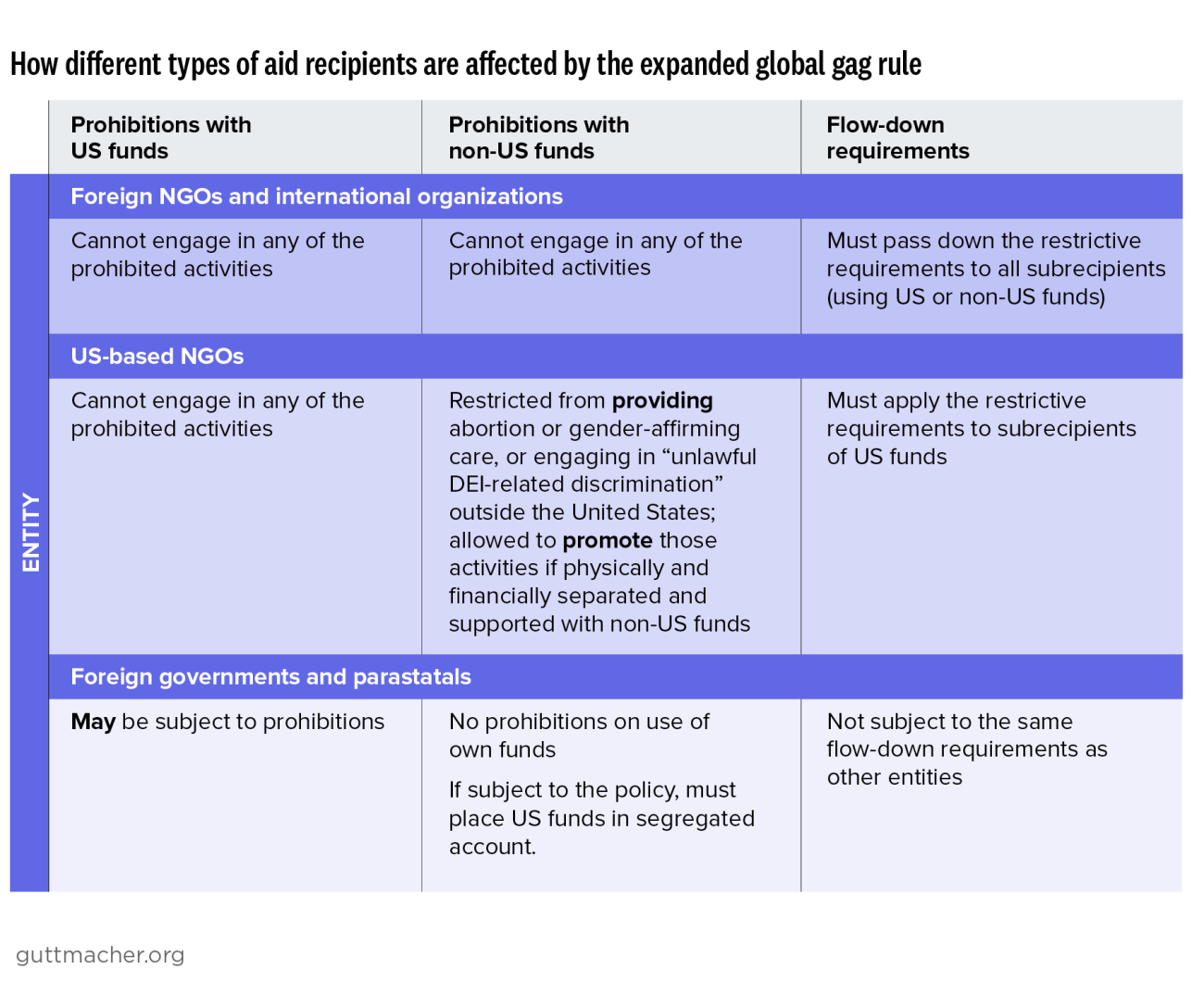
Since the policy is being implemented so quickly and expansively, and will be overseen by a State Department workforce that has been dramatically cut and reshaped in the past year, it is clear that part of the goal is to create chaos and confusion for aid recipients. For example, even in its attempt to provide clarity about a waiver process, the State Department was vague about exactly what information recipients need to provide in their applications or how decisions would be made about which entities are exempt from all or part of the policy.
In other instances, there are significant questions about how the policy will be implemented in humanitarian settings, where organizations must respond quickly to conflict and crises. Humanitarian care often involves addressing a lack of access to health care—a particular concern for pregnant people—as well as high rates of sexual violence. Different health care services cannot be divided into separate funding streams or physical locations, putting women’s health and well-being at risk if humanitarian organizations are unable to provide the full spectrum of care and support that many communities urgently need.
Prohibiting Support for Abortion, Transgender People, and Diversity, Equity and Inclusion
Similar to past iterations, the policy prohibits activities related to “abortion as a method of family planning.” This includes providing abortion in any circumstance other than in cases of rape or incest, or when the pregnant person’s health or life is in danger. However, years of implementing the global gag rule have shown that these exceptions are very hard to administer in practice, especially as organizations receiving US aid are often reluctant to engage in any care related to abortion. Further, any activity related to funding, counseling or referring, lobbying, educating or informing people about abortion care is prohibited.
Beyond abortion, the Trump administration has tried to replicate its domestic crusades against the rights of transgender people and against any program or speech that supports diversity, equity and inclusion by enshrining these goals in its foreign policy. The new policy prohibits the promotion of so-called “gender ideology,” which includes providing, counseling or trying to increase access to “sex-rejecting procedures or sex-rejecting social transition.” Notably, the policy implicates more than gender-affirming care, with definitions in the rule that are not medically accurate and encompass activities such as treatment by a counselor, modifying a person’s name or pronouns, bathroom use, athletic participation and more.
In addition to “gender ideology,” the policy also prohibits the promotion of “discriminatory equity ideology.” This is defined in the rule as “an ideology that treats individuals as members of preferred or disfavored groups, rather than as individuals, and minimizes agency, merit, and capability in favor of generalizations.” Grantees are prohibited from engaging in “discrimination on the basis of race, color, religion, or national origin if such discrimination violates US federal antidiscrimination law” and from “using or teaching educational materials that advance this ideology.”
This aspect of the policy not only puts the onus on grantees to understand US laws and their specific context, it negates the powerful purpose of programs and services that aim to address unmet needs and ongoing inequities and to correct for historical persecutions that have disadvantaged and harmed certain groups. The Trump administration is attempting to impose a uniquely US-focused and destructive view of diversity, equity and inclusion practices on myriad cultures around the world, and this aspect of the policy will be challenging to interpret. It is anticipated to be especially harmful if, in implementation, grantees are barred from any number of efforts to ensure equitable representation among staff, program recipients and services offered.
Past experience with the global gag rule demonstrates that a lack of clarity can result in a chilling effect, leading entities to comply in advance with the policy or in overly broad ways because of uncertainty and fear of losing funds. This effect will only be exacerbated as thousands of entities that have never been impacted by the global gag rule will now need to comply with an even more restrictive and confusing version of the policy.
Throughout the rules and descriptions of prohibited activities, this new global gag rule employs vague language and dehumanizing and discriminatory rhetoric in an attempt to stifle free speech. The policy also disregards any notion that organizations providing health care, education, humanitarian aid and other valuable programs and services have both a right and an obligation to respect and meet the needs of the communities they serve.
Weaponizing US Foreign Assistance
The newly expanded global gag rule does not exist in isolation. It comes after a year in which the Trump administration wrought chaos and harm by abruptly freezing all foreign assistance for an extended period, dismantling the US Agency for International Development (USAID), cutting all funding for international family planning assistance, and terminating funding and cutting US ties with the UN Population Fund (UNFPA).
From that destruction came the State Department’s new “America First Global Health Strategy,” which attempts to leverage foreign health assistance to shape other countries’ policies to fit an ultra-conservative, anti-human rights model. With a focus on bilateral agreements with individual countries, private companies and some faith-based organizations, the strategy is less holistic and more transactional, completely neglecting elements of reproductive health and seeking to sideline NGOs that have been engaged in meeting the health needs of communities for decades.
That strategy runs parallel to the Trump administration’s attacks on the UN, multilateralism and international cooperation—evidenced by the fact that international organizations, including UN agencies, are now directly affected by this expanded gag rule. It is a blatant attempt by the administration to place conditions on the work of multilateral agencies in order to force adherence to its narrow worldview, even if doing so would contradict those agencies’ own missions and funding agreements with other donor governments.
The grossly expanded global gag rule is also part of the Trump administration’s wider efforts to export its anti–human rights and anti-equity agenda around the globe. The administration stated explicitly in the final rules that the policy is necessary to align US foreign policy goals as enshrined in the Geneva Consensus Declaration, an extreme antiabortion and anti-LGBTQ document brought forth in the first Trump administration (though never adopted by the UN) that seeks to overturn decades of well-established human rights principles. Further, the policy builds on Trump’s executive orders focused on domestic policy that similarly target support for the rights of LGBTQI individuals and attack diversity, equity and inclusion programs within the United States.
Combating This Destructive Policy
As the global gag rule has been turned off and on for decades—and now promises more far-reaching harm than ever—Congress must use its power to permanently eradicate this policy. In the short term, legislators must use all mechanisms available, including passing Congressional Review Act resolutions that overturn the three rules under the PHFFA policy and ensuring that no congressionally appropriated funds are used to enforce the rules. In the longer term, Congress must pass bills like the Global Health, Empowerment and Rights (HER) Act, which would prohibit restrictions related to provision of health care services from being placed on foreign NGOs as a condition of receiving US aid, as well as introduce new legislation to ensure that any such restrictions—like those in this expanded policy—cannot be placed on any type of entity receiving US foreign assistance.
Policymakers and civil society organizations around the world must also work together to push back against these attacks. That includes efforts to ensure entities are not complying in advance of being obligated to or complying too broadly with the policy, that they are seeking and have access to alternative sources to US funds, and that they have support in staying true to their values and mission. Donors must be bold and provide more funding where possible to address gaps in sexual and reproductive health services. Overall, world leaders must make clear that human rights are not up for negotiation. There is too much at stake for human rights, bodily autonomy, freedom and equity for people around the world not to resist.