
In January 2026, the Trump administration massively expanded the “global gag rule” in an unprecedented attempt by the US government to roll back rights worldwide. Compared with previous versions of this rule, it applies to more foreign aid funds, impacts more entities and imposes several new restrictions on activities and speech related to abortion, so-called “gender ideology,” and diversity, equity and inclusion. This extreme and far-reaching policy uses foreign aid as a means to impose a conservative ideology that restricts health care, bodily autonomy and equity for all people, and it threatens to negatively impact the landscape of global health and human rights for years to come.
Harm Caused by Past Iterations of the Global Gag Rule
Also referred to as the Mexico City Policy, the global gag rule has been in effect under every Republican president since 1984. Past iterations of the policy deemed non-US nongovernmental organizations (NGOs) ineligible for US foreign assistance if they provided, referred people for or promoted abortion services—even if they used other funding to do so. During his first administration, President Trump expanded the policy from applying solely to international family planning assistance to all global health funding and required recipients of US foreign aid to apply the rule’s restrictions to all of their subrecipients (even those that do not receive any US funding).
Decades of research document the global gag rule’s detrimental impacts on reproductive health, advocacy, health systems and services in countries around the world. For example, Guttmacher research in Uganda and Ethiopia revealed how the global gag rule during Trump’s first term stalled and even reversed progress on the countries’ reproductive health outcomes by disrupting access to contraception and increasing rates of unintended pregnancies. Research is clear that when policies like the global gag rule attempt to target specific rights or types of health care, the effects are broader, limiting access to other types of sexual and reproductive health services and harming entire health systems.
Understanding the Supercharged Global Gag Rule
The US State Department released this new, expanded foreign policy in a way it had not done in years past: posting three final rules in the Federal Register, a process typically reserved for domestic US policies. Under the umbrella of the Promoting Human Flourishing in Foreign Assistance (PHFFA) policy, the rules are: Protecting Life in Foreign Assistance, Combating Gender Ideology in Foreign Assistance and Combating Discriminatory Equity Ideology in Foreign Assistance. They went into effect 30 days after posting, on February 26, 2026.
Taken together, this newly expanded policy applies to all non-military foreign assistance provided through the State Department, which could be close to $39.8 billion, the amount the US obligated in foreign aid in fiscal year 2024. For comparison, $7.3 billion in global health assistance was affected by the previous iteration of the global gag rule in Trump’s first term. The new policy has the potential for tremendous damage to global health programs and many others, as it now applies to humanitarian assistance, civil society and democracy programs, economic and development assistance, and stabilization assistance.
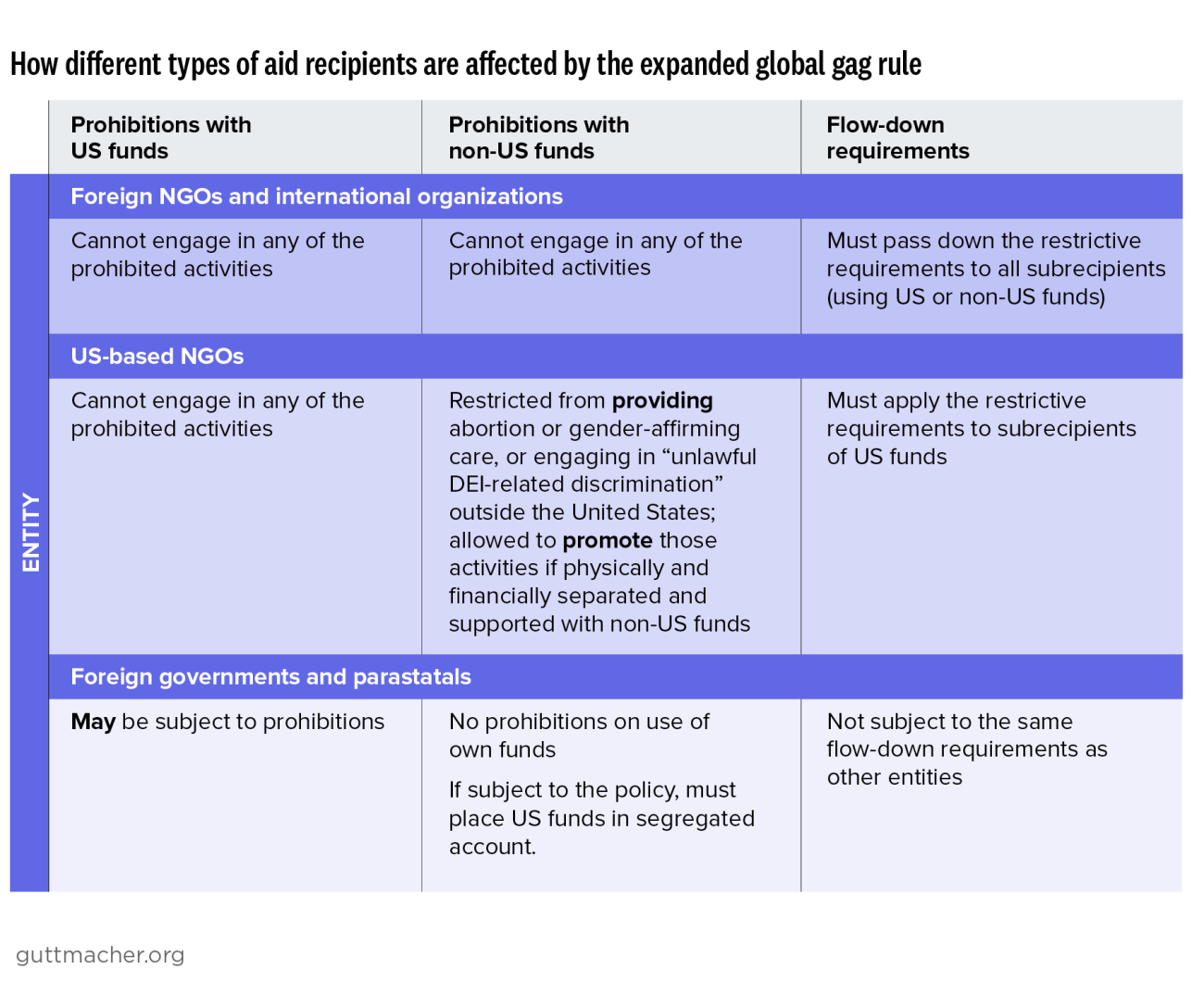
The policy also extends beyond foreign NGOs to apply to US-based NGOs, international organizations, foreign governments and parastatals (nonprofit organizations or for-profit companies in which a foreign government has a controlling interest). There are different requirements for each type of entity that accepts US foreign aid, with the most restrictions on foreign NGOs and international organizations, including UN agencies and other multilateral organizations: They are banned from using US foreign aid as well as non-US funds on any of the prohibited activities described in the policy. Further, they must pass down the policy’s restrictions to all subrecipients. US-based organizations receiving aid have similar restrictions, but with some exceptions—albeit impractical and unworkable—for activities related to speech and promotion of prohibited activities. In contrast, the new policy states that foreign governments “may be required” to comply with the policy and, if they are, it will not apply to any non-US funds.