
It was six in the evening, several days into the Women Deliver conference in Melbourne, Australia. People had been starting their days at 7:30 AM, and they were tired and jet-lagged. Despite this, the room was packed.
Making the Invisible Visible
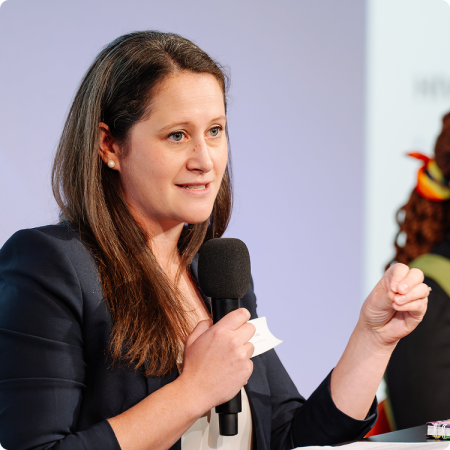
Advocates for reproductive health had crowded in to watch a new tool go live: Guttmacher’s Safe Abortion Calculator, which lets them pull up, for their own regions and countries, the cost of unsafe abortion and the savings of providing safe care. As she stood onstage with partners from Ipas, ARROW and Afya na Haki, Director of International Research Elizabeth Sully felt the presentation land. “You know you’ve hit it right when people are saying, ‘yes, finally, thank you, this is what we need,’” she says.
The presentation came at a precarious moment for global health funding. “We’re in a moment of scarcity,” Sully says. “With aid, it’s gotten exponentially worse with the cuts that have happened over the last year, and the ones that are still coming.” Following the dismantling of USAID, other major government donors have also pulled back on foreign aid. Facing domestic economic pressures, trade regulations and competing crises like wars, these donor nations are increasingly prioritizing other sectors, leaving reproductive health care in low- and middle-income countries dangerously underfunded.
In that climate, every dollar has to justify itself, and Guttmacher has felt this need directly. “It feels like we have had more requests for our data than I remember of any prior year because people have needed data on the cost. They’ve needed data on impact.” The requests come from donors trying to defend their spending, from governments making the case for their own investment and from advocates trying to ensure that critical programs and services retain funding.
Part of the challenge is just making the problem visible. “When abortion is stigmatized, if it’s legally restricted, people think it’s invisible,” Sully says. “And yet the health system is absorbing the costs of unsafe abortion.” Almost every country provides post-abortion care for complications from unsafe procedures, often as a free service. “We can say this is what you are currently spending this money on, and it is unnecessary to be spending it in this way.” By preventing unsafe abortions, the costs—and the harms—are reduced.
Behind the Safe Abortion calculator sits Adding It Up, the deep well of sexual and reproductive health data that Guttmacher has built over many years. This ongoing research initiative estimates, for 128 low- and middle-income countries, what it would cost to meet people’s sexual and reproductive health needs and what that investment would return. “It is a trove of data,” Sully says. “There are depths of just how many things we measure. The data sets are so big and so dense that most people only ever encounter one piece of it. For a long time, the sector has relied on us for the investment case for family planning specifically,” she says.
The numbers on safe abortion care, and what its absence costs, are also in Adding It Up: how much a health system already spends treating complications from unsafe abortions, how much it would save and how many lives it would protect by providing safe care instead. The Safe Abortion Calculator takes this one critical data set and makes it usable. Instead of needing a researcher to dig through the data, an advocate can now open the tool, select their own country, and quickly see the tradeoffs. “Let’s get that data into the hands of advocates and the public,” Sully says. “Let’s make it accessible.”
The energy in Melbourne, Sully says, didn’t come from the tool alone. Onstage, the partners each got up and talked through their own regional advocacy strategies, what the work looks like in Latin America, in Africa, in Asia, and how this kind of evidence could feed the movements they were leading. “There is an ecosystem,” she says. “The field is coming together. There’s what Guttmacher does, and there’s what all of our partners are doing, too. Things from our model feed into our partners’ critical work, and their asks for evidence feed into the work we pursue.”
All of this interconnected, global data have a very important job: it lets people see. Sully believes that data are what makes harm visible, and that visibility is fragile.
“When you lose that, then it’s hard to build back. You have to make things visible if you’re actually going to be able to protect them.”
By the Numbers
$1.56 billion spent
The annual cost to treat complications of unsafe abortion across the 117 countries included in the Safe Abortion Calculator.
$1.39 billion saved
The costs that would be saved annually by investing an additional $666 million in safe abortion services—a more than two-to-one return.
128 countries
The number of low- and middle-income countries in the Adding it Up dataset, which powers the Safe Abortion Calculator.
100+ interventions
The number of distinct medical treatments the Adding It Up model prices out for a single country, from a specific contraceptive method to maternal, newborn and post-abortion care.
5 months
How long it took to build the calculator from development to execution. To hit the sweet spot between scientific rigor and real-world usability, the team gathered partner input early through focus groups and a multilingual survey.
10 people
The size of the Adding It Up team, the minds behind a dataset the global field leans on.
1 argument
Investing in safe abortion saves health systems money while simultaneously reducing the health complications that women suffer due to unsafe abortions.
0 paywalls
The full dataset and the model’s entire code are public on the Open Science Framework, so anyone can check the work or build on it.