Guttmacher Institute

Search

  • Facebook
  • Instagram
  • Youtube
  • LinkedIn
  • Contact
Donate

Highlights

  • Reproductive Health Impact Study
  • Adding It Up
  • Abortion Worldwide
  • Guttmacher-Lancet Commission
  • US policy resources
  • State policy resources
  • International Perspectives on Sexual and Reproductive Health (1975–2020)
  • Perspectives on Sexual and Reproductive Health (1969–2020)

Reports

  • Global
  • United States

Articles

  • Global research
  • US research
  • Policy analysis
  • Guttmacher Policy Review
  • Opinion

Fact Sheets

  • Global
  • United States
  • US State Laws and Policies

Tools

  • Interactive Map: US Abortion Policies and Access After Roe
  • Safe Abortion Calculator
  • Family Planning Investment Impact Calculator
  • Monthly Abortion Provision Study Dashboard
  • Public-use data sets

Global

  • Abortion
  • Contraception
  • Pregnancy
  • Teens

US

  • Abortion
  • Contraception
  • Pregnancy
  • Teens

Our Work by Geography

  • Global
  • Africa
  • Asia
  • Europe
  • Latin America & the Caribbean
  • Northern America
  • Oceania

Who We Are

  • About
  • Staff
  • Board
  • Job opportunities
  • History
  • Financials
  • Conflict of Interest Policy
  • Impact Report 2026

Media

  • Media office
  • News releases
  • Videos

Awards & Scholarships

  • Darroch Award
  • Richards Scholarship
  • Bixby Fellowship

Join our community

  • Ways to Give
  • Sign up for our newsletter
  • Contact
Guttmacher Institute
Donate

Highlights

  • Reproductive Health Impact Study
  • Adding It Up
  • Abortion Worldwide
  • Guttmacher-Lancet Commission
  • US policy resources
  • State policy resources
  • International Perspectives on Sexual and Reproductive Health (1975–2020)
  • Perspectives on Sexual and Reproductive Health (1969–2020)

Reports

  • Global
  • United States

Articles

  • Global research
  • US research
  • Policy analysis
  • Guttmacher Policy Review
  • Opinion

Fact Sheets

  • Global
  • United States
  • US State Laws and Policies

Tools

  • Interactive Map: US Abortion Policies and Access After Roe
  • Safe Abortion Calculator
  • Family Planning Investment Impact Calculator
  • Monthly Abortion Provision Study Dashboard
  • Public-use data sets

Global

  • Abortion
  • Contraception
  • Pregnancy
  • Teens

US

  • Abortion
  • Contraception
  • Pregnancy
  • Teens

Our Work by Geography

  • Global
  • Africa
  • Asia
  • Europe
  • Latin America & the Caribbean
  • Northern America
  • Oceania

Who We Are

  • About
  • Staff
  • Board
  • Job opportunities
  • History
  • Financials
  • Conflict of Interest Policy
  • Impact Report 2026

Media

  • Media office
  • News releases
  • Videos

Awards & Scholarships

  • Darroch Award
  • Richards Scholarship
  • Bixby Fellowship

Join our community

  • Ways to Give
  • Sign up for our newsletter
  • Contact
Donate
  • Facebook
  • Instagram
  • Youtube
  • LinkedIn
  • Contact
Guttmacher 2026 Impact Report

Closing the Distance to Care

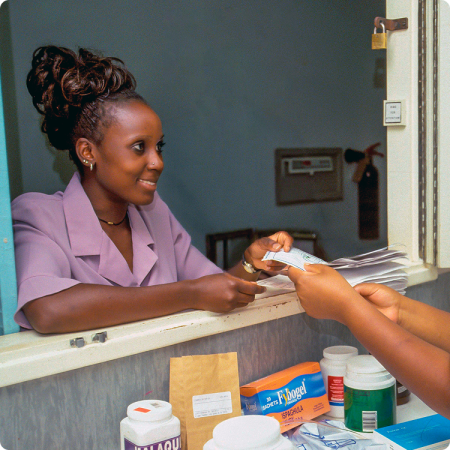
woman handing medications to another person

A young woman steps into a pharmacy in Addis Ababa and explains that she has missed her period. Is there anything, she asks, that the pharmacist can give her to help?

This woman is an actor, recruited from an acting school in the city and trained to be one of the “mystery clients” Guttmacher and its local partner, the St. Paul Institute for Reproductive Health and Rights (SPIRHR), sent into pharmacies and drugstores across the Ethiopian capital. She is not pregnant but posing as a woman seeking to end a pregnancy. The moment she leaves the pharmacy counter, she meets a data collector outside and walks through what just happened: Did she get medication abortion drugs? Was she given instructions on how to take them? What did they cost? Did she feel respected? Did the experience feel private?

Mystery client studies offer an established means to capture how a stigmatized service operates in practice—rather than as designed. In Ethiopia, that gap is the difference between getting care and going without.

Ethiopia has one of the most liberal abortion laws in Sub-Saharan Africa, and medication abortion drugs are included in the national essential medicines list. But the guidelines still require a woman to see a provider for a prescription before she can fill it at a pharmacy.

“It’s just an additional step for a woman seeking abortion to have to visit a health facility,” says Stephanie Küng, the senior research associate at Guttmacher who helped lead the study. In a country where stigma already keeps many women from seeking care, that extra doctor visit can be a barrier. She says the bottleneck could be removed if pharmacists were allowed to dispense the drugs directly.

How the researchers went looking for answers matters as much as what they found. Global health research has long been top-down, with institutions in high-income countries designing the studies and gathering the data. This study was built the other way around, based on a principle Guttmacher calls equitable partnership. This approach, which is a key priority in Guttmacher’s 2026–2029 strategic plan, empowers local experts to steer the work, and the Institute’s contributions are guided by the partner’s priorities and needs.

The results from the mystery-client study revealed a critical gap. Many of Ethiopia’s pharmacists have the knowledge and skills to guide someone safely through a medication abortion, and women often treat pharmacies as their first stop for health care. But the medication abortion drugs themselves were often missing from the shelves. In the study’s first phase, in 2024, data collectors surveyed every pharmacy and drugstore across Addis Ababa (roughly 1500) to record what they stocked. Fewer than a third carried medication abortion drugs regularly, and only 17% had them on hand the day a data collector visited. Why the gap exists remains unclear. “Good question, and hard to answer,” Küng says. “I don’t think we really know.” One clear pattern was geographic: pharmacies near health facilities stocked the drugs more reliably.

A separate, independent pilot showed what could be gained if that gap closed. In the Oromia region, the reproductive health organization Ipas Ethiopia trained pharmacists to dispense medication abortion pills directly, under an exception from local regulators. In the follow-up surveys from Ipas, 99% of clients followed the instructions and 98% had complete abortions. The result matched what Küng already expected. “It’s a beautiful finding. We love to see it,” she says. “It’s not particularly surprising to us, because medication abortion is well established as very safe and effective using these drugs.”

Two studies, conducted separately, arrived at the same place: Ethiopia could expand access dramatically by letting pharmacists dispense medication abortion pills directly.

The mystery-client study grew out of a partnership built over years, and the idea for it did not start in a Guttmacher office. It came from the local partner, SPIRHR. “They are the ones who had the idea for this research project,” Küng says. “This research idea was entirely theirs.”

Guttmacher’s job was to help secure funding, provide technical support, contribute to trainings and build the data collection tools, while SPIRHR led on-the-ground implementation. What set this project apart was who drove it. With the results of this data collection effort out, Küng notes, SPIRHR now stands as a leader in abortion research in Ethiopia.

The advocacy for this initiative follows the same principle as the research: local partners lead, and Guttmacher supports rather than steers. SPIRHR was well positioned to make the case to Ethiopia’s Ministry of Health. And a local youth organization, Talent Youth Association (TaYA), is helping lead outreach to young people and women’s rights groups. “The equitable partnership ethos and commitment is one that we carry with us in every international partnership that we have,” Küng says.

On June 2, Küng and Senior Research Scientist Alice Cartwright, alongside SPIRHR and Ipas colleagues, presented the findings in Addis Ababa to a room of Ministry of Health officials, NGO staff and pharmacists. In the name of equitable partnership, the Guttmacher team deliberately withheld its own policy recommendation, letting SPIRHR and the room shape it. The reaction was positive. “A lot of people in that room were like, great, maybe it’s time we revisit the guidelines based on these results.” Küng says. “Health officials were very interested in wanting to bring care closer to women and girls,” she says.

The road ahead is long. Letting pharmacists dispense abortion medication drugs directly would put Ethiopia at the forefront of the practice. But this collaborative campaign now has converging evidence behind it. Between Guttmacher and SPIRHR’s map of the stocking gap and Ipas’s proof of efficacy, that gives advocates what they need to argue for updated guidelines.

Across the region, a growing network of research and advocacy organizations, Guttmacher among them, is sharing evidence, teaming up on studies and coordinating responses to threats.

That level of collaboration will be needed. Abortion rights across the region face sustained, well-organized attacks. But increasingly, the partners who will carry it, in Ethiopia and beyond, have the evidence, the capacity and one another. That is what true partnership is meant to bring forward.

First published on Guttmacher 2026 Impact Report: November 11, 2026

Share

Guttmacher Institute

Center facts. Shape policy.
Advance sexual and reproductive rights.®

Donate Now
Newsletter Signup  Contact Us 
  • Facebook
  • Instagram
  • Youtube
  • LinkedIn
  • Contact

Footer

  • Privacy Policy
  • Accessibility Statement
© 2026 Guttmacher Institute. The Guttmacher Institute is registered as a 501(c)(3) nonprofit organization under the tax identification number 13-2890727. Contributions are tax deductible to the fullest extent allowable.