Guttmacher Institute

Search

  • Facebook
  • Instagram
  • Youtube
  • LinkedIn
  • Contact
Donate

Highlights

  • Reproductive Health Impact Study
  • Adding It Up
  • Abortion Worldwide
  • Guttmacher-Lancet Commission
  • US policy resources
  • State policy resources
  • International Perspectives on Sexual and Reproductive Health (1975–2020)
  • Perspectives on Sexual and Reproductive Health (1969–2020)

Reports

  • Global
  • United States

Articles

  • Global research
  • US research
  • Policy analysis
  • Guttmacher Policy Review
  • Opinion

Fact Sheets

  • Global
  • United States
  • US State Laws and Policies

Tools

  • Interactive Map: US Abortion Policies and Access After Roe
  • Safe Abortion Calculator
  • Family Planning Investment Impact Calculator
  • Monthly Abortion Provision Study Dashboard
  • Public-use data sets

Global

  • Abortion
  • Contraception
  • Pregnancy
  • Teens

US

  • Abortion
  • Contraception
  • Pregnancy
  • Teens

Our Work by Geography

  • Global
  • Africa
  • Asia
  • Europe
  • Latin America & the Caribbean
  • Northern America
  • Oceania

Who We Are

  • About
  • Staff
  • Board
  • Job opportunities
  • History
  • Financials
  • Conflict of Interest Policy
  • Impact Report 2025

Media

  • Media office
  • News releases
  • Videos

Awards & Scholarships

  • Darroch Award
  • Richards Scholarship
  • Bixby Fellowship

Join our community

  • Ways to Give
  • Sign up for our newsletter
  • Contact
Guttmacher Institute
Donate

Highlights

  • Reproductive Health Impact Study
  • Adding It Up
  • Abortion Worldwide
  • Guttmacher-Lancet Commission
  • US policy resources
  • State policy resources
  • International Perspectives on Sexual and Reproductive Health (1975–2020)
  • Perspectives on Sexual and Reproductive Health (1969–2020)

Reports

  • Global
  • United States

Articles

  • Global research
  • US research
  • Policy analysis
  • Guttmacher Policy Review
  • Opinion

Fact Sheets

  • Global
  • United States
  • US State Laws and Policies

Tools

  • Interactive Map: US Abortion Policies and Access After Roe
  • Safe Abortion Calculator
  • Family Planning Investment Impact Calculator
  • Monthly Abortion Provision Study Dashboard
  • Public-use data sets

Global

  • Abortion
  • Contraception
  • Pregnancy
  • Teens

US

  • Abortion
  • Contraception
  • Pregnancy
  • Teens

Our Work by Geography

  • Global
  • Africa
  • Asia
  • Europe
  • Latin America & the Caribbean
  • Northern America
  • Oceania

Who We Are

  • About
  • Staff
  • Board
  • Job opportunities
  • History
  • Financials
  • Conflict of Interest Policy
  • Impact Report 2025

Media

  • Media office
  • News releases
  • Videos

Awards & Scholarships

  • Darroch Award
  • Richards Scholarship
  • Bixby Fellowship

Join our community

  • Ways to Give
  • Sign up for our newsletter
  • Contact
Donate
  • Facebook
  • Instagram
  • Youtube
  • LinkedIn
  • Contact
Policy Analysis
November 2026

More Than Just the Numbers: How Funding Cuts Threaten Sexual and Reproductive Health in Liberia

Guttmacher logo

Reproductive rights are under attack. Will you help us fight back with facts?

Donate

Key Takeaways

  • Starting in 2025, Liberia lost at least $2.4 million in family planning and sexual and reproductive health and rights support following US and Swedish funding cuts. Without this support, hundreds of thousands of women and couples in Liberia will lose access to contraception, as well as other essential services, putting more women at risk of unintended pregnancy, unsafe abortion and maternal death.
  • Before the cuts, teenage girls in Liberia were already struggling to get the contraception they wanted. By increasing barriers to access, the cuts could result in around 22,400 additional unintended pregnancies among teenage girls in a single year, putting their education, their employment and their critical contributions to Liberia’s future at risk.
  • Evidence further shows that prevention offers the greatest savings. Protecting access to contraception and comprehensive sexuality education reduces unintended pregnancies, unsafe abortions, HIV infections and other STIs, generating critical savings for Liberia’s health system.
  • The Liberian government must act urgently to protect the health and lives of women and girls. Priorities include:
    • Integrating sexual and reproductive health care across public, nongovernmental and donor-funded services and equipping community health workers to provide care in line with national guidelines.
    • Prioritizing and protecting access to high-quality, age-appropriate health education.
Background

The right to choose when to have a child and the ability to access health services for safe childbearing are at significant risk in Liberia. Over the last two years, Liberia has experienced sweeping losses in its external health funding and uncertainty over domestic policy protections for sexual and reproductive health and rights. Following the abrupt loss of US health assistance in early 2025, Liberia saw US family planning disbursements fall by 34%, with US family planning support for 2026 likely to fall close to zero. In December 2025, Sweden, the second-largest donor to Liberia after the United States and one of the strongest champions of gender equality and sexual and reproductive health and rights, announced it would wind down its own development assistance to the country.1 That has led to the end of Sweden’s 2021–2025 cooperation strategy with Liberia that totaled SEK1.85 billion (about US$197 million) across 39 projects that included sexual and reproductive health and rights, gender equality and youth empowerment.

On the domestic policy front, the Public Health Bill—passed by the House of Representatives in 2022 to modernize the country’s public health law, expand access to safe abortion care up to 18 weeks and promote comprehensive sexuality education—remains stalled in the Senate and pressure is mounting to strip its provisions related to sexual and reproductive health and rights.

What Is at Risk from Funding Cuts

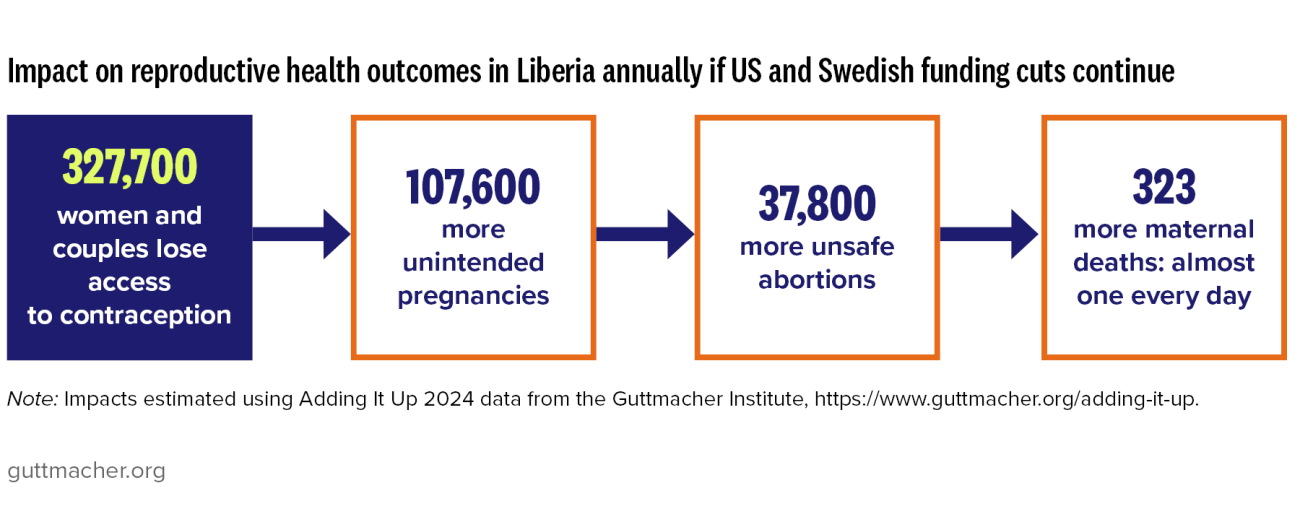
Starting in 2025, Liberia lost $2.4 million of US family planning funding and Swedish sexual and reproductive health and rights (SRHR) funding.2 One of the most immediate effects of these funding cuts is the loss of critical support for contraceptive services in Liberia, which will carry many harmful impacts for the health and lives of women across the country.

Impact on reproductive health outcomes in Liberia annually if US and Swedish funding cuts continue

SRHR Funding Losses Lead to Higher Costs for the Health Care System

  • When access to contraception is restricted, unintended pregnancy rates increase. In Liberia, about four in 10 unintended pregnancies end in abortions.
  • Before the cuts, an estimated 131,500 unintended pregnancies occurred among Liberian women aged 15–49 each year and about 54,500 ended in abortions, of which only around 15% were safe.
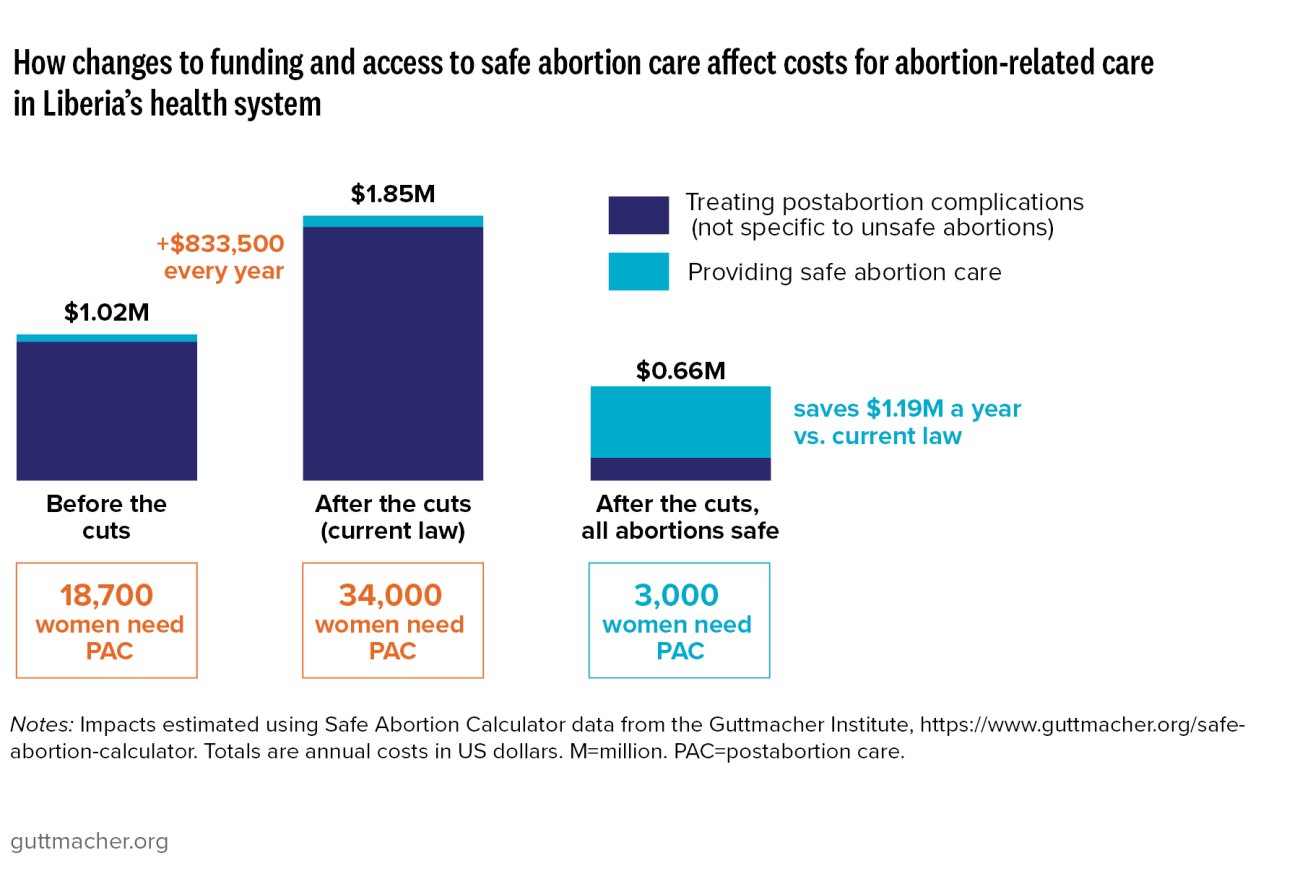
  • About 18,700 women in Liberia needed postabortion care each year, at a cost of nearly $976,000, and total abortion-related care (for safe abortion provision and postabortion care) cost about $1.02 million. A national study led by the Ministry of Health found that more than 14,500 women sought treatment for abortion complications in 2021, and about one in 10 died or nearly died.3
  • After the cuts, the expected rise in unintended pregnancies due to loss of access to contraception would result in 37,800 additional unsafe abortions and 6,800 additional safe abortions, raising the annual number of abortions to about 99,100. Under current law, the number of women needing postabortion care each year would rise to about 34,000, an 82% increase, and costs for abortion-related care (to provide postabortion care and safe abortion care) would rise to $1.85 million, or an additional $833,500 each year. Put simply, every 1,000 additional unsafe abortions create the need for postabortion care for about 400 women and costs the health system about $20,900 to provide this care.
How changes to funding and access to safe abortion care affect costs for abortion-related care in Liberia’s health system

Teenage Girls May Face the Greatest Risk

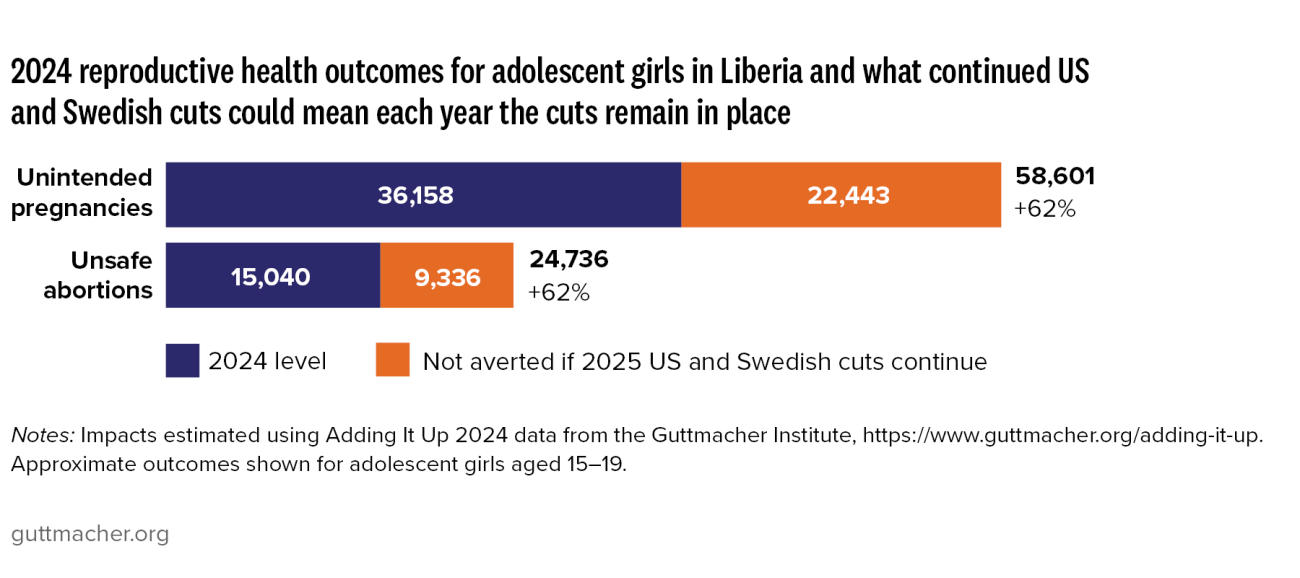
  • Before the cuts, adolescent girls already faced distinct barriers to accessing contraception when compared with older women, including provider bias, cost barriers and social stigma. In 2024, more than half of adolescent girls in Liberia who wanted to avoid pregnancy were not using modern contraception. The same year, adolescent girls made up 28% of total unintended pregnancies in the country.
  • After the cuts, these barriers are likely to deepen due to the support that donor financing provided for youth-friendly service points, community outreach and free commodity distribution.4,5 If the United States and Sweden’s 2025 cuts to bilateral aid continue, this could result in approximately 22,400 additional unintended pregnancies and 9,300 additional unsafe abortions among adolescent girls each year.
2024 reproductive health outcomes for adolescent girls in Liberia and what continued US and Swedish cuts could mean each year the cuts remain in place

Funding Cuts Undermine National Development and Progress Toward the Sustainable Development Goals

  • The numbers speak for themselves: Funding cuts to family planning and other SRHR programs lead to worse health outcomes and put enormous strain on national budgets.
  • Research has further shown that reproductive agency and access to sexual and reproductive health care are closely associated with a variety of factors, including access to education, economic empowerment and personal autonomy in decision-making,6 all of which are essential to a country’s long-term economic development.
  • The anticipated increases in unintended pregnancies, unsafe abortions, adolescent pregnancy rates, gaps in postabortion care and limited access to comprehensive sexuality education resulting from these funding losses pose significant threats to Liberia’s national development and its progress toward the Sustainable Development Goals.


Informal Working Group on Reproductive Rights and Health


References

1. Choat I, Sweden ends aid to Liberia in a hammer blow to women’s rights and healthcare, Guardian, Aug. 31, 2026, https://www.theguardian.com/global-development/2026/aug/31/sweden-ends-aid-liberia-hammer-blow-womens-healthcare.

2. US Foreign Assistance, https://foreignassistance.gov/data; OECD Data Explorer, https://data-explorer.oecd.org/. Modern contraceptive disbursements data at the country level were derived from Organisation for Economic Co-operation and Development’s Development Assistance Committee data using the revised Muskoka methodology.

3. Ushie BA et al., National estimates of Liberia’s 2021 unintended pregnancy and induced abortion, International Journal of Women’s Health, 2026, 18:558100, https://doi.org/10.2147/IJWH.S558100.

4. International Rescue Committee, IRC receives $17.8m USAID grant to scale up health services in Liberia, news release, Feb. 9, 2021, https://www.rescue.org/press-release/irc-receives-178m-usaid-grant-scale-health-services-liberia.

5. EDC, USAID Liberia Youth Advance, https://edc.org/projects/usaid-youth-advance/.

6. Borel F and Udell A, Unintended pregnancy and gender inequality: A refined measurement yields new insights, Fact Sheet, New York: Guttmacher Institute, 2025, https://www.guttmacher.org/fact-sheet/unintended-pregnancy-and-gender-inequality-refined-measurement-yields-new-insights.

First published online: November 9, 2026

Share

Download Analysis

Read More

Safe Abortion Calculator

Family Planning Investment Impact Calculator

Fact Sheet

Adding It Up 2024: Investing in Sexual and Reproductive Health in Low- and Middle-Income Countries in Africa

Policy Analysis

Just the Numbers: The Impact of US International Family Planning Assistance, 2024

Fact Sheet

Unintended Pregnancy and Gender Inequality: A Refined Measurement Yields New Insights

Topic

Global

  • Our work: Adding It Up

Geography

  • Global
  • Africa: Liberia

US Policy Resources

More
Guttmacher Institute

Center facts. Shape policy.
Advance sexual and reproductive rights.®

Donate Now
Newsletter Signup  Contact Us 
  • Facebook
  • Instagram
  • Youtube
  • LinkedIn
  • Contact

Footer

  • Privacy Policy
  • Accessibility Statement
© 2026 Guttmacher Institute. The Guttmacher Institute is registered as a 501(c)(3) nonprofit organization under the tax identification number 13-2890727. Contributions are tax deductible to the fullest extent allowable.