
Since January 20, 2025, access to sexual and reproductive health care in the United States and around the world has undergone a seismic change. Guttmacher has deployed its resources and expertise to respond to rapid shifts in the landscape, providing rigorous research that informs the public, helps quantify the impact on patients and providers, and arms policymakers supportive of reproductive health and rights to fight back. We sat down with the team leading Guttmacher’s rapid response to hear how they are keeping up in a time of constant change—and why they’ll never give up the fight.
“The Floodgates Opened”: Fighting for Sexual and Reproductive Health and Rights in Extraordinary Times
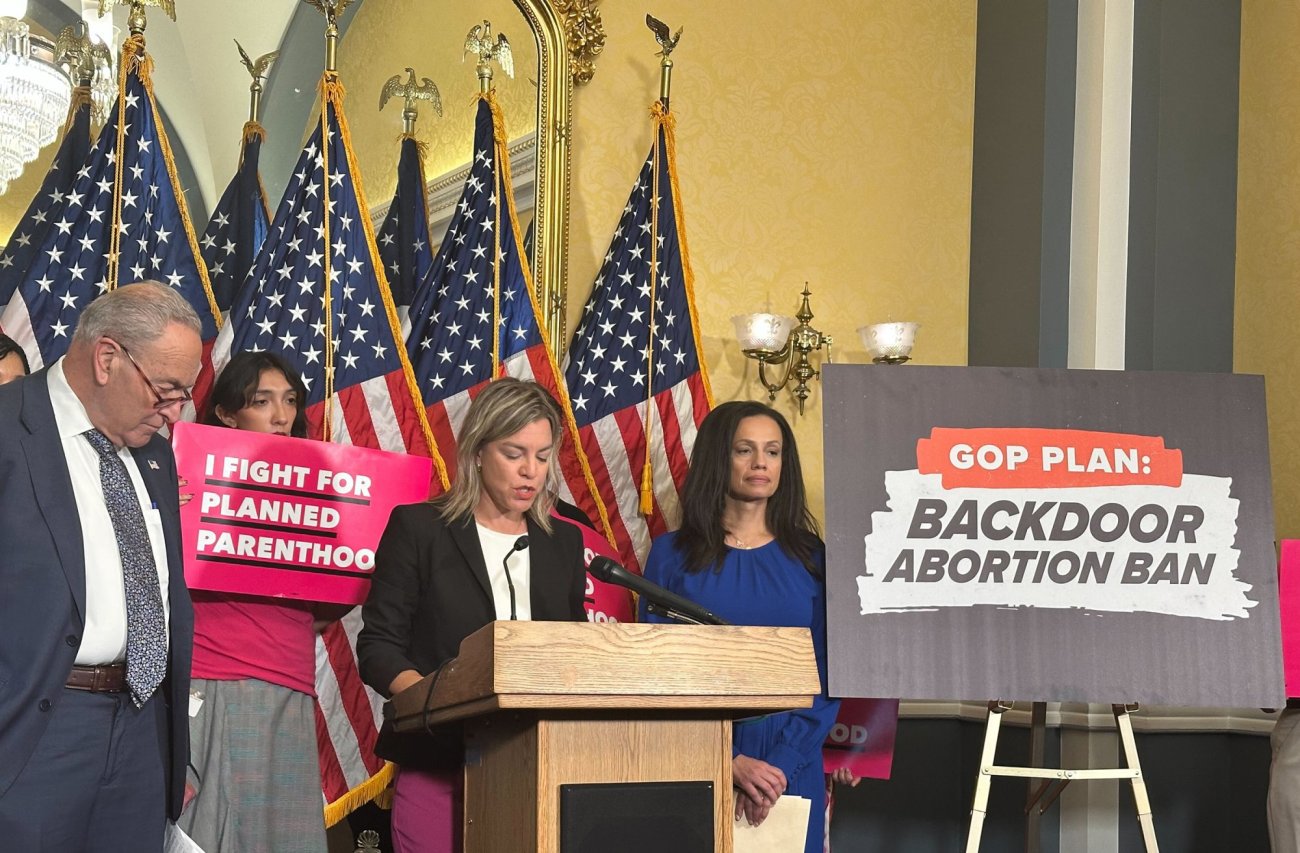
Amy Friedrich-Karnik, Director of Federal Policy (center), speaks at a press conference hosted by US Senator Chuck Schumer (left) about the harms of the budget reconciliation bill.
Guttmacher started preparing well before the 2024 US elections took place. As a 501(c)3 organization, your work does not influence election outcomes, but it is necessarily informed by them. What did your scenario planning look like?
Amy Friedrich-Karnik, Director of Federal Policy: It was a whole Institute effort. Every single division, from finance to IT to research, thought through what would be needed regardless of the election outcome. We mapped the policies we anticipated in different scenarios and how we would respond—what kind of analysis and communications we would need to put out and when, what research projects we could be thinking about to respond and capture the impacts of the projected policies. We wanted to have a robust plan.
Beth Sully, Director of International Research: There was also a window between the election and inauguration where we focused on helping partners in other countries start to plan for what they might expect after the inauguration. The scenario planning allowed us to bring expertise to other countries’ governments and policymakers. And we had a blueprint for what to potentially expect with Project 2025, which laid out some of the worst-case policy scenarios to plan for.
So you were ready to respond as the public grappled with what was on the horizon. But after January 20, things began to move very quickly.
Joerg Dreweke, Director of US Communications: This administration completely threw out the playbook that previous anti-abortion administrations had been using. They have sideswiped our issues. Having agency heads who are not just hostile to our issues across the board, but also not bound by norms or even the law in many cases, is an unprecedented situation. We knew it would be very challenging, but I don’t think any of us anticipated it would be quite like this. Still, we were able to adjust quickly to these radically new challenges.
Beth: Guttmacher immediately made the choice to be vocal at a time when many other organizations were reliant on USAID funding and operating under a lot of uncertainty. Guttmacher had an important role to play in speaking up—to the media, to policymakers, and with new research to show the impact of what was taking place. We got a lot of appreciation from colleagues who felt like their life’s work was destroyed [when much of the US foreign aid infrastructure was dismantled]. They appreciated how quickly and loudly Guttmacher was able to speak up in that moment and to share real data about the impact of such destruction.
Amy: Our laser focus on being prepared has allowed us to stay grounded when things we didn’t anticipate—like dissolving USAID—happened. We were able to pivot and execute our response because of that preparation.
The unprecedented actions of this administration require incredible coordination to stay relevant and respond in the moment. How do you stay in communication, make quick decisions and keep up?
Joerg: Our teams were joined at the hip already, as far as information sharing goes. So the infrastructure was in place.
Beth: The floodgates opened after the inauguration. Amy convened cross-divisional groups to make sure there was rapid exchange of information, to verify information as it came in, to understand what was happening on the ground with each of these changes in policy.
Kirsten Sherk, Director of Global Communications: The pace hasn’t slowed down much. We’re still meeting regularly because new policies keep coming out. Or, there are rumors and we’re trying to chase down what’s real, what’s not, and what the impact is. It’s an ongoing effort.
Beth: When the foreign aid freeze happened, we had a piece out within four days. That means crunching the data, developing a plan, designing the piece. Everyone was aligned with what the priorities were. Everyone said, “Drop what you are doing. We’re all going to work together to make this happen.”
Joerg: We were first out of the gate with that impact analysis. The idea that they would feed USAID “into the wood chipper,” as Elon Musk put it, I don’t think anybody had that on their radar. But because we had this cross-divisional infrastructure in place, we were quickly able to pivot and respond to it.
Hundreds of partners rely on Guttmacher’s research and analysis to inform decision-making and support advocacy for SRHR [sexual and reproductive health and rights]. Who is coming to you now, and what are their needs?
Amy: Our advocacy partners are coming to us often for rapid response data. One came to us three times in the last six weeks alone.
Beth: Globally, we’ve had members of parliamentary groups asking us to brief them. We’ve talked with lots of donor agencies. We have more and more civil society partners in other countries coming to us because of the dismantling of foreign aid.
Kirsten: And the media has come to us, domestically and globally. Our data are being picked up for weeks and weeks, and we’ve been sought out for direct interviews and media briefings. It’s been remarkable to see how much the media counts on us to have both the numbers and the story behind the numbers.
Joerg: The reason we’ve been able to be so responsive to requests is a huge credit to our experts and spokespeople. Last week, Amy was in three separate press calls, including one with Senator Schumer on the Hill and another with Planned Parenthood.
Are you worried about capacity? Can you handle all of the requests you’re getting?
Kirsten: As more and more cuts are happening to foreign aid across other countries, we’re starting to wonder whether we will be able to provide new analyses adapted for every context. We haven’t had to say no yet, but we have absolutely maxed out our capacity, especially since much of this is unfunded and new work that we have to adapt workplans and budgets to cover.
Joerg: Are we in a marathon? I don’t think so. It feels like a series of overlapping sprints. There are real concerns about the sustainability of this work. But we are committed to this fight. Hopefully, our supporters will bolster our ability to sustain the pace.
Amy: We also have to be true to what we do at Guttmacher as a research organization. We’ll sometimes get asked for data points or analysis that don’t currently exist or would take years to study and understand. So they’re not available for rapid response. We have to think instead about what can be produced that maintains research integrity, is within our capacity and also speaks to the moment.
How is that influencing your planning? Are there new investments Guttmacher needs to make?
Joerg: Right now, there’s a huge focus on rapid response, and it’s enormously important to gauge the impact of these new [Trump administration] policies. But at the same time, we have to focus on the foundational work that Guttmacher does. It’s this type of ongoing, long-term data collection that allows us to quickly pull numbers and then contribute to current debates.
Beth: Yes, we have invested years in building the data infrastructure that has given us this rapid response capability. We can’t lose sight of what other work is needed to maintain these systems and models so that we can continue to have this capacity to respond in the future as well.
Kirsten: We would love to be able to stop, drop and roll. But research necessarily works at a slow pace. A good example: the US government funded the Demographic and Health Surveys, the most significant source of demographic data on SRHR globally. It’s a resource that many governments have relied on, and that data source is now dead. It’s gone. So now Guttmacher is in conversations about how we begin to maintain robust data systems in the absence of those surveys. That will take time.
A lot of this work has been reactive to the decisions of the Trump administration. But one of Guttmacher’s strengths is anticipating what might be coming next. How are you thinking ahead?
Amy: The last few months have been focused on, “What is the policy, and has it been implemented?” Now, I’d like to be able to go to policymakers with data on how those policies will affect people’s lives. We need to be able to talk about what the impact would be if it got worse, because there are absolutely more bad policies that could come.
Candace Gibson, Director of State Policy: That’s especially important for communities that have historically been marginalized. For instance, we’re trying to support organizations working at the intersection of immigration and sexual and reproductive health care. It’s very hard to get data on immigrant access to that care. These are communities that are already under surveillance. So how do you collect that data? How do you build partnerships with those communities? Those questions are top of mind for us.
We’re at the beginning of a long road. The impacts of these policies will reverberate for a generation. What keeps all of you going?
Amy: I keep grounded in the day-to-day work. Just this morning we found out that a provision that was going to get into the Big Bad Bill was kicked out. We helped stop a bad thing from happening. That’s a win.
Joerg: We have incredible people at Guttmacher. I draw on the energy, the brains, the dedication and the sheer will to make a difference.
Candace: I also think this is a rich time for us in the United States to learn from other countries. I’m astounded by the bravery of advocates elsewhere, who find a way—regardless of the legal situation in their country—to ensure people get the care they need.
Beth: And as a researcher, I see how many countries are moving toward more progressive SRHR environments. The United States is an outlier. So, I remember how many other champions are out there. I go read speeches from governments that are strong advocates for abortion rights, and I get riled up. All is not lost.
Related Resource
Timeline: Tracking Actions Against SRHR Under the Trump Administration