
Originally published in The Advocate.
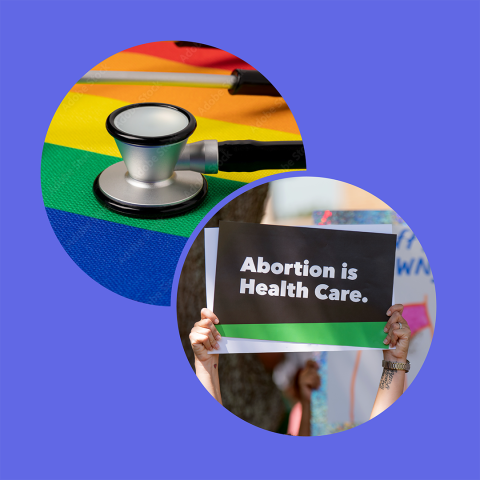
What does a person seeking abortion care have in common with a young trans person seeking gender-affirming care? More than most people think.
The campaign to restrict gender-affirming care follows a well-worn and ultimately successful playbook designed by anti-abortion advocates. That success has emboldened them to target intersecting issues and groups who face the steepest barriers to accessing sexual and reproductive health care, like young people.
Now, the movements to restrict gender-affirming care and abortion care are evolving together too. Many of the same policymakers are using parallel tactics to limit access to both. As state policy experts tracking attacks on LGBTQ+ communities and on reproductive health and rights, we can connect the dots between these strategies that increasingly depend on criminalization, expanding state surveillance of personal health care decisions, and limiting young people’s autonomy. Understanding how these attacks overlap is critical to resisting them and building solidarity across both fights.
These movements have both been disturbingly effective, and as they become increasingly interlinked, could build on each other to reinforce strategies for restricting care. Thirteen states are enforcing total abortion bans, and many more restrict access throughout pregnancy. Twenty-four states are enforcing total bans on gender-affirming care for young people, with last year’s decision in United States v. Skrmetti effectively endorsing state efforts to restrict this best practice health care.
Young people are in the crosshairs of both movements, as they face the steepest barriers to accessing abortion and gender-affirming care. This is because young people have the fewest resources to travel, and often face parental involvement restrictions. Policymakers are increasing these barriers, working to eliminate processes like judicial bypass that can provide a path for abortion care for young people who do not or cannot involve a parent and systematically dismantling the support systems and information young people rely on. Tennessee and Idaho have enacted abortion support bans — partially blocked by courts — that impose civil or criminal liability on non-parent adults who help minors travel out of state for care. These laws threaten abortion funds and support organizations that can help young people get financial or logistical support to obtain health care that is legal in other states.
Young people in many states also cannot access gender-affirming care due to bans – yet policymakers are still going further to chill access. Eight states have adopted vague “aiding and abetting” provisions that can harm young people by restricting providers from making referrals, sharing medical records, discussing out-of-state treatment options, refilling prescriptions, or even conducting lab work. These bills actively harm young people, and send the message that providers and others will pay the price for supporting them.
Criminalization is another powerful tool in this shared playbook. States have paired restrictions on gender-affirming care with harsh penalties, including loss of licensure, steep fines, and criminal and civil penalties to create a chilling effect on provision.These attacks mirror how criminal threats have been deployed against abortion providers and helpers, with laws that increasingly target patients, providers, abortion funds, and others who help people obtain care. In both efforts, the end goal goes far beyond criminalization; policymakers want to create a chilling effect over entire care infrastructures to make them too risky to sustain.
We’re also seeing policymakers weaponize private health data. In the abortion context, mandated abortion reporting, required in almost every state, has become increasingly dangerous. Given the current landscape, that data may pose a huge threat to patient privacy and can be tools for law enforcement, particularly intimidating for patients who are forced to travel across state lines for care. We are also seeing this dynamic in the gender-affirming care context, through efforts to investigate providers, subpoena private patient records, and even punish supportive parents. Just this March, policymakers in Tennessee introduced a new bill that would add extensive reporting requirements for gender-affirming care providers—the same bureaucratic trap used to target abortion providers designed to bury providers in paperwork and create data sources that could be misused and turned against patients.
It is far past time to think of attacks on gender-affirming care and abortion care as separate political agendas. These overlapping strategies demand joint advocacy and political responses. As we fight for a world where everyone can access the health care they need, abortion and gender-affirming care must be non-negotiable.