
Guttmacher Institute

Search

  • Facebook
  • Instagram
  • Youtube
  • LinkedIn
  • Contact

Highlights

  • Reproductive Health Impact Study
  • Adding It Up
  • Abortion Worldwide
  • Guttmacher-Lancet Commission
  • US policy resources
  • State policy resources
  • International Perspectives on Sexual and Reproductive Health (1975–2020)
  • Perspectives on Sexual and Reproductive Health (1969–2020)

Reports

  • Global
  • United States

Articles

  • Global research
  • US research
  • Policy analysis
  • Guttmacher Policy Review
  • Opinion

Fact Sheets

  • Global
  • United States
  • US State Laws and Policies

Tools

  • Interactive Map: US Abortion Policies and Access After Roe
  • Safe Abortion Calculator
  • Family Planning Investment Impact Calculator
  • Monthly Abortion Provision Study Dashboard
  • Public-use data sets

Global

  • Abortion
  • Contraception
  • Pregnancy
  • Teens

US

  • Abortion
  • Contraception
  • Pregnancy
  • Teens

Our Work by Geography

  • Global
  • Africa
  • Asia
  • Europe
  • Latin America & the Caribbean
  • Northern America
  • Oceania

Who We Are

  • About
  • Staff
  • Board
  • Job opportunities
  • Newsletter
  • History
  • Contact
  • Conflict of Interest Policy

Media

  • Media office
  • News releases
  • Videos

Support Our Work

  • Make a gift today
  • Monthly Giving Circle
  • Ways to Give
  • Guttmacher Guardians
  • Guttmacher Legacy Circle
  • Financials
  • Impact Report 2025

Awards & Scholarships

  • Darroch Award
  • Richards Scholarship
  • Bixby Fellowship
Donate
Guttmacher Institute
Donate

Highlights

  • Reproductive Health Impact Study
  • Adding It Up
  • Abortion Worldwide
  • Guttmacher-Lancet Commission
  • US policy resources
  • State policy resources
  • International Perspectives on Sexual and Reproductive Health (1975–2020)
  • Perspectives on Sexual and Reproductive Health (1969–2020)

Reports

  • Global
  • United States

Articles

  • Global research
  • US research
  • Policy analysis
  • Guttmacher Policy Review
  • Opinion

Fact Sheets

  • Global
  • United States
  • US State Laws and Policies

Tools

  • Interactive Map: US Abortion Policies and Access After Roe
  • Safe Abortion Calculator
  • Family Planning Investment Impact Calculator
  • Monthly Abortion Provision Study Dashboard
  • Public-use data sets

Global

  • Abortion
  • Contraception
  • Pregnancy
  • Teens

US

  • Abortion
  • Contraception
  • Pregnancy
  • Teens

Our Work by Geography

  • Global
  • Africa
  • Asia
  • Europe
  • Latin America & the Caribbean
  • Northern America
  • Oceania

Who We Are

  • About
  • Staff
  • Board
  • Job opportunities
  • Newsletter
  • History
  • Contact
  • Conflict of Interest Policy

Media

  • Media office
  • News releases
  • Videos

Support Our Work

  • Make a gift today
  • Monthly Giving Circle
  • Ways to Give
  • Guttmacher Guardians
  • Guttmacher Legacy Circle
  • Financials
  • Impact Report 2025

Awards & Scholarships

  • Darroch Award
  • Richards Scholarship
  • Bixby Fellowship
Donate
  • Facebook
  • Instagram
  • Youtube
  • LinkedIn
  • Contact
Fact Sheet
October 2026

Abortion Rights Are on the Ballot in Four States in 2026

In the November 2026 election, voters in three states (Idaho, Nevada and Virginia) will consider ballot measures designed to protect abortion rights by affirming a statutory or constitutional right to abortion and in some cases other reproductive rights. Additionally, voters in one state (Missouri) will vote on an anti-abortion measure that would undo the right to reproductive freedom previously established by a state ballot measure.

Idaho is the only state featuring a protective abortion rights ballot measure that is also enforcing a total ban on abortion—which would likely be challenged in court should the ballot measure pass. Data from Guttmacher's Monthly Abortion Provision Study show that in 2025, 850 abortions were provided via telehealth to Idaho residents by clinicians based in other US states and under the protection of shield laws, due to the total ban in effect. In the other states featuring abortion rights ballot measures this year, over 59,000 abortions were provided by clinicians in 2025—the vast majority of which were provided in Virginia.

While measures that add constitutional or statutory protections for abortion are vital, they do not automatically repeal restrictions, and litigation is often needed to overturn them. Moreover, protections for abortion rights may fall short of ensuring access to care for everyone who needs it. Such laws often protect abortion access up to “viability” (a medically variable threshold that is often reached between 24–26 weeks of pregnancy) and often allow the state to regulate abortion care after viability.

Efforts to restrict abortion often intersect with other movements aimed at restricting people’s rights. Voters in a total of five states will face ballot measures this fall that would undermine the rights of transgender minors, primarily by targeting best practice gender-affirming care for young people and sports participation by trans youth. The anti-abortion measure in Missouri also targets gender-affirming care for minors, which is already banned in the state.

Given the success of ballot measures protecting abortion access in states across the country, anti-abortion advocates have become increasingly forceful with strategies aimed at restricting ballot measures at every stage of the process. In several additional states this year, voters will face propositions that will make it more difficult to pass ballot measures. A similar effort already failed in Missouri in August 2026—when voters declined to pass a measure that would have dramatically restricted future ballot initiatives by requiring them to be approved by a majority of voters in every congressional district, rather than a state-wide majority.

Ballot Measures Have Protected and Expanded Abortion Access

Ballot measures affirming abortion rights have been effective tools for expanding and protecting abortion rights, even in states with abortion restrictions. In the 2024 elections, 10 states featured ballot measures affirming abortion rights, and seven of these passed. In elections in 2022 and 2023, voters in all seven states where abortion rights measures were on the ballot came down decisively in favor of retaining or expanding such rights.

Since the 2024 ballot measure victories, advocates in states with abortion restrictions have used these new protections as a legal basis to expand abortion access. In 2024, Missouri voters established a right to reproductive freedom in their state constitution, providing a legal avenue to overturn the state's total abortion ban. Litigation and ensuing court rulings repealed Missouri’s abortion restrictions, eventually allowing procedural abortion care to resume in the state in 2025 and for medication abortion provision to return in June 2026 for the first time since 2018. Similarly, in Arizona, voters protected the right to abortion through a ballot measure in November 2024, providing a legal avenue to strike down the state's 15-week ban later that year. Ensuing litigation also lifted additional restrictions in February 2026, rescinding bans on telehealth and the mailing of abortion pills, while removing mandates for biased counseling, medically unnecessary ultrasounds, and punitive waiting periods that made it more difficult for people to access abortion care in Arizona.

The anti-abortion measure Missouri voters will face this fall threatens to undo the progress that has allowed hundreds of Missourians to access care in their state earlier this year.
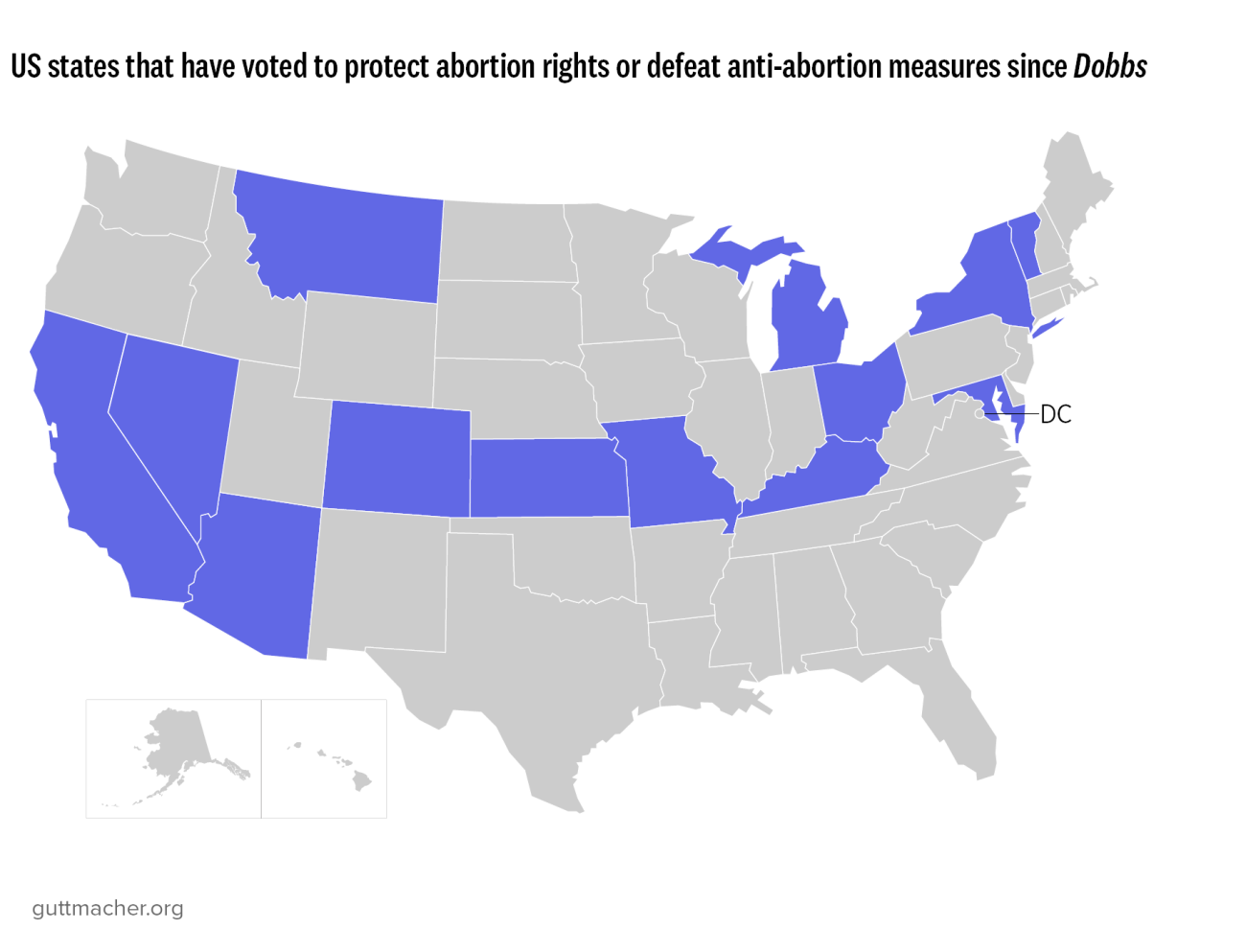
US states that have voted to protect abortion rights or defeat anti-abortion measures since Dobbs

Abortion Rights Measures

Idaho

Proposition 1 (Reproductive Freedom and Privacy Act Initiative)

Led by Idahoans United for Women and Families, this ballot measure would create a legal avenue to challenge the state's total abortion ban through a state statute establishing a right to reproductive freedom and privacy. The statute would prevent the state from restricting abortion before viability, at which point it could be restricted except in cases of medical emergency. The measure would also protect people’s decision-making around pregnancy, childbirth, contraception, fertility treatments and pregnancy loss care from governmental interference.

However, the Idaho measure would not amend the state's constitution but instead create a statutory right to abortion in the state. While statutory protections for abortion rights would be a vital step forward for Idahoans, statutes are more easily repealed than amendments to state constitutions.

Context:

  • Abortion policies in Idaho are categorized on Guttmacher’s interactive state policy map as “Most Restrictive," given the total abortion ban in effect, as well as numerous other restrictions.
  • Despite the total ban, Idahoans have been able to access abortion via two main pathways: telehealth shield law provision and travel to other states.
  • In 2025, 850 abortions were provided via telehealth to Idaho residents by clinicians in other states, a 16% increase from 2024.
  • Also in 2025, 1,680 Idaho residents were forced to travel out of state for care, including to Oregon (960), Washington (410), Utah (210) and other states (100).

Nevada

Question 6 (Right to Abortion Initiative)

Led by Nevadans for Reproductive Freedom, this measure would establish a right to abortion in the state constitution, but would allow restrictions on abortion care after viability, except when necessary to protect the pregnant person’s life or physical health.

This is the second time Nevada voters will vote on this measure due to the state’s “two-election” requirement to amend the state constitution. The measure passed for the first time in 2024 and if passed again, would take effect following a vote by the state supreme court, which has previously been supportive of abortion rights.

Context:

  • Abortion policies in Nevada are categorized on our interactive map as “Protective,” reflecting policies such as a statute that protects abortion rights, state Medicaid coverage of abortion when accompanied by a letter of medical necessity, and a shield law protecting abortion care from investigations by other states.
  • 16,190 abortions were provided by clinicians in Nevada in 2025. While this was a slight decrease (6.3%) from 2024, it was a 47% increase compared to 2020, the last year with Guttmacher Institute abortion data from before Roe was overturned.
  • 69% of clinician-provided abortions in Nevada were medication abortions in 2023, the most recent year with data on abortion methods.
  • Some Nevadans sought care in other states in 2025, while Nevada also served as an access point for residents of other states:
  • 720 Nevadans traveled out of state for abortion care in 2025, including to California (520) and other states (200).
  • 890 people traveled into Nevada for abortion care, including from Texas (320), Arizona (220), Utah (140) and other states (210).

Virginia

Question 1 (Right to Reproductive Freedom Amendment)

Led by Virginians for Reproductive Freedom, this ballot measure would enshrine the right to reproductive freedom in the state constitution.

The measure specifically protects people’s freedom to make and carry out personal decisions about prenatal care, childbirth, postpartum care, birth control, abortion, pregnancy loss and fertility care. The measure also protects patients, doctors and nurses from being punished for these personal decisions or helping others exercise their right to make such decisions. However, the measure allows for restrictions on access to abortion during the third trimester of pregnancy—except when the patient’s health is at risk, or the pregnancy cannot survive.

Context:

  • Abortion policies in Virginia are categorized as “Some Restrictions/Protections” on Guttmacher’s interactive map, due to policies such as an abortion ban in the third trimester, a state Medicaid coverage ban, and parental involvement laws that limit minors' access to abortion.
  • 40,090 abortions were provided by clinicians in Virginia in 2025, approximately the same number as in 2024. The number of abortions provided in Virginia increased by nearly 114% from 2020 to 2025, in part because Virginia became a key point of access for those traveling from out of state.
  • 66% of Virginia’s clinician-provided abortions in 2023 were medication abortions.
  • Some Virginians sought care in other states in 2025, while the state also served as a critical point of access for people seeking abortion care in the Southeast.
  • More than 8,500 people traveled to Virginia to access abortion care in 2025, primarily from states with more restrictive policies. The largest number of people came from North Carolina (2,180), Florida (1,770) and Georgia (1,240).
  • Meanwhile, 2,920 people from Virginia traveled out of state for care, to Maryland (1,220), DC (860), North Carolina (680), and other states (160).

Anti-Abortion Measures

Missouri

Amendment 3 (Prohibit Abortion and Gender Transition Procedures for Minors Amendment)

Led by the anti-abortion Her Health and Her Future PAC, this measure would overturn the right to reproductive freedom enshrined in the Missouri state constitution by voters in 2024. The amendment would prohibit abortion except in cases of medical emergency, fetal anomaly, rape, or incest, and require parent or guardian consent for minors seeking an abortion. The measure would bar public funding for abortion and allow the legislature to enact various unnecessary restrictions, known as targeted regulation of abortion providers (TRAP) laws, which are intended to increase scrutiny of clinics and make provision more costly and cumbersome to provide.

The amendment would also prohibit gender-affirming care for minors, which is already banned by state statute.

Missouri voters’ 2024 affirmation of the right to reproductive freedom in the state constitution provided a legal avenue for overturning the state’s total abortion ban, allowing procedural abortion care to resume in the state in 2025. In June 2026, another ruling overturned restrictions that prevented clinics in the state from offering medication abortion care, allowing in-state clinical provision of this care method to resume for the first time since 2018.

Context:

  • Abortion policies in Missouri are categorized as “Restrictive” on Guttmacher’s interactive map due to numerous restrictions still in effect, such as a state Medicaid and private insurance coverage ban, an in-person requirement for medication abortion, and parental involvement laws that limit minors’ access to abortion care.
  • 3,550 abortions were provided by clinicians in Missouri in 2025, a 53.5% increase from 2024.
  • Due to the restrictive environment prior to the 2025 court decisions mentioned above, more than 11,500 people were forced to travel out of state for abortion care in 2025, including to Illinois (7,690), Kansas (3,940) and other states (60).

Acknowledgments

Isabel Guarnieri and Priyanka Sookhai, and edited by Ian Lague.

Share

Printer-friendly version

Reproductive rights are under attack. Will you help us fight back with facts?

Donate

Read More

Policy Analysis

Abortion Rights Ballot Measures Win in 7 out of 10 US States

Initiative

Monthly Abortion Provision Study

Resource

Interactive Map: US Abortion Policies and Access After Roe

Topic

United States

  • Abortion

Geography

  • Northern America: United States
Guttmacher Institute

Center facts. Shape policy.
Advance sexual and reproductive rights.®

Donate Now
Newsletter Signup  Contact Us 
  • Facebook
  • Instagram
  • Youtube
  • LinkedIn
  • Contact

Footer

  • Privacy Policy
  • Accessibility Statement
© 2026 Guttmacher Institute. The Guttmacher Institute is registered as a 501(c)(3) nonprofit organization under the tax identification number 13-2890727. Contributions are tax deductible to the fullest extent allowable.