
Guttmacher Institute

Search

  • X
  • Facebook
  • Instagram
  • Youtube
  • LinkedIn
  • Contact

Highlights

  • Reproductive Health Impact Study
  • Adding It Up
  • Abortion Worldwide
  • Guttmacher-Lancet Commission
  • US policy resources
  • State policy resources
  • International Perspectives on Sexual and Reproductive Health (1975–2020)
  • Perspectives on Sexual and Reproductive Health (1969–2020)

Reports

  • Global
  • United States

Articles

  • Global research
  • US research
  • Policy analysis
  • Guttmacher Policy Review
  • Opinion

Fact Sheets

  • Global
  • United States
  • US State Laws and Policies

Tools

  • Interactive Map: US Abortion Policies and Access After Roe
  • Family Planning Investment Impact Calculator
  • Monthly Abortion Provision Study Dashboard
  • State legislation tracker
  • Public-use data sets

Global

  • Abortion
  • Contraception
  • Pregnancy
  • Teens

US

  • Abortion
  • Contraception
  • Pregnancy
  • Teens

Our Work by Geography

  • Global
  • Africa
  • Asia
  • Europe
  • Latin America & the Caribbean
  • Northern America
  • Oceania

Who We Are

  • About
  • Staff
  • Board
  • Job opportunities
  • Newsletter
  • History
  • Contact
  • Conflict of Interest Policy

Media

  • Media office
  • News releases

Support Our Work

  • Make a gift today
  • Monthly Giving Circle
  • Ways to Give
  • Guttmacher Guardians
  • Guttmacher Legacy Circle
  • Financials
  • Impact Report 2025

Awards & Scholarships

  • Darroch Award
  • Richards Scholarship
  • Bixby Fellowship
Donate
Guttmacher Institute
Donate

Highlights

  • Reproductive Health Impact Study
  • Adding It Up
  • Abortion Worldwide
  • Guttmacher-Lancet Commission
  • US policy resources
  • State policy resources
  • International Perspectives on Sexual and Reproductive Health (1975–2020)
  • Perspectives on Sexual and Reproductive Health (1969–2020)

Reports

  • Global
  • United States

Articles

  • Global research
  • US research
  • Policy analysis
  • Guttmacher Policy Review
  • Opinion

Fact Sheets

  • Global
  • United States
  • US State Laws and Policies

Tools

  • Interactive Map: US Abortion Policies and Access After Roe
  • Family Planning Investment Impact Calculator
  • Monthly Abortion Provision Study Dashboard
  • State legislation tracker
  • Public-use data sets

Global

  • Abortion
  • Contraception
  • Pregnancy
  • Teens

US

  • Abortion
  • Contraception
  • Pregnancy
  • Teens

Our Work by Geography

  • Global
  • Africa
  • Asia
  • Europe
  • Latin America & the Caribbean
  • Northern America
  • Oceania

Who We Are

  • About
  • Staff
  • Board
  • Job opportunities
  • Newsletter
  • History
  • Contact
  • Conflict of Interest Policy

Media

  • Media office
  • News releases

Support Our Work

  • Make a gift today
  • Monthly Giving Circle
  • Ways to Give
  • Guttmacher Guardians
  • Guttmacher Legacy Circle
  • Financials
  • Impact Report 2025

Awards & Scholarships

  • Darroch Award
  • Richards Scholarship
  • Bixby Fellowship
Donate
  • X
  • Facebook
  • Instagram
  • Youtube
  • LinkedIn
  • Contact
Policy Analysis
September 2025

States Without Total Abortion Bans See Declines in Clinician-Provided Abortions and Out-of-State Patients

An image of the United States

Authors

Kelly Baden, Guttmacher Institute Isabel DoCampo , Guttmacher Institute Emma Stoskopf-Ehrlich, Guttmacher Institute

Reproductive rights are under attack. Will you help us fight back with facts?

Donate

New findings from the Monthly Abortion Provision Study show that an estimated 518,940 clinician-provided abortions occurred in the first six months of 2025 in states without total abortion bans: a 5% decrease compared to the same period in 2024.

Declines in clinician-provided abortions occurred in 22 states without total abortion bans; they were largest in states that implemented six-week bans during this period and in states that border those with total abortion bans. Out-of-state travel for abortion care to states without total bans declined by 8% over this period. These trends likely reflect the impact of recent abortion restrictions, the expanding availability of medication abortion via shield law provision in states with total bans, the increasing hardship posed by travel for abortion care, and growing strains on the abortion funds and support networks that help enable out-of-state travel for care.

Importantly, these preliminary data do not yet provide a basis for full-year findings and do not include abortion pills mailed by clinicians under the protection of shield laws to individuals residing in states with total bans. They also do not include data on self-managed abortions, including abortion pills obtained from community support networks or websites. As such, the new data represent an undercount of the total number of abortions occurring in the United States. However, they offer a critical first look at where and how people are accessing abortion in 2025 and illustrate the ongoing need for policy solutions to mitigate the effects of abortion bans.  

Six-Week Bans Are Devastating to Abortion Access

Six-week abortion bans in Florida and Iowa resulted in substantial declines in abortion provision between the first halves of 2024 and 2025. These findings build on previous Guttmacher data conveying the significant impact of six-week bans on abortion care. Florida—one of the last states in the Southeast that had permitted abortion beyond the first trimester—implemented a six-week abortion ban in May 2024. Consequently, there were 12,090 (or 27%) fewer abortions in Florida in the first half of 2025 relative to the first half of 2024. This change in abortion caseloads was the largest absolute change observed in any state and accounted for over two-fifths of the overall decline in states without total bans documented by the Monthly Abortion Provision Study between the first six months of 2024 and 2025. In Iowa, where a six-week ban took effect in July 2024, the number of abortions declined by 900 (or 39%) between the first halves of 2024 and 2025.

New Data Reveal Changes in Interstate Travel

Guttmacher research has demonstrated that out-of-state travel for abortion care more than doubled post-Dobbs; however, this trend appears to be reversing. In the first half of 2024, 80,870 people traveled to states without total bans to obtain abortion care, compared to 74,490 individuals in the first half of 2025. These declines in out-of-state travel contributed significantly to state-level declines in abortion provision—particularly in states that border those with total bans.
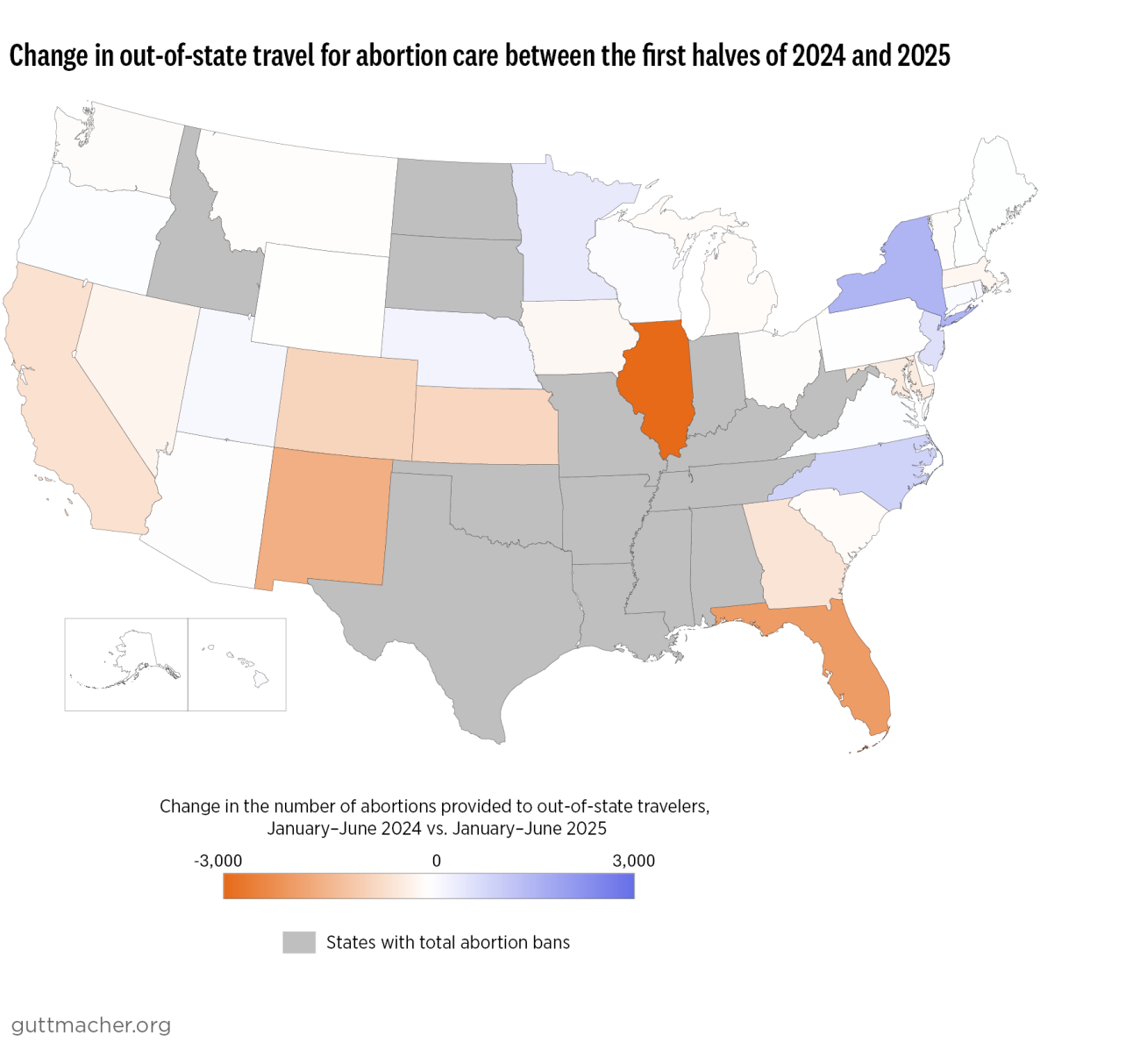
Change in out-of-state travel for abortion care between the first halves of 2024 and 2025 Map

In Illinois, abortion provision declined by 9% between the first halves of 2024 and 2025—with 71% of this decline due to a decrease in the number of patients who traveled to Illinois during this period and the remainder due to declines among Illinois residents. In New Mexico, declines in out-of-state travel accounted for all of the 15% decline in caseloads observed between the first halves of 2024 and 2025. Kansas and Colorado—other major destinations for out-of-state patients—also saw declines in out-of-state travel during this period.

Still, out-of-state travel for abortion care remains significantly higher than pre-Dobbs levels and creating a welcoming policy and provision climate for people traveling for care should continue to be a priority for governors, state attorneys general, state legislators, advocates and clinicians. Importantly, some states saw increases in the number of out-of-state patients between the first halves of 2024 and 2025. In New York, for example, out-of-state travel increased by 51% during this period, likely due to an increase in people traveling from Florida. Taking into account our findings for all states without total bans, however, travel for abortion care appears to be on the decline, likely due to a number of factors.

Shield laws are likely contributing to these changes

Eight abortion-protective states have enacted shield laws that provide legal protections for clinicians to prescribe and mail abortion pills directly to patients in states with total abortion bans or telehealth restrictions, offering these patients a critical point of access despite their states’ extremist policies. Consequently, online clinics offering abortion care to individuals in ban states are expanding.

While shield law provision may not be an appropriate or preferred option for some patients—those at later gestational durations, for example, or those who prefer procedural abortion to medication abortion—this critical innovation is likely a key factor in reducing travel for abortion care, particularly by residents of states with total bans. As the Monthly Abortion Provision Study only captures abortions occurring in states without total abortion bans, it is possible that increasing shield law provision to states with total bans could partially account for the declines in overall caseloads and travel between the first halves of 2024 and 2025. Nationally, the #WeCount project estimates that 40,890 abortions were provided under shield laws to states with total bans in the second half of 2024, up from 35,250 in the first half of the year.

Logistical and financial barriers to travel may also be driving this shift

Travel across state lines can come at a significant cost for patients, who must factor in transportation, lodging, childcare, time off work, and a variety of other expenses, in addition to the cost of the abortion itself. Some patients may also consider increased risks of travel related to rising ICE activity and anti-immigrant hostility. The intensive efforts of clinicians, abortion funds and practical support organizations (as well as patients themselves) have been key in facilitating interstate travel for abortion. However, this work may not be sustainable; abortion funds in ban states like Texas as well as protective states like New York are reporting decreased donations while costs for abortion and related services are rising, potentially reducing support for out-of-state travelers.

Options for travel, meanwhile, are increasingly constricted for many residents of states with total bans. In the first half of 2024, over 3,000 individuals traveled to Florida for abortion care; in the first half of 2025, with the six-week ban in place, just 1,130 did so. Virginia is now one of two states in the Southeast that allows abortion beyond six weeks, and the only one with no forced waiting period. As a result, residents of the region may be increasingly reluctant to travel, as there are few nearby options for care. Those who cannot travel, and do not obtain care via shield law provision, may be self-managing their abortions or be forced to remain pregnant.

The Data Point to Critical Policy Interventions

This early look at the 2025 abortion provision landscape sheds light on how changing factors are impacting abortion access—and how policymakers and advocates can support patients despite the anti-abortion climate of many states and the threats to abortion access posed by the Trump administration.

Shield law protections have expanded care options for people in ban states, and it is of little surprise that such laws are a key target of the anti-abortion movement. From litigation to legislation, conservative lawyers and policymakers are weaponizing the legal system in an attempt to eliminate this critical modality of care. More states should pass shield laws with explicit protections for telehealth provision and policymakers should continue to analyze the provision landscape to evaluate and strengthen existing shield law protections. States should also follow Colorado, Massachusetts, Maine, New York, Vermont and Washington in allowing shield law providers’ names to be removed from prescription labels and replaced with the names of their health care facilities to protect sensitive data, along with considering other data privacy protections.

In addition to enacting shield laws, policymakers can address the financial burdens imposed on patients traveling out of state for abortion care. States and cities can fund abortions directly and should also evaluate these financial assistance programs to ensure efficient and timely access for patients. States can also consider following Maryland’s innovative use of unspent Affordable Care Act surcharge savings to supplement abortion funds.

Tracking state-level abortion provision is critical to analyzing the impacts of changing abortion policies and offering a roadmap for lawmakers everywhere to protect access to essential health care. While everyone deserves access to abortion when, where and how they desire it, the reality is that hostile policy climates and financial and logistical barriers prevent many people from getting the abortion care they seek. These new data from the Monthly Abortion Provision Study, indicating a reversal of recent trends in abortion provision, can thus offer critical new insights into how state policies and abortion funding networks impact patients’ ability to access care.

Methodology

Data are drawn from Guttmacher’s Monthly Abortion Provision Study, which produces estimates of the number of abortions provided by clinicians in states without total abortion bans based on data collected from samples of abortion providers. Estimates include abortions provided at brick-and-mortar facilities (including those that use telehealth) and online-only providers (including providers who mail abortion pills to patients in states without total bans under the protection of shield laws). These estimates do not include self-managed abortions or any abortions involving medication mailed to states with total abortion bans (either self-managed or provided by out-of-state clinicians).

Number of clinician-provided abortions in states without total bans, overall and to out-of-state travelers, first halves of 2024 and 2025

  Clinician-provided abortions Travel for abortion care
  Number of abortions Percent change Number of abortions Percent change
Jurisdiction January–June 2024 January–June 2025   January–June 2024 January–June 2025  
All jurisdictions without total bans 547,150 518,940 -5% 80,870 74,490 -8%
Alaska 830 910 10% 20 20 0%
Arizona 8,820 8,820 0% 110 140 27%
California 93,940 92,460 -2% 2,000 1,400 -30%
Colorado 12,820 11,010 -14% 3,380 2,520 -25%
Connecticut 7,550 7,590 1% 280 360 29%
District of Columbia 4,780 5,270 10% 2,530 2,690 6%
Delaware 2,020 2,020 0% 200 180 -10%
Florida 44,660 32,570 -27% 3,120 1,130 -64%
Georgia 17,890 17,630 -1% 2,740 2,210 -19%
Hawaii 2,010 1,950 -3% 60 110 83%
Iowa 2,330 1,430 -39% 150 0 -100%
Illinois 48,810 44,450 -9% 19,670 16,570 -16%
Kansas 11,920 10,950 -8% 8,140 7,330 -10%
Massachusetts 11,090 10,540 -5% 590 410 -31%
Maryland 20,410 20,110 -1% 3,150 2,770 -12%
Maine 1,430 1,390 -3% 100 120 20%
Michigan 19,120 18,290 -4% 1,390 1,320 -5%
Minnesota 8,280 8,220 -1% 1,310 1,740 33%
Montana 1,270 1,290 2% 120 90 -25%
North Carolina 24,050 24,630 2% 8,200 9,110 11%
Nebraska 1,630 2,340 44% 110 350 218%
New Hampshire 1,410 1,370 -3% 190 210 11%
New Jersey 30,220 30,210 0% 1,640 2,280 39%
New Mexico 9,940 8,430 -15% 6,870 5,260 -23%
Nevada 8,890 8,940 1% 860 640 -26%
New York 62,230 59,390 -5% 3,040 4,590 51%
Ohio 15,550 15,090 -3% 1,820 1,760 -3%
Oregon 6,100 6,180 1% 610 650 7%
Pennsylvania 20,040 18,780 -6% 1,640 1,630 -1%
Rhode Island 1,690 1,930 14% 130 260 100%
South Carolina 3,300 3,760 14% 240 160 -33%
Utah 2,560 2,900 13% 260 400 54%
Virginia 21,100 19,900 -6% 4,670 4,710 1%
Vermont 750 790 5% 170 140 -18%
Washington 12,530 12,100 -3% 670 610 -9%
Wisconsin 3,250 3,790 17% 40 90 125%
Wyoming 390 250 -36% 50 30 -40%
Notes: Jurisdictions without total bans are defined as those without a total ban in place for at least some part of 2024 or 2025. Though North Dakota's total ban was lifted by a district judge in September 2024, abortion provision remained limited in the state throughout the year; as such, North Dakota is not included in the definition of "jurisdictions without total bans." Missouri's total abortion ban was blocked by constitutional amendment in November 2024. However, because litigation is ongoing and access to abortion remains highly restricted in the state, Guttmacher is not currently publishing state-level estimates for Missouri.

Acknowledgments

This analysis was edited by Ian Lague. 

First published online: September 30, 2025

Share

Printer-friendly version

Read More

News Release

Preliminary Guttmacher Data Show a Decline in Abortions and Cross-Border Care in States Without Total Abortion Bans

Initiative

Monthly Abortion Provision Study

Topic

Abortion in the United States

Policy Analysis

Attacks on Shield Laws Are the Next Step in Criminalizing Abortion Care

State Laws and Policies

Shield Laws Related to Sexual and Reproductive Health Care

Topic

United States

  • Abortion

Geography

  • Northern America: United States

Tags

provision study

US Policy Resources

More
Guttmacher Institute

Center facts. Shape policy.
Advance sexual and reproductive rights.®

Donate Now
Newsletter Signup  Contact Us 
  • X
  • Facebook
  • Instagram
  • Youtube
  • LinkedIn
  • Contact

Footer

  • Privacy Policy
  • Accessibility Statement
© 2025 Guttmacher Institute. The Guttmacher Institute is registered as a 501(c)(3) nonprofit organization under the tax identification number 13-2890727. Contributions are tax deductible to the fullest extent allowable.