
Guttmacher Institute

Search

  • Facebook
  • Instagram
  • Youtube
  • LinkedIn
  • Contact

Highlights

  • Reproductive Health Impact Study
  • Adding It Up
  • Abortion Worldwide
  • Guttmacher-Lancet Commission
  • US policy resources
  • State policy resources
  • International Perspectives on Sexual and Reproductive Health (1975–2020)
  • Perspectives on Sexual and Reproductive Health (1969–2020)

Reports

  • Global
  • United States

Articles

  • Global research
  • US research
  • Policy analysis
  • Guttmacher Policy Review
  • Opinion

Fact Sheets

  • Global
  • United States
  • US State Laws and Policies

Tools

  • Interactive Map: US Abortion Policies and Access After Roe
  • Family Planning Investment Impact Calculator
  • Monthly Abortion Provision Study Dashboard
  • Public-use data sets

Global

  • Abortion
  • Contraception
  • Pregnancy
  • Teens

US

  • Abortion
  • Contraception
  • Pregnancy
  • Teens

Our Work by Geography

  • Global
  • Africa
  • Asia
  • Europe
  • Latin America & the Caribbean
  • Northern America
  • Oceania

Who We Are

  • About
  • Staff
  • Board
  • Job opportunities
  • Newsletter
  • History
  • Contact
  • Conflict of Interest Policy

Media

  • Media office
  • News releases

Support Our Work

  • Make a gift today
  • Monthly Giving Circle
  • Ways to Give
  • Guttmacher Guardians
  • Guttmacher Legacy Circle
  • Financials
  • Impact Report 2025

Awards & Scholarships

  • Darroch Award
  • Richards Scholarship
  • Bixby Fellowship
Donate
Guttmacher Institute
Donate

Highlights

  • Reproductive Health Impact Study
  • Adding It Up
  • Abortion Worldwide
  • Guttmacher-Lancet Commission
  • US policy resources
  • State policy resources
  • International Perspectives on Sexual and Reproductive Health (1975–2020)
  • Perspectives on Sexual and Reproductive Health (1969–2020)

Reports

  • Global
  • United States

Articles

  • Global research
  • US research
  • Policy analysis
  • Guttmacher Policy Review
  • Opinion

Fact Sheets

  • Global
  • United States
  • US State Laws and Policies

Tools

  • Interactive Map: US Abortion Policies and Access After Roe
  • Family Planning Investment Impact Calculator
  • Monthly Abortion Provision Study Dashboard
  • Public-use data sets

Global

  • Abortion
  • Contraception
  • Pregnancy
  • Teens

US

  • Abortion
  • Contraception
  • Pregnancy
  • Teens

Our Work by Geography

  • Global
  • Africa
  • Asia
  • Europe
  • Latin America & the Caribbean
  • Northern America
  • Oceania

Who We Are

  • About
  • Staff
  • Board
  • Job opportunities
  • Newsletter
  • History
  • Contact
  • Conflict of Interest Policy

Media

  • Media office
  • News releases

Support Our Work

  • Make a gift today
  • Monthly Giving Circle
  • Ways to Give
  • Guttmacher Guardians
  • Guttmacher Legacy Circle
  • Financials
  • Impact Report 2025

Awards & Scholarships

  • Darroch Award
  • Richards Scholarship
  • Bixby Fellowship
Donate
  • Facebook
  • Instagram
  • Youtube
  • LinkedIn
  • Contact
Policy Analysis
April 2026

Just the Numbers: Australia’s Support for Global Sexual and Reproductive Health and Rights

New Evidence on Impacts of Investment in Family Planning, 2024

On a violet background are two overlapping circles: the left circle is white with an orange “A$” symbol, and the right circle is a stylized image of the globe, focused on the Asian and Pacific region.

Authors

Meltem Odabaș, Guttmacher Institute Chelsea Polis, Guttmacher Institute Elizabeth A. Sully, Guttmacher Institute

Reproductive rights are under attack. Will you help us fight back with facts?

Donate

Investments in sexual and reproductive health and rights (SRHR) are among the most cost-effective development interventions available. Supporting SRHR improves health, prevents unintended pregnancies, reduces maternal and infant mortality, and expands educational and economic opportunities for women and girls. The evidence is clear: Funding for sexual and reproductive health is central to resilient health systems, human rights, gender equality and sustainable development.

In Asia and the Pacific,* the need for comprehensive sexual and reproductive health services remains substantial, driven by persistent gaps in health system capacity, geographic barriers to service delivery, and increasing vulnerability to humanitarian crises and climate-related disasters. These challenges contribute to significant gaps in access to essential services, including contraception, safe abortion care, and maternal and newborn health services.

As one of the region’s most established development partners, Australia is uniquely positioned to contribute in response to these needs, ensuring that services that support and expand SRHR reach the populations most in need. The country has a long-standing commitment to health, gender equality and support for resilient, inclusive health systems and communities across the region, with a particular emphasis on the Southeast Asia subregion and the Pacific region. In 2023, approximately 2.8% of Australia’s official development assistance was directed toward SRHR, and Australia ranked 12th among donor countries by the share of such assistance dedicated to SRHR.1
Impact of Australia’s Global Investments in Family Planning

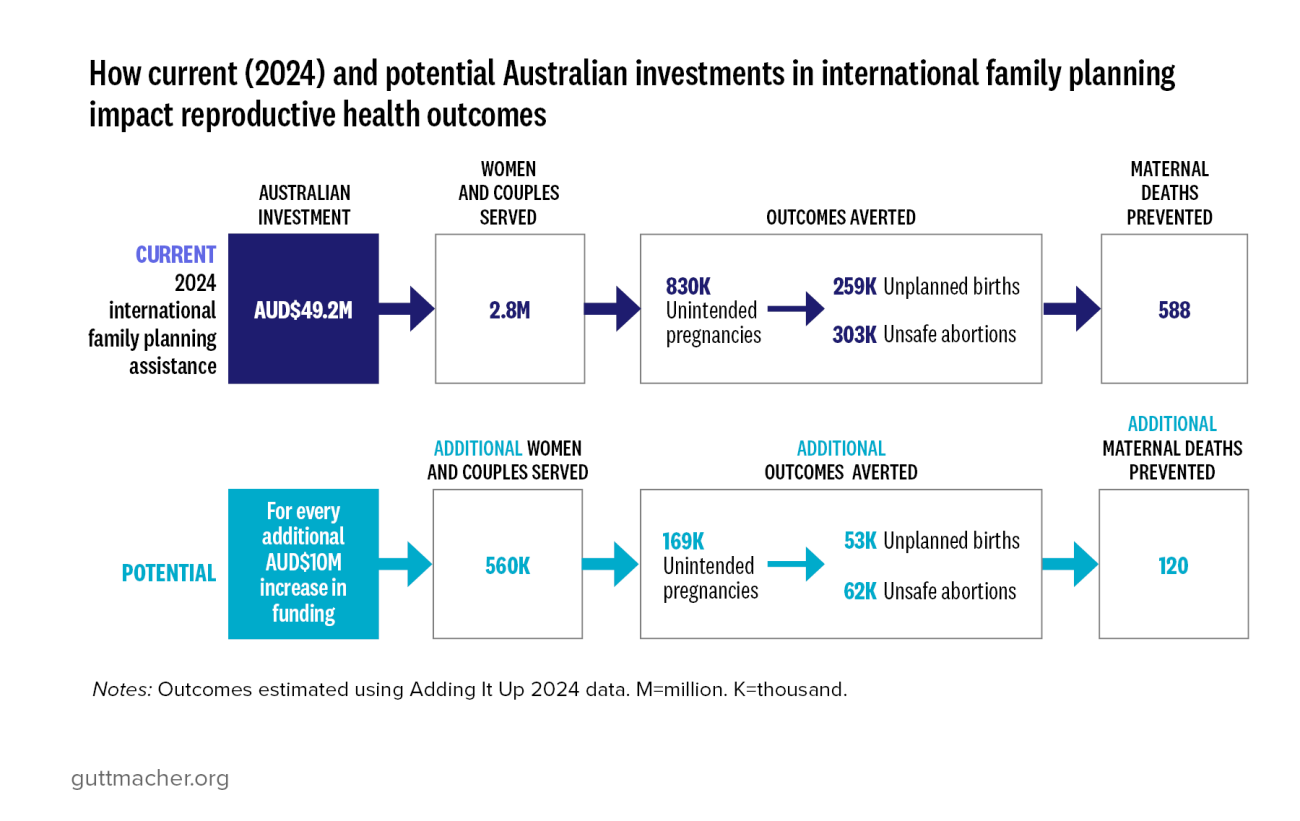
Australian support for expanding access to the full, comprehensive package of SRHR programs already includes critical investments in contraceptive care. In 2024, Australia’s bilateral and multilateral funding for international assistance for family planning was an estimated AUD$49.2 million.† Of this amount, about 38% supported bilateral funding to individual countries, 32% supported regions or did not specify recipient countries, and 30% supported multilateral organizations.

These investments delivered measurable, life-saving results by providing modern contraceptive methods to an estimated 2.8 million women and couples around the world. As shown in the graphic below, approximately 830,000 unintended pregnancies were averted—avoiding approximately 303,000 unsafe abortions and 259,000 unplanned births, which prevented 588 maternal deaths.

If Australia were to further increase investments in family planning, even greater impacts could be realized. Specifically, every additional AUD$10 million increase in funding for family planning would serve an additional 560,000 women and couples with contraceptive services, avert an additional 169,000 unintended pregnancies and prevent an additional 120 maternal deaths around the world.

How current (2024) and potential Australian investments in international family planning impact reproductive health outcomes

Impact of Australia’s Investments in Family Planning in Asia and the Pacific

Nearly all Australian bilateral, country-level family planning funding‡ (97%) is directed to 36 countries in Asia and the Pacific (see Appendix Table A1). In 30 of these countries with available data on unmet contraceptive demand,§2 295 million women were using modern contraceptive methods in 2024, and an additional 27.7 million women had unmet demand. This is slightly more than one-third of all global unmet demand across all low and middle-income countries (LMICs).

The need for contraceptive care in the region is immense. Australia’s bilateral funding for family planning in Asia and the Pacific (including unspecified bilateral funding that goes to the region, in addition to the 36 countries noted above) served more than 1.6 million contraceptive users in 2024. This contribution played an important role in meeting regional contraceptive demand—across all 36 countries and the region, 468,000 unintended pregnancies were averted, avoiding 176,000 unsafe abortions and 146,000 unplanned births, and preventing 269 maternal deaths.

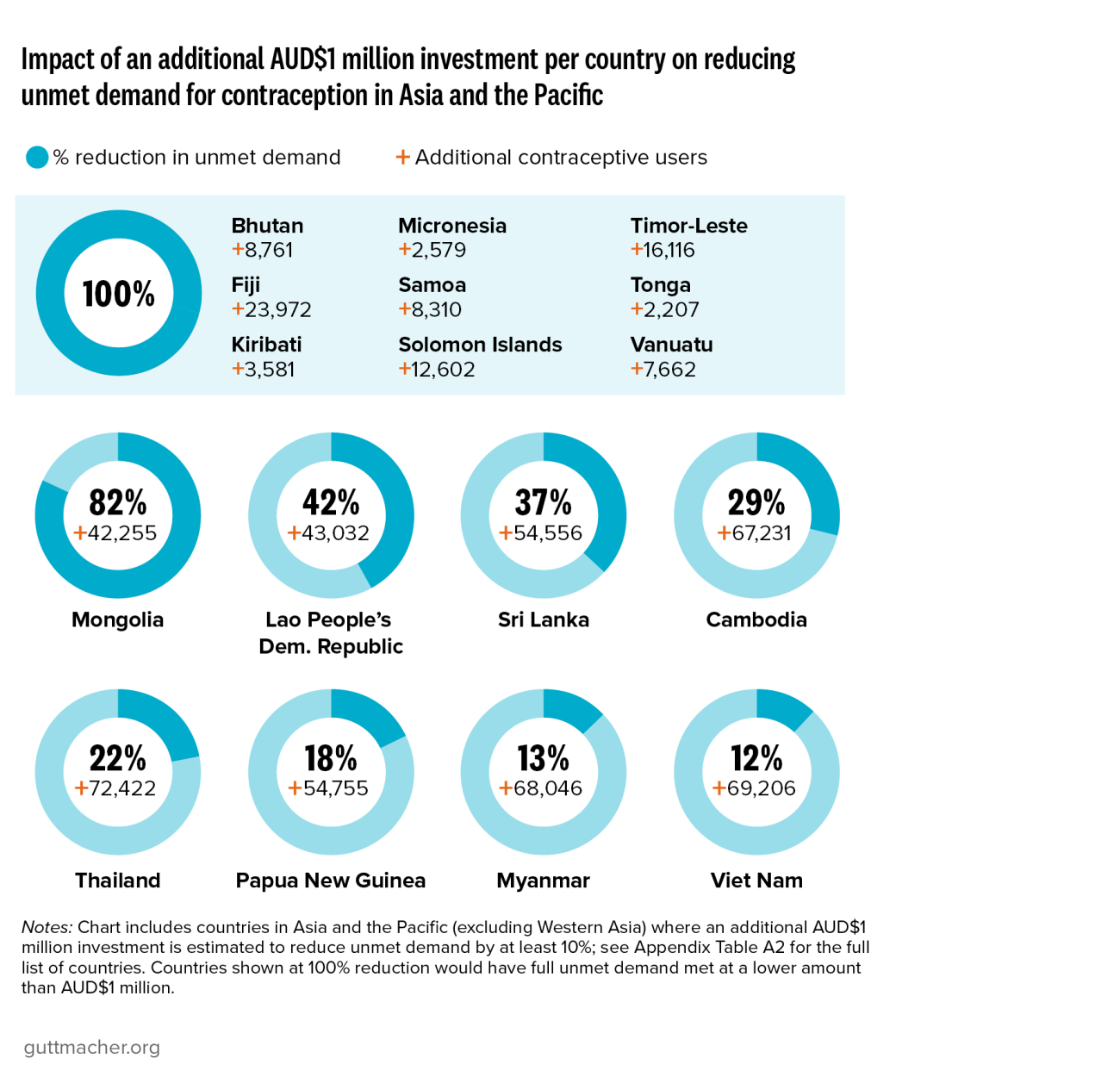
Targeted investments at the country level could further amplify these positive outcomes and move the needle in addressing the need for contraceptive care in those countries. For example, if Australia increased funding in the Philippines by a modest AUD$1 million annually, this would serve almost 56,000 additional contraceptive users, meeting 5% of unmet contraceptive demand in the country. In other countries in the region, an additional investment of AUD$1 million would be even more transformative in addressing unmet contraceptive demand (see graphic below and Appendix Table A2). Across the same 30 countries with available unmet demand data, a combined annual investment of AUD$452 million could close the gap in unmet demand for contraception entirely.

Impact of an additional AUD$1 million investment per country on reducing unmet demand for contraception in Asia and the Pacific

Beyond direct health impacts, investments in family planning deliver significant economic returns. In LMICs in the Southeast Asia subregion, every additional AUD$1 invested in contraceptive services saves AUD$1.44 in pregnancy-related and newborn care costs; in LMICs in the Pacific, AUD$3.91 would be saved under the same scenario.**3 By reducing unintended pregnancies, family planning reduces pressure on maternal and newborn health systems, freeing resources for other health priorities. At the same time, expanding access to contraception advances gender equality by enabling women and girls and LGBTQIA+ people to make informed choices about their reproductive lives, pursue education and employment opportunities, and participate more fully in economic and social life. This makes investment in contraceptive care one of the most cost-effective investments in development and strengthens the case for concentrating on additional funding in Asia and the Pacific, where both health and economic gains would be significant.

Australia’s Support for Sexual and Reproductive Health and Rights

Beyond the investments specifically in contraceptive services, Australia also invests in SRHR more broadly. Australia channels these investments through strategic partnerships with multilateral organizations and civil society groups, with a strong focus on reaching populations facing the greatest barriers to care.

A flagship example is the TUSIP (Towards Universal Sexual and Reproductive Health and Rights in the Indo-Pacific) initiative. The Australian Government’s Department of Foreign Affairs and Trade supports partners through this program—including the International Planned Parenthood Federation (IPPF), MSI Reproductive Choices, United Nations Population Fund (UNFPA) and United Nations Children’s Fund (UNICEF)—to expand access to contraception, broader sexual and reproductive health services, and care related to sexual and gender-based violence, while also strengthening health service delivery systems and enabling environments for SRHR policy advocacy across the region.4

These investments deliver critical results. Program partners estimated that the Australian-supported RESPOND Phase II program (a partnership between IPPF and MSI Reproductive Choices operating across nine countries in Asia) supported the provision of over 1.5 million sexual and reproductive health services—including safe abortion care, contraceptive care and other essential services—in just the first year (August 2024–June 2025).5 IPPF and MSI also estimated that family planning services provided through the program in its first year generated over 120,000 couple-years of protection.

The RESPOND II program prioritizes reaching those furthest from care, including marginalized groups in Cambodia, Lao People’s Democratic Republic (PDR), the Philippines and Viet Nam. More than one-third of clients served were living in poverty, while about one in five were younger than 25. Services also reached women in some of the most challenging operating environments in the region, from conflict-affected areas of Myanmar to remote communities in Afghanistan.

Australian investments in SRHR account for the complex and challenging environments in which services are provided and seek to address those challenges directly. From outreach services in Myanmar and the Philippines to reduce geographic barriers to care, to provider trainings in Cambodia and Lao PDR to strengthen the delivery of inclusive family planning services, the RESPOND II program goes beyond direct service delivery to strengthen the health systems that underpin it: focusing on building sustainable capacity through provider training, policy advocacy and community education to last longer than individual funding cycles. New programming in 2025 led by UNFPA, UNICEF and IPPF aims to address female genital mutilation/cutting in Southern and Southeast Asia.

The Australian Government has invested in the Transformative Agenda for Women, Adolescents and Youth in the Pacific since 2018. Phase II of the program, a $43.6 million investment for 2023–2027, is delivered through UNFPA in partnership with nine Pacific region countries to accelerate realization of SRHR through a systemic and multisectoral approach.4 The program encompasses work that includes improving health worker training on inclusive sexual and reproductive health service delivery, advancing family life education in secondary schools, helping governments strengthen policies that expand access to services and supporting awareness campaigns. In addition to the Transformative Agenda, Australia's investment in the UNFPA Supplies Partnership supports access to essential reproductive and maternal health commodities throughout the Pacific. UNFPA estimated that between 2022 and 2025, the nine countries in the Transformative Agenda program showed an increase in people accessing modern contraceptive care from 50,257 to 125,882; support for supply chain management helped increase the number of health facilities offering at least three modern methods of contraception from 61% to 91%; and the program led to a near doubling of couple-years of protection from 118,095 in 2022 to 209,342 in 2025.6

Australia also supports SRHR in humanitarian and fragile settings through the SPRINT initiative, implemented by IPPF in Asia, the Pacific and Africa.7 This program ensures continuity of essential sexual and reproductive health services—including contraception, maternal health care, and care for survivors of sexual and gender-based violence—delivered in situations where health systems are under extreme strain and where women, girls and LGBTQIA+ people face the highest risks.

By investing in these contexts, Australia is choosing to address some of the deepest inequities in access to sexual and reproductive health care, and make the critical investments needed to serve those hardest to reach. Together, these investments reflect a comprehensive, rights-based approach to sexual and reproductive health care that pairs direct service delivery with the system strengthening, policy engagement and community trust building needed to sustain gains over time.

Maintaining Australian Leadership in Funding in Southeast Asia and the Pacific and Globally

Australia’s investments in SRHR have delivered measurable, life-saving results, but the need for sustained leadership is growing. The global funding landscape for SRHR is rapidly deteriorating. Major reductions in US foreign assistance—including the dismantling of US Agency for International Development programs and the expansion of anti-SRHR policies—have already disrupted health systems and partner operations in several countries prioritized for Australian development assistance. As other donors scale back commitments, the need for services does not diminish; instead, the responsibility for enduring partners grows. Australia is well-positioned to help fill this gap, especially in Southeast Asia and the Pacific, a region that continues to be prioritized by Australia for international development assistance.

Meeting the scale of sexual and reproductive health needs in this region will require more than any single donor. The global financing gap for SRHR programs in LMICs was estimated at AUD$82 billion in 2024 and the gap has only increased since that time.3 Investments in LMICs in Southeast Asia and the Pacific would need to increase by AUD$269 million annually (beyond 2024 investment levels) to meet all contraceptive need, resulting in a total annual investment of AUD$1.4 billion. Australia can play a catalytic role by sustaining its investments while supporting partner governments to strengthen domestic health financing, supply chains and service delivery systems. Pairing international assistance with strong national ownership will be essential to sustaining progress and prioritization of rights-based sexual and reproductive health care.

Maintaining and, where possible, expanding investments in family planning and other SRHR programs would reinforce Australia’s leadership on reproductive health and gender equality at a moment when such leadership is urgently needed.

Methodology and Sources

Family planning funding data

For this analysis, we estimated Australia’s international assistance for family planning funding for calendar year 2024. Family planning disbursements data at the country level were derived from 2024 Organisation for Economic Co-operation and Development (OECD)’s Development Assistance Committee (DAC) data using the revised Muskoka methodology,8 with analytical support from KFF. The Muskoka2 methodology estimates the proportion of bilateral and multilateral contributions that support reproductive, maternal, newborn and child health using official development assistance data reported to the OECD DAC.9 At the 2012 London Summit on Family Planning, donor governments agreed to a revised Muskoka methodology for estimating aid to family planning specifically.1 For bilateral funding, shares are applied to DAC purpose codes; for multilateral core contributions, fixed shares are applied to total disbursements: 20% for UNFPA, 5% for the World Health Organization, 1% for the World Bank and 5% for the Global Fund.††1(p.104–105)

For data on SRHR programs funded through the Australian Government’s Department of Foreign Affairs and Trade, we reviewed annual project reports submitted to the department by its program partners.

Regional classifications

Guttmacher’s Adding It Up 2024 study,3 on which cost and impact estimates in this analysis are based, groups LMICs according to the United Nations Statistics Division’s regional and subregional geographic definitions.10 To reflect priority funding areas for Australia, adjustments were made to these regional labels. In this analysis, “Asia and the Pacific” refers to countries in the UN Statistics Division classifications for Asia (subregions: Central Asia, Eastern Asia, Southeast Asia, Southern Asia, Western Asia) and Oceania (subregions: Melanesia, Micronesia, Polynesia). See country listing in Appendix Table A1. “Southeast Asia and the Pacific” refers to the following countries: Cambodia, Democratic People’s Republic of Korea (North Korea), Fiji, Indonesia, Kiribati, Lao People’s Democratic Republic, Malaysia, Micronesia, Myanmar, Papua New Guinea, Philippines, Samoa, Solomon Islands, Thailand, Timor-Leste, Tonga, Vanuatu and Viet Nam. Our analysis excluded China from Southeast Asia and the Pacific, although it is included in some definitions of the region used by the Australian Government.

Modeled estimates for health outcomes

The impacts of current and increased investments outlined in this analysis are based on costs and impacts from Adding It Up 2024,3 and a well-established methodology for measuring the impacts of family planning investment.11 The number of women and couples who would receive contraceptive care at a given funding level was estimated by dividing the annual investment by the average annual cost of contraceptive care per user. This average cost reflects the distribution of contraceptive methods in use and the cost of annual use of each method in the recipient country as of 2024. It encompasses both direct family planning service delivery costs and associated program and system costs necessary to support the broader health system in providing this care. Australian funding supports seven countries not included in the Adding It Up 2024 analysis (Kosovo, Marshall Islands, Nauru, Niue, Palau, Tuvalu, Wallis and Futuna), for which we imputed costs and impacts using the Southern Europe subregional and Oceania regional averages, as applicable.

Ratios of health outcomes per contraceptive user served, drawn from Adding It Up 2024, were applied to estimate the number of unintended pregnancies, unsafe abortions, unplanned births and maternal deaths averted at each funding level. Outcomes are based on costs in the current service provision environment and do not account for the additional indirect costs that would be required to scale up services to reach many additional users, such as new infrastructure development or workforce expansion.

We also examined the relationship between additional contraceptive users served and the extent to which this would reduce “unmet demand” for contraception. Unmet demand is defined to include women who want to avoid pregnancy, are not using either a modern or traditional contraceptive method, and report that they intend to use contraception in the future or are open to future use. Estimates of the number of women with unmet demand are derived from Adding It Up 2024.12 In estimating the impact of additional funding on unmet contraceptive demand, we excluded countries that receive Australian funding but are not included in the Adding It Up 2024 model, because total unmet demand estimates are not available for these countries. Additional contraceptive users estimated for increased investment amounts were assumed to come from the population with unmet demand for contraception until that demand is met.

Appendix Tables


Table A1. Countries that received 2024 Australian bilateral family planning funding and those included in Asia and the Pacific regional analysis

Recipient countries Included in Asia and the Pacific analysis
Afghanistan

X

Bangladesh

X

Bhutan

X

Cambodia

X

Cameroon


Cuba


Democratic Republic of the Congo


Djibouti


Egypt


Eritrea


Eswatini


Ethiopia


Fiji

X

Ghana


Guinea-Bissau


Honduras


India

X

Indonesia

X

Iran

X

Kenya


Kiribati

X

Kosovo


Lao People's Democratic Republic

X

Lebanon

X

Lesotho


Madagascar


Malaysia

X

Mali


Marshall Islands

X*

Mauritius


Micronesia

X

Mongolia

X

Montenegro


Morocco


Mozambique


Myanmar

X

Nauru

X*

Nepal

X

Nigeria


Niue

X*

North Macedonia


Pakistan

X

Palau

X*

Papua New Guinea

X

Philippines

X

Rwanda


Samoa

X

Sao Tome and Principe


Serbia


Solomon Islands

X

Somalia


South Africa


South Sudan


Sri Lanka

X

State of Palestine

X

Tajikistan

X

Tanzania


Thailand

X

Timor-Leste

X

Tonga

X

Tunisia


Türkiye

X

Tuvalu

X*

Uganda


Ukraine


Vanuatu

X

Viet Nam

X

Wallis and Futuna Islands

X*

Zambia


Zimbabwe


*While these countries are included in analyses of Australian funding impacts in Asia and the Pacific, they were excluded from analyses of the impact of additional funding on reducing unmet contraceptive demand for lack of data availability.

Notes: Information on which countries received bilateral family planning funding in 2024 is based on the Organisation for Economic Co-operation and Development’s Development Assistance Committee Creditor Reporting System, using the revised Muskoka methodology (see Methodology and Sources section for more details). Australia also provides regional funding or funding that cannot be specifically applied to individual countries; our analyses included these funds that are also within Asia and the Pacific.


Table A2: Estimates of additional users served and percentage reduction in unmet contraceptive demand with a hypothetical AUD$1 million annual increase for each country in Asia and the Pacific receiving Australian bilateral family planning funding

Country Amount needed to meet all unmet demand if less than AUD$1 million Additional users served with hypothetical funding increase % reduction in unmet demand with hypothetical funding increase

Afghanistan


38,101

4%

Bangladesh


66,687

2%

Bhutan

$145,731

8,761

100%

Cambodia


67,231

29%

Fiji

$618,265

23,972

100%

India


131,673

2%

Indonesia


62,235

2%

Iran


25,961

7%

Kiribati

$53,132

3,581

100%

Lao People's Dem. Republic


43,032

42%

Lebanon*


12,618

27%

Malaysia


30,032

5%

Micronesia

   $61,434

2,579

100%

Mongolia


42,255

82%

Myanmar


68,046

13%

Nepal


105,299

10%

Pakistan


34,582

1%

Papua New Guinea


54,755

18%

Philippines


55,544

5%

Samoa

$202,144

8,310

100%

Solomon Islands

$186,280

12,602

100%

Sri Lanka


54,556

37%

State of Palestine*

$807,025

45,890

100%

Tajikistan


160,928

64%

Thailand


72,422

22%

Timor-Leste

$219,069

16,116

100%

Tonga

$46,577

2,207

100%

Türkiye


33,331

12%

Vanuatu

 $185,731

7,662

100%

Viet Nam


69,206

12%

*Countries that have undergone recent humanitarian crises and war have estimates of unmet contraceptive demand based on survey data that likely no longer reflect the current scale of contraceptive need. For more information on country-level data sources, see reference 12.

Note: Six countries were excluded because unmet contraceptive demand data are not available: Marshall Islands, Nauru, Niue, Palau, Tuvalu, and Wallis and Futuna Islands.


Table A3: Estimates of additional users served and percentage reduction in unmet contraceptive demand with a hypothetical AUD$5 million annual increase for each country in Asia and the Pacific receiving Australian bilateral family planning funding

Country Amount needed to meet all unmet demand if less than AUD$5 million Additional users served with hypothetical funding increase % reduction in unmet demand with hypothetical funding increase

Afghanistan


190,503

18%

Bangladesh


333,434

9%

Bhutan

$145,731

8,761

100%

Cambodia

$3,412,264

229,411

100%

Fiji

$618,265

23,972

100%

India


658,367

8%

Indonesia


311,175

8%

Iran


129,806

33%

Kiribati

$53,132

3,581

100%

Lao People's Dem. Republic

$2,355,049

101,343

100%

Lebanon*

$3,662,739

46,216

100%

Malaysia


150,161

26%

Micronesia

$61,434

2,579

100%

Mongolia

$1,226,876

51,841

100%

Myanmar


340,228

63%

Nepal


526,495

48%

Pakistan


172,909

4%

Papua New Guinea


273,775

91%

Philippines


277,721

24%

Samoa

$202,144

8,310

100%

Solomon Islands

$186,280

12,602

100%

Sri Lanka

$2,724,526

148,639

100%

State of Palestine*

$807,025

45,890

100%

Tajikistan

$1,553,802

250,049

100%

Thailand

$4,650,484

336,796

100%

Timor-Leste

$219,069

16,116

100%

Tonga

$46,577

2,207

100%

Türkiye


166,654

62%

Vanuatu

$185,731

7,662

100%

Viet Nam


346,032

61%

*Countries that have undergone recent humanitarian crises and war have estimates of unmet contraceptive demand based on survey data that likely no longer reflect the current scale of contraceptive need. For more information on country-level data sources, see reference 12.

Note: Six countries were excluded because unmet contraceptive demand data are not available: Marshall Islands, Nauru, Niue, Palau, Tuvalu, and Wallis and Futuna Islands.

Footnotes

*In this document, “Asia and the Pacific” refers to countries in the United Nations Statistics Division’s geographic region classifications for Asia (subregions: Central Asia, Eastern Asia, Southeast Asia, Southern Asia, Western Asia) combined with Oceania as "the Pacific" (subregions: Melanesia, Micronesia, Polynesia). Appendix Table A1 shows countries from these regions that are included in the current analysis. See UN Statistics Division, Methodology page (https://unstats.un.org/unsd/methodology/m49/) for a listing of all countries by geographic region and subregion.

†This estimate reflects 2024 calendar year data rather than fiscal year reporting. Amounts are derived from the Organisation for Economic Co-operation and Development’s Development Assistance Committee Creditor Reporting System data on bilateral and multilateral disbursements and adjusted using the methodology agreed upon at the 2012 London Summit on Family Planning; see the Methodology and Sources section for details.

‡Bilateral funding refers to official development assistance provided directly from Australia to partner countries, regions or implementing organizations for family planning and reproductive health programs.

§Those with "unmet demand" for modern contraceptives refers to women who want to avoid pregnancy (sexually active, fertile women who do not want a child within two years), are not currently using any contraceptive method, and report intending to (or potentially being open to) use contraception in the future. This measure reflects a person-centered approach, grounded in women’s own preferences, and helps identify those with the most immediate contraceptive needs that remain unmet.

**Low- and middle-income countries included in Southeast Asia subregion for this analysis: Cambodia, Democratic People’s Republic of Korea (North Korea), Indonesia, Lao People’s Democratic Republic, Malaysia, Myanmar, Philippines, Thailand, Timor-Leste, Viet Nam; in Pacific region: Fiji, Kiribati, Micronesia, Papua New Guinea, Samoa, Solomon Islands, Tonga, Vanuatu.

†† We made one adjustment from the revised Muskoka methodology used in reference 1: While the Donors Delivering for SRHR 2025 report applied a 0% fixed share to total disbursements from the International Development Association (IDA), we applied a 1% fixed share to total disbursements from the World Bank in this analysis. Our approach of applying 1% is based on the original revised Muskoka methodology (though other applications have applied this 1% exclusively to IDA, rather than all World Bank funding).

Suggested Citation

Odabaș M, Polis CB and Sully EA, Just the Numbers: Australia’s Support for Global Sexual and Reproductive Health and Rights—New Evidence on Impacts of Investment in Family Planning, 2024, New York: Guttmacher Institute, 2026, https://www.guttmacher.org/2026/04/just-numbers-australia-global-srhr-investment-impact-2024.

References

1. Deutsche Stiftung Weltbevölkerung (DSW), Donors Delivering for SRHR Report 2025: Tracking OECD DAC Donor Funding for Sexual and Reproductive Health and Rights, Brussels, Belgium: DSW, 2025, https://donorsdelivering.report.

2. Sully EA, Rosenberg JD and Borel F, It is time to take a new approach to measuring contraceptive need globally: adopting a rights-based measure in Adding It Up 2024, Policy Analysis, New York: Guttmacher Institute, 2025, https://www.guttmacher.org/2025/10/adding-it-up-person-centered-approach-to-measuring-contraceptive-need.

3. Sully EA et al., Adding It Up 2024: Investing in Sexual and Reproductive Health in Low- and Middle-Income Countries, New York: Guttmacher Institute, 2025, https://www.guttmacher.org/report/adding-it-up-2024-investing-sexual-and-reproductive-health-low-and-middle-income-countries.

4. Department of Foreign Affairs and Trade (DFAT), Australian Government, Regional health initiatives, https://www.dfat.gov.au/development/topics/development-issues/education-health/health/regional-health-initiatives.

5. Byington J and Wilson M, Towards Universal Sexual and Reproductive Health Rights in the Indo Pacific (TUSIP) – RESPOND Phase II: DFAT Performance Report—Annual Report August 2024–June 2025, International Planned Parenthood Federation (IPPF) and MSI Asia Pacific, unpublished report, 2025.

6. United Nations Population Fund, Transformative Agenda II Annual Report for 2025, draft report, 2026.

7. IPPF, SPRINT: Sexual and reproductive health in crisis and post-crisis situations, https://www.ippf.org/our-approach/programmes/sprint-sexual-and-reproductive-health-crisis-and-post-crisis-situations.

8. Organisation for Economic Co-operation and Development (OECD), Development Co-operation Directorate, Development Assistance Committee (DAC), Policy Brief: Recommendations to the OECD DAC to Improve the Tracking of SRMNCAH ODA, 2018, No. DCD/DAC/STAT/RD(2018)3/RD2, https://one.oecd.org/document/DCD/DAC/STAT/RD(2018)3/RD2/en/pdf.

9. Dingle A et al., Estimates of aid for reproductive, maternal, newborn, and child health: findings from application of the Muskoka2 method, 2002–17, Lancet Global Health, 2020, 8(3):e374–e386, https://doi.org/10.1016/S2214-109X(20)30005-X.

10. United Nations Statistics Division, Methodology: standard country or area codes for statistical use (M49), https://unstats.un.org/unsd/methodology/m49/.

11. Guttmacher Institute, Family Planning Investment Impact Calculator Methodology, https://www.guttmacher.org/fp-impact-calculator-methodology.

12. Rosenberg JD et al., Adding It Up 2024: Investing in Sexual and Reproductive Health in Low- and Middle-Income Countries—Methodology Report, New York: Guttmacher Institute, 2025, https://osf.io/hrw6f.

Acknowledgments

This analysis was written by Meltem Odabaş, Chelsea B. Polis and Elizabeth A. Sully, all of the Guttmacher Institute. It was edited by Chris Olah, Guttmacher Institute, and reviewed by Phoebe Ryan, Julia Byington and Stefanie Wallach of the International Planned Parenthood Federation Secretariat.

The authors thank Adam Wexler and colleagues at KFF for generously sharing bilateral country-level family planning disbursement data based on the revised Muskoka methodology, as well as for providing helpful insights that informed the analysis. The authors also thank members of the Australian Government’s Department of Foreign Affairs and Trade for verifying the family planning estimates.

First published online: April 23, 2026

Share

Download Analysis

Read More

Report

Adding It Up 2024: Investing in Sexual and Reproductive Health in Low- and Middle-Income Countries

Policy Analysis

It Is Time to Take a New Approach to Measuring Contraceptive Need Globally: Adopting a Rights-Based Measure in Adding It Up 2024

Resource

Family Planning Investment Impact Calculator

Policy Analysis

Just the Numbers: The Impact of Canada’s International Assistance for Family Planning, 2023–2024

Policy Analysis

Just the Numbers: The Impact of UK International Assistance for Family Planning and HIV, 2024

Policy Analysis

Just the Numbers: The Impact of US International Family Planning Assistance, 2024

Topic

Global

  • Our work: Adding It Up
  • Contraception: Costs and Benefits

Geography

  • Global
  • Oceania: Australia

US Policy Resources

More
Guttmacher Institute

Center facts. Shape policy.
Advance sexual and reproductive rights.®

Donate Now
Newsletter Signup  Contact Us 
  • Facebook
  • Instagram
  • Youtube
  • LinkedIn
  • Contact

Footer

  • Privacy Policy
  • Accessibility Statement
© 2026 Guttmacher Institute. The Guttmacher Institute is registered as a 501(c)(3) nonprofit organization under the tax identification number 13-2890727. Contributions are tax deductible to the fullest extent allowable.