
Guttmacher Institute

Search

  • X
  • Facebook
  • Instagram
  • Youtube
  • LinkedIn
  • Contact

Highlights

  • Reproductive Health Impact Study
  • Adding It Up
  • Abortion Worldwide
  • Guttmacher-Lancet Commission
  • US policy resources
  • State policy resources
  • International Perspectives on Sexual and Reproductive Health (1975–2020)
  • Perspectives on Sexual and Reproductive Health (1969–2020)

Reports

  • Global
  • United States

Articles

  • Global research
  • US research
  • Policy analysis
  • Guttmacher Policy Review
  • Opinion

Fact Sheets

  • Global
  • United States
  • US State Laws and Policies

Tools

  • Interactive Map: US Abortion Policies and Access After Roe
  • Family Planning Investment Impact Calculator
  • Monthly Abortion Provision Study Dashboard
  • State legislation tracker
  • Public-use data sets

Global

  • Abortion
  • Contraception
  • Pregnancy
  • Teens

US

  • Abortion
  • Contraception
  • Pregnancy
  • Teens

Our Work by Geography

  • Global
  • Africa
  • Asia
  • Europe
  • Latin America & the Caribbean
  • Northern America
  • Oceania

Who We Are

  • About
  • Staff
  • Board
  • Job opportunities
  • Newsletter
  • History
  • Contact
  • Conflict of Interest Policy

Media

  • Media office
  • News releases

Support Our Work

  • Make a gift today
  • Monthly Giving Circle
  • Ways to Give
  • Guttmacher Guardians
  • Guttmacher Legacy Circle
  • Financials
  • Impact Report 2025

Awards & Scholarships

  • Darroch Award
  • Richards Scholarship
  • Bixby Fellowship
Donate
Guttmacher Institute
Donate

Highlights

  • Reproductive Health Impact Study
  • Adding It Up
  • Abortion Worldwide
  • Guttmacher-Lancet Commission
  • US policy resources
  • State policy resources
  • International Perspectives on Sexual and Reproductive Health (1975–2020)
  • Perspectives on Sexual and Reproductive Health (1969–2020)

Reports

  • Global
  • United States

Articles

  • Global research
  • US research
  • Policy analysis
  • Guttmacher Policy Review
  • Opinion

Fact Sheets

  • Global
  • United States
  • US State Laws and Policies

Tools

  • Interactive Map: US Abortion Policies and Access After Roe
  • Family Planning Investment Impact Calculator
  • Monthly Abortion Provision Study Dashboard
  • State legislation tracker
  • Public-use data sets

Global

  • Abortion
  • Contraception
  • Pregnancy
  • Teens

US

  • Abortion
  • Contraception
  • Pregnancy
  • Teens

Our Work by Geography

  • Global
  • Africa
  • Asia
  • Europe
  • Latin America & the Caribbean
  • Northern America
  • Oceania

Who We Are

  • About
  • Staff
  • Board
  • Job opportunities
  • Newsletter
  • History
  • Contact
  • Conflict of Interest Policy

Media

  • Media office
  • News releases

Support Our Work

  • Make a gift today
  • Monthly Giving Circle
  • Ways to Give
  • Guttmacher Guardians
  • Guttmacher Legacy Circle
  • Financials
  • Impact Report 2025

Awards & Scholarships

  • Darroch Award
  • Richards Scholarship
  • Bixby Fellowship
Donate
  • X
  • Facebook
  • Instagram
  • Youtube
  • LinkedIn
  • Contact
Fact Sheet
September 2025

Unintended Pregnancy and Gender Inequality: A Refined Measurement Yields New Insights

Sexual and reproductive health and rights (SRHR) are integral to social and economic development, human rights and gender equality. SRHR and universal access to sexual and reproductive health services are also essential to fulfilling the 2030 Agenda for Sustainable Development and the Sustainable Development Goals (SDG) adopted by all UN member governments in 2015, which include such goals as universal health coverage, climate change resilience, peace and security, and inclusive economic growth.1–2

The 2025 UN Sustainable Development Goals Report warns that only 35% of all SDG targets are on track to be achieved by 2030, with progress across many goals remaining fragile and uneven.3 In particular, progress toward SDG 3, on good health and well-being, and SDG 5, on gender equality, is slowing down and at significant risk of backsliding unless global efforts are considerably accelerated.4–5

Universal access to sexual and reproductive health care services and women’s ability to make decisions about their own reproductive lives are essential components of health and gender equality. Research has shown that reproductive agency and access to SRH care are closely associated with a variety of factors, including access to education, economic empowerment and personal autonomy in decision-making.1 This relationship is reflected, in part, through pregnancy intention. Unintended pregnancy can follow from multiple factors, including limited reproductive autonomy, limited access to quality services or contraceptive failure, and it can compromise women’s and girls’ ability to continue their education, participate in social and economic activities and pursue the lives they want. Estimates of unintended pregnancy therefore provide an important measure of how fully women and girls are able to exercise their reproductive rights. However, new research from the Guttmacher Institute shows that some standard metrics have masked the strength of the relationship between unintended pregnancy and gender inequality.

Background on the Study

The Guttmacher Institute conducted an analysis to explore whether and how gender inequality is associated with unintended pregnancy across 132 countries over a 30-year time period (1990–2019). The scope of this study reflects diverse experiences across different regions and levels of development.

Unintended pregnancy is a helpful metric to measure women’s ability to determine freely whether and when to have children and to exercise their right to bodily autonomy, which is an integral part of gender equality. The standard measure used to estimate a country’s Unintended Pregnancy Rate (UPR) looks at the number of unintended pregnancies for every 1,000 women of reproductive age (15–49 years old).

The Guttmacher study builds on previous bodies of research and examines more deeply the correlation between gender inequality and unintended pregnancy. Drawing on the UN Development Program’s Gender Inequality Index and Gender Development Index, the study seeks to provide better understanding of this relationship by looking at the two main outcomes of unintended pregnancy—unplanned birth and abortion—and using a refined measure to estimate unintended pregnancy called the Conditional Unintended Pregnancy Rate (CUPR).
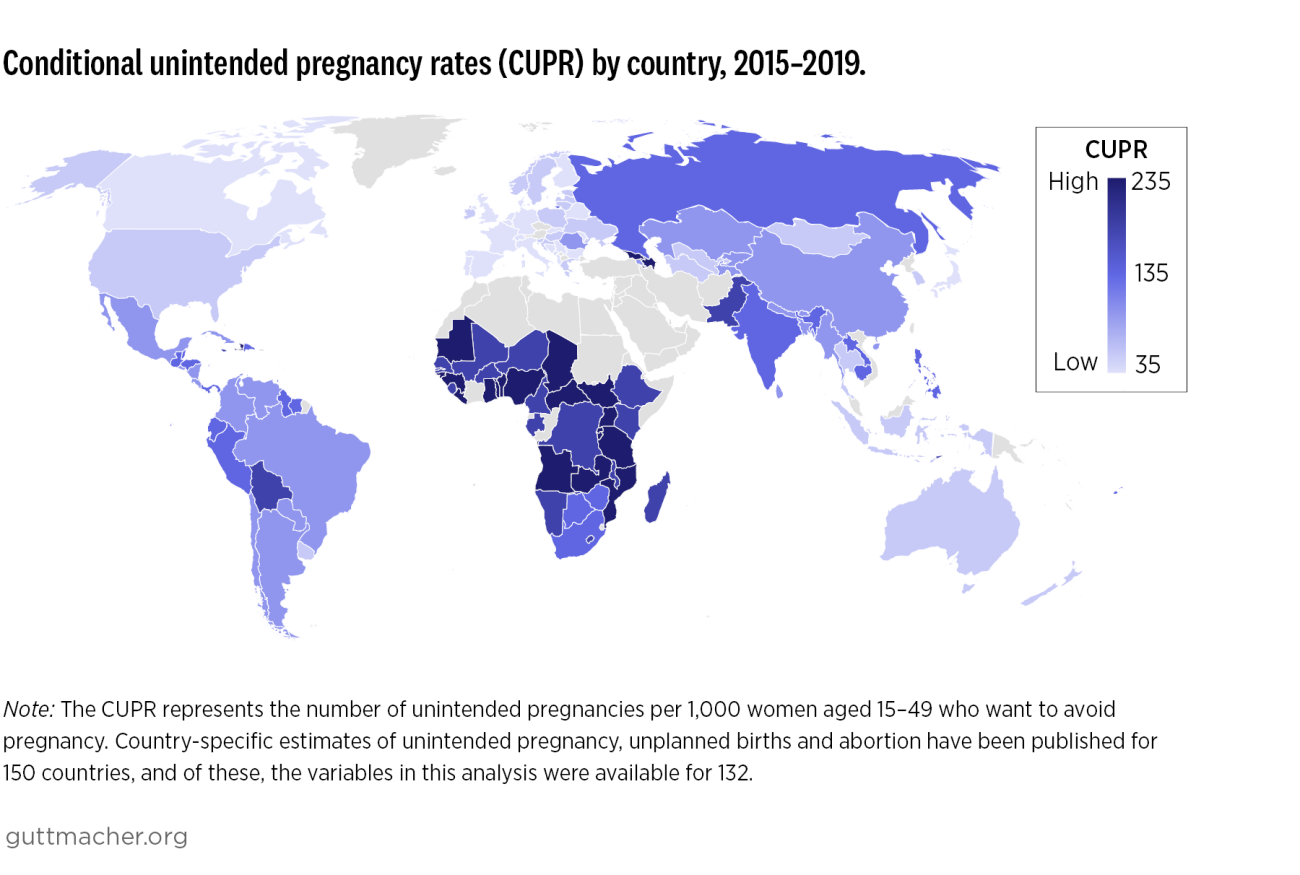
World map of conditional unintended pregnancy rates (CUPR) by country, 2015-2019

A New Approach to Measuring Unintended Pregnancy

Estimating the number of unintended pregnancies is critical to understanding the extent to which women are able to prevent a pregnancy if they desire and whether they can have healthy pregnancies. While the standard UPR measurement assumes that all women of reproductive age (15–49) are at risk of unintended pregnancy, the actual picture is more complex.6 The UPR does not account for differences across settings in the proportion of women who wish to avoid pregnancy, which can obscure the strength of the observed relationship between measures of gender inequality and unintended pregnancy.

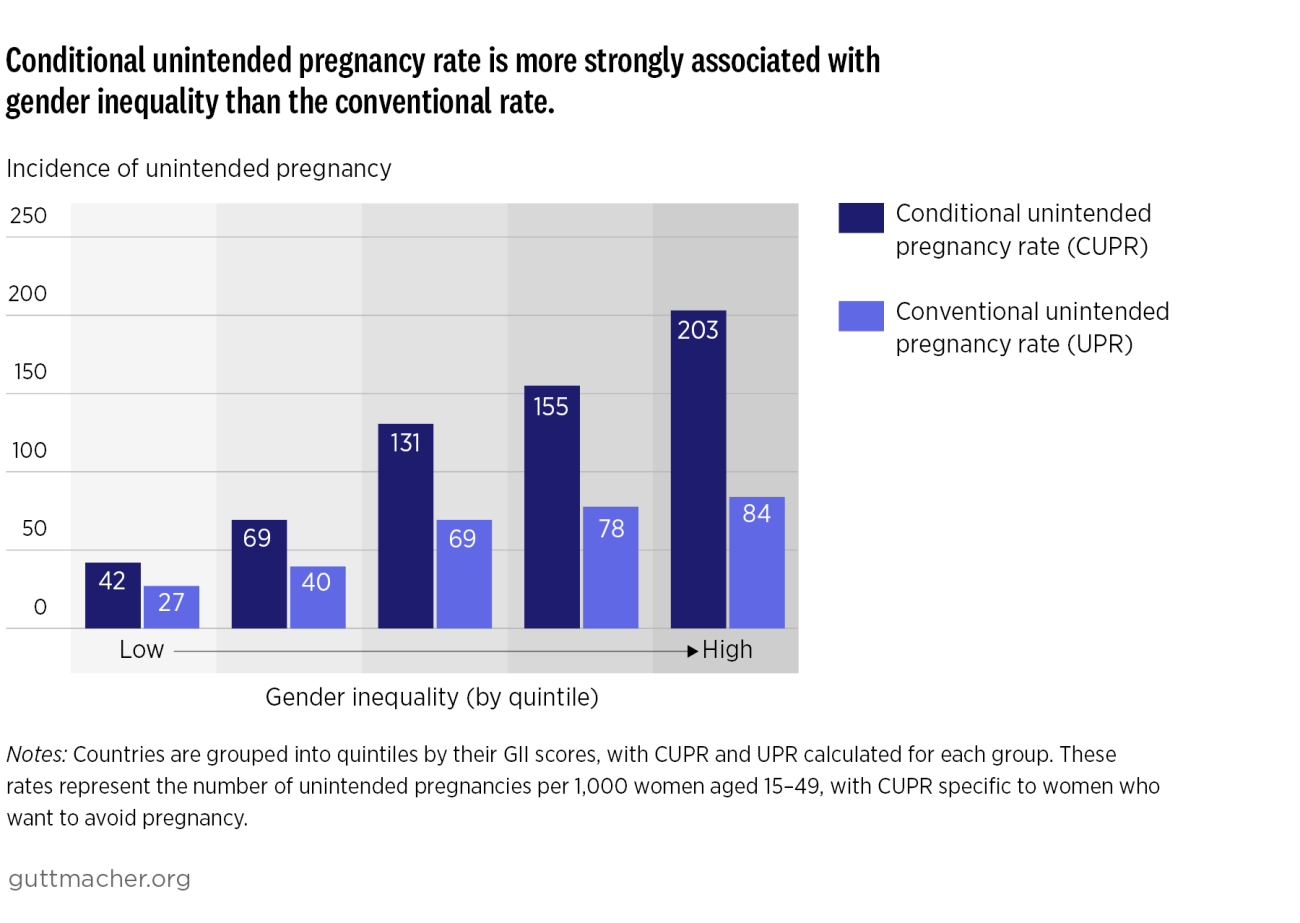
By focusing on women at risk of becoming pregnant who reported wanting to avoid pregnancy, the CUPR provides a more refined metric that can capture previously masked associations and trends. For some regions, the CUPR has identified sharper declines in unintended pregnancy over the time period studied than the UPR, demonstrating the progress that sexual and reproductive health programs have made in providing individuals and couples with the resources they need to avoid pregnancy. In this Guttmacher study, the CUPR yielded critical new insights into the relationship between unintended pregnancy and key components of gender inequality, such as gender gaps in economic opportunity, education, health and political leadership. To assess these relationships, three composite measures of gender inequality were used: the Gender Inequality Index (GII), the Gender Development Index (GDI), and the Global Gender Gap Index (GGI).

Key Findings

  • The study found that in all time periods from 1990 to 2019, gender inequality was strongly correlated with the incidence of unintended pregnancy among women wanting to avoid pregnancy. This held true even after accounting for economic development, which often occurs alongside improvements in gender equality.
  • The component of gender inequality most strongly correlated with unintended pregnancy was educational attainment: countries where women had lower educational attainment than men were found to have higher rates of unintended pregnancy.
  • Using the new CUPR measure, the study found the relationship between gender inequality and unintended pregnancy to be even stronger than previously estimated. As gender inequality decreases, educational and employment opportunities for women increase and women may have more control over their reproductive decision-making.
  • The strong relationship between gender inequality and unintended pregnancy suggests that social and structural barriers impact women’s desires for pregnancy while also limiting their ability to act on their reproductive preferences, make informed decisions about their reproductive health, and access necessary care. By accounting for changes over time that impact the number of women wanting to avoid pregnancy, the CUPR more clearly measures the relationship between gender inequality and unintended pregnancy.
Conditional unintended pregnancy rate is more strongly associated with gender inequality than the conventional rate

Recommendations

  • The new CUPR measure should be applied alongside the standard UPR when assessing needs, tracking progress and mapping investments in relevant SRH programs. The standard UPR measure can provide insight into the overall prevalence of unintended pregnancy, while the CUPR can reveal differences across settings and highlight trends over time in reproductive health outcomes. Leveraging both measures can strengthen advocacy, inform evidence-based policymaking and help target resources more effectively.  
  • Decision-makers and advocates working on development priorities and the implementation of the SDGs should address gender inequality as a structural determinant of reproductive health, given its impact on women’s ability to prevent unintended pregnancies and to access quality sexual and reproductive health services.
  • Research on global health and development priorities should recognize that investments in reducing gender inequality are also investments in reproductive health. And that when women have access to quality reproductive health services, they are better able to take advantage of new opportunities in education and employment.  
  • Efforts to change patriarchal social norms and values should be understood as public health priorities and funded alongside campaigns to expand contraceptive access and advance other SRH goals.  
  • Gender equality and sexual and reproductive health and rights should not be treated as isolated priorities, especially in the development context. Progress on SDG 3 (health) and on SDG 5 (gender equality) are deeply interconnected, and investments in one area reinforce gains in the other. Recognizing this interdependence is essential to accelerating progress across the 2030 Agenda.

Source

The primary information in this fact sheet can be found in Sedgh G and Bearak JM, Unintended pregnancy and gender inequality worldwide: an ecological analysis, BMJ Global Health, 2025, 10(3):e016573, https://doi.org/10.1136/bmjgh-2024-016573.

1. United Nations Department of Economic and Social Affairs (UN DESA), Sustainable Development: The 17 Goals, https://sdgs.un.org/goals.

2. Sedgh G et al., Sexual and reproductive health and rights and global development, Studies in Family Planning, 2025, 56(2):232–242, https://doi.org/10.1111/sifp.70016.

3. UN DESA, The Sustainable Development Goals Report 2025, 2025, https://unstats.un.org/sdgs/report/2025/.

4. UN DESA, Goal 3: Ensure healthy lives and promote well-being for all at all ages, https://sdgs.un.org/goals/goal3#targets_and_indicators.

5. UN DESA, Goal 5: Achieve gender equality and empower all women and girls, https://sdgs.un.org/goals/goal5#targets_and_indicators.

6. Bearak JM et al., Alignment between desires and outcomes among women wanting to avoid pregnancy: a global comparative study of "conditional" unintended pregnancy rates, Studies in Family Planning, 2023, 54(1):265–280, https://doi.org/10.1111/sifp.12234.

References

1. United Nations Department of Economic and Social Affairs (UN DESA), Sustainable Development: The 17 Goals, https://sdgs.un.org/goals.

2. Sedgh G et al., Sexual and reproductive health and rights and global development, Studies in Family Planning, 2025, 56(2):232–242, https://doi.org/10.1111/sifp.70016.

3. UN DESA, The Sustainable Development Goals Report 2025, 2025, https://unstats.un.org/sdgs/report/2025/.

4. UN DESA, Goal 3: Ensure healthy lives and promote well-being for all at all ages, https://sdgs.un.org/goals/goal3#targets_and_indicators.

5. UN DESA, Goal 5: Achieve gender equality and empower all women and girls, https://sdgs.un.org/goals/goal5#targets_and_indicators.

6. Bearak JM et al., Alignment between desires and outcomes among women wanting to avoid pregnancy: a global comparative study of "conditional" unintended pregnancy rates, Studies in Family Planning, 2023, 54(1):265–280, https://doi.org/10.1111/sifp.12234.

Acknowledgments

Floriane Borel and Allegra Udell. It was edited by Ian Lague. The project on which this fact sheet is based was undertaken with financial support from the Gates Foundation, the Children's Investment Fund Foundation, Global Affairs Canada and the Hewlett Foundation. The contents of this publication are the sole responsibility of the Guttmacher Institute and do not necessarily reflect the viewpoints of the funders.

Gates Foundation, Children's Investment Fund Foundation, Global Affairs Canada, Hewlett Foundation logos

Share

Reproductive rights are under attack. Will you help us fight back with facts?

Donate

Read More

Research Article

Unintended pregnancy and gender inequality worldwide: an ecological analysis

BMJ Global Health
Research Article

Progress towards sustainable development goals related to sexual health

Bulletin of the World Health Organization
Research Article

Capturing pregnancy recognition trajectories: a critical reflection of new quantitative measures tested in Ethiopia, Malawi, Nigeria and Zambia

Sexual and Reproductive Health Matters

Topic

Global

  • Abortion
  • Our work: Abortion Worldwide
  • Pregnancy

Geography

  • Global

Tags

Sustainable Development Goals (SDGs)
Guttmacher Institute

Center facts. Shape policy.
Advance sexual and reproductive rights.®

Donate Now
Newsletter Signup  Contact Us 
  • X
  • Facebook
  • Instagram
  • Youtube
  • LinkedIn
  • Contact

Footer

  • Privacy Policy
  • Accessibility Statement
© 2025 Guttmacher Institute. The Guttmacher Institute is registered as a 501(c)(3) nonprofit organization under the tax identification number 13-2890727. Contributions are tax deductible to the fullest extent allowable.
