
Updated May 7, 2025. See note below.
New data from the Guttmacher Institute reaffirm that medication abortion is a fundamental component of abortion provision in states across the country, even as anti-abortion policymakers use all levers of government to target this safe and effective method of abortion care. For the first time, Guttmacher’s Monthly Abortion Provision Study includes state-level estimates of the proportion of abortions provided via medication in 2023 in states without total abortion bans. It also provides state-level data on the proportion of abortions provided by online-only clinics in 2023.
As we learn more about how people access abortion care across the states in a post-Roe v. Wade environment, many policy attacks on medication abortion now target telemedicine provision or attempt to unnecessarily complicate the process of prescribing and dispensing medication abortion in person. And, despite clear medical evidence demonstrating the safety and efficacy of medication abortion obtained in-person or online, anti-abortion policymakers often ignore that evidence and promote false claims about risks.
Latest Findings on Medication Abortion Provision by State
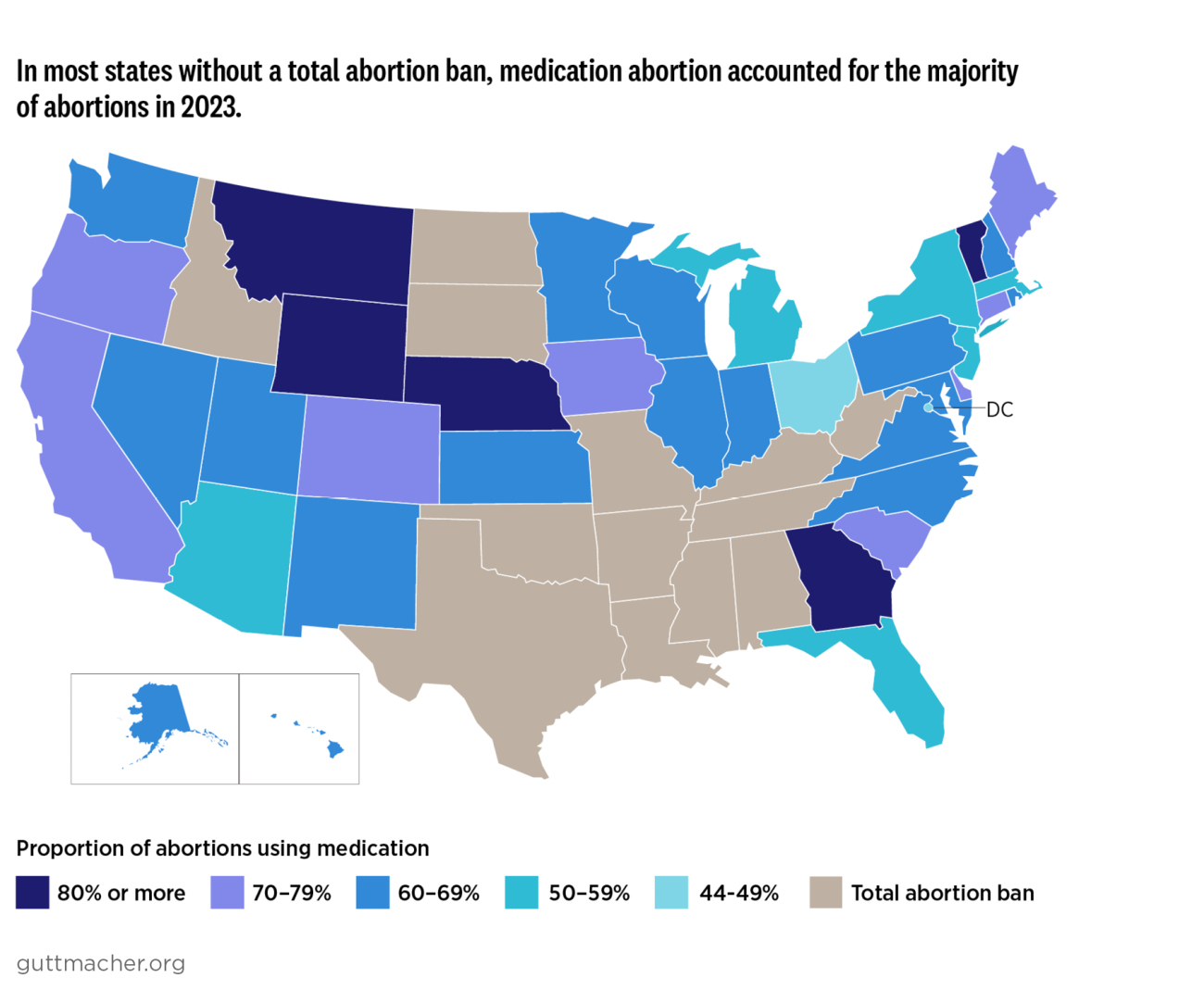
Per the most recent data, medication abortion accounts for the majority of abortions provided in most US states without total abortion bans. These results expand on Guttmacher’s finding that medication abortions accounted for 63% of all clinician-provided abortions in 2023 in states without total abortion bans. Proportions of medication abortion provision were lowest in the District of Columbia (44%) and Ohio (46%), and highest in Wyoming (95%) and Montana (84%; see table).
Our counts include medication abortion prescribed at an in-person clinic visit, or via telemedicine from a brick-and-mortar or online-only clinic (including from out-of-state providers operating under the protection of shield laws), for states without total abortion bans. The new estimates indicate that one in 10 (10%) abortions in 2023 were provided by online-only clinics, with proportions ranging from 7% (California, DC and New York) to 60% (Wyoming).