Investments in sexual and reproductive health and rights (SRHR) are among the most cost-effective development interventions available. Supporting SRHR globally saves lives, prevents unintended pregnancies, reduces maternal and newborn mortality, and expands educational and economic opportunities for women, girls and LGBTQIA+ people. The evidence is unequivocal: Funding for sexual and reproductive health is central to resilient health systems, human rights, gender equality and sustainable development.1 Yet, the global financing gap for meeting the sexual and reproductive health needs of women in low- and middle-income countries stands at US$54 billion.2 In the current context of decreasing foreign aid and increasing ideological attacks, having predictable, multiyear, bold commitments to SRHR will ensure that services and programs can continue to be provided.
Norway’s Support for SRHR
At the 2019 Nairobi Summit on ICPD25, Norway committed approximately NOK10.4 billion to protect and promote SRHR, including NOK9.6 billion (for 2020–2025) for SRHR programs and NOK760 million (for 2020–2023) for the elimination of harmful practices.3 Politically, this represented a Norwegian commitment to defend established norms and universal rights, and to make gender equality a central objective of its bilateral assistance.4,5
Norway consistently allocates around 1% of gross national income to official development assistance (ODA)—NOK55.7 billion in 20246 —and total funding for SRHR accounted for 4.7% of Norwegian ODA in 2024.7 Norway is currently the single-largest core donor to the United Nations Population Fund (UNFPA),8 contributing NOK589.6 million annually in 2024 and 2025, with the same level committed for 2026.9 Norway’s global SRHR investments focus on three priorities: comprehensive sexuality education; comprehensive, safe and legal abortion; and contraceptives and access to sexual and reproductive health services.10 Norad partners with civil society, multilateral organizations and government actors to reach women, adolescents, young people and other underserved populations in low-income countries with high SRHR needs in order to advance these goals.
Impact of Norway’s Investment in Family Planning
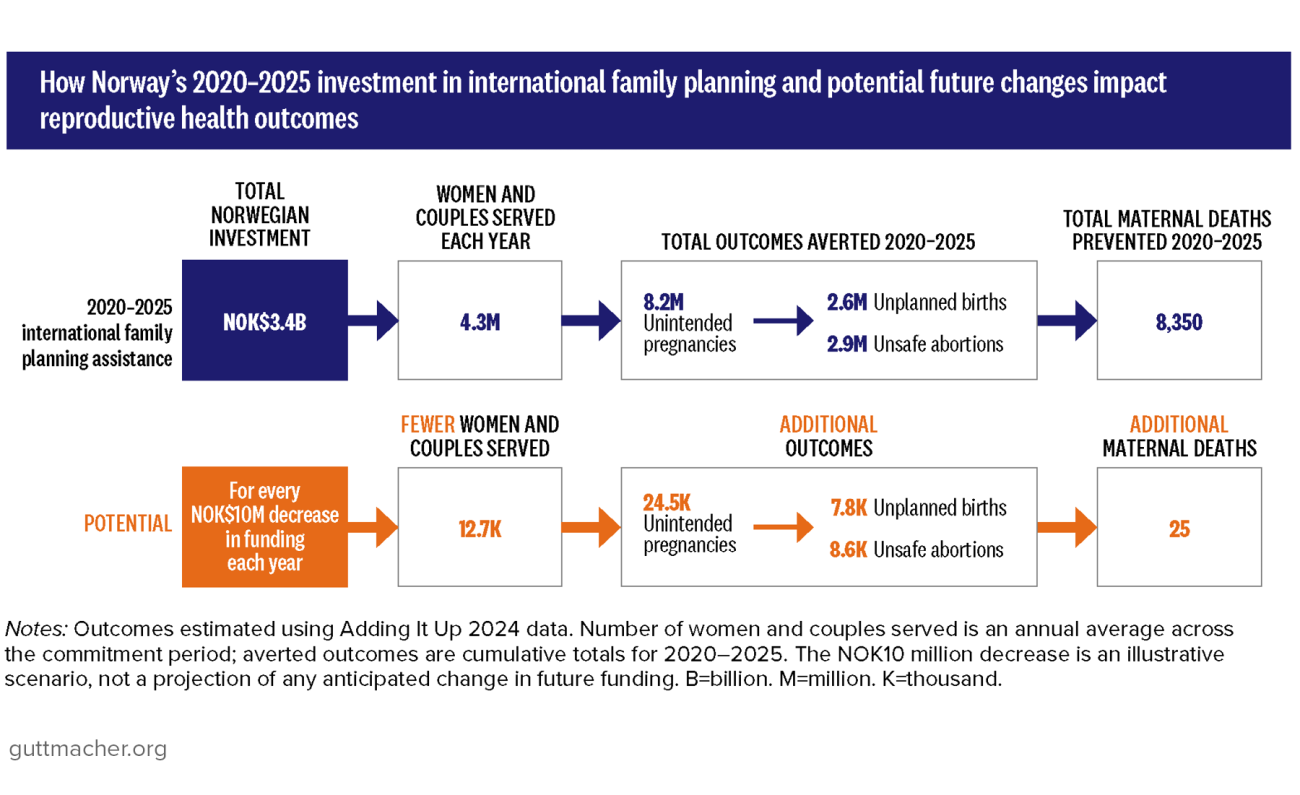
Norway’s comprehensive support for SRHR includes critical investments in contraceptive care. Over the 2020–2025 commitment period, Norway’s international assistance specifically for family planning is estimated at NOK3.4 billion (US$313 million), an average of NOK561 million per year, or roughly one-third of the value of its total SRHR commitment.* The amount of family planning assistance disbursed each year during this time period varied, starting at NOK497 million (US$46.2 million) in 2020, reaching a peak of NOK667 million (US$62.1 million) in 2024, and dropping slightly at the end of the commitment period to NOK652 million (US$60.7 million) in 2025.
These investments delivered measurable, lifesaving results. From 2020 to 2025, Norwegian funding provided modern contraceptive methods to an average of 4.3 million women and couples each year. Norway’s family planning funding supported 3.7 million users in 2020, which rose to 5.2 million users served modern contraceptive care in 2024. Across the full commitment period, Norway’s investment in contraceptive services averted an estimated 8.2 million unintended pregnancies in low- and middle-income countries—avoiding 2.9 million unsafe abortions and 2.6 million unplanned births—and prevented 8,350 maternal deaths.