
Guttmacher Institute

Search

  • X
  • Facebook
  • Instagram
  • Youtube
  • LinkedIn
  • Contact

Highlights

  • Reproductive Health Impact Study
  • Adding It Up
  • Abortion Worldwide
  • Guttmacher-Lancet Commission
  • US policy resources
  • State policy resources
  • International Perspectives on Sexual and Reproductive Health (1975–2020)
  • Perspectives on Sexual and Reproductive Health (1969–2020)

Reports

  • Global
  • United States

Articles

  • Global research
  • US research
  • Policy analysis
  • Guttmacher Policy Review
  • Opinion

Fact Sheets

  • Global
  • United States
  • US State Laws and Policies

Tools

  • Interactive Map: US Abortion Policies and Access After Roe
  • Family Planning Investment Impact Calculator
  • Monthly Abortion Provision Study Dashboard
  • State legislation tracker
  • Public-use data sets

Global

  • Abortion
  • Contraception
  • Pregnancy
  • Teens

US

  • Abortion
  • Contraception
  • Pregnancy
  • Teens

Our Work by Geography

  • Global
  • Africa
  • Asia
  • Europe
  • Latin America & the Caribbean
  • Northern America
  • Oceania

Who We Are

  • About
  • Staff
  • Board
  • Job opportunities
  • Newsletter
  • History
  • Contact
  • Conflict of Interest Policy

Media

  • Media office
  • News releases

Support Our Work

  • Make a gift today
  • Monthly Giving Circle
  • Ways to Give
  • Guttmacher Guardians
  • Guttmacher Legacy Circle
  • Financials
  • Impact Report 2025

Awards & Scholarships

  • Darroch Award
  • Richards Scholarship
  • Bixby Fellowship
Donate
Guttmacher Institute
Donate

Highlights

  • Reproductive Health Impact Study
  • Adding It Up
  • Abortion Worldwide
  • Guttmacher-Lancet Commission
  • US policy resources
  • State policy resources
  • International Perspectives on Sexual and Reproductive Health (1975–2020)
  • Perspectives on Sexual and Reproductive Health (1969–2020)

Reports

  • Global
  • United States

Articles

  • Global research
  • US research
  • Policy analysis
  • Guttmacher Policy Review
  • Opinion

Fact Sheets

  • Global
  • United States
  • US State Laws and Policies

Tools

  • Interactive Map: US Abortion Policies and Access After Roe
  • Family Planning Investment Impact Calculator
  • Monthly Abortion Provision Study Dashboard
  • State legislation tracker
  • Public-use data sets

Global

  • Abortion
  • Contraception
  • Pregnancy
  • Teens

US

  • Abortion
  • Contraception
  • Pregnancy
  • Teens

Our Work by Geography

  • Global
  • Africa
  • Asia
  • Europe
  • Latin America & the Caribbean
  • Northern America
  • Oceania

Who We Are

  • About
  • Staff
  • Board
  • Job opportunities
  • Newsletter
  • History
  • Contact
  • Conflict of Interest Policy

Media

  • Media office
  • News releases

Support Our Work

  • Make a gift today
  • Monthly Giving Circle
  • Ways to Give
  • Guttmacher Guardians
  • Guttmacher Legacy Circle
  • Financials
  • Impact Report 2025

Awards & Scholarships

  • Darroch Award
  • Richards Scholarship
  • Bixby Fellowship
Donate
  • X
  • Facebook
  • Instagram
  • Youtube
  • LinkedIn
  • Contact
Report
October 2025

Adding It Up 2024: Investing in Sexual and Reproductive Health in Low- and Middle-Income Countries

Adding It Up global report

Author(s)

Elizabeth A. Sully, Jessica D. Rosenberg, Mira Tignor, Christina E. Geddes, Ana Dilaverakis Fernandez and Chelsea Polis

Reproductive rights are under attack. Will you help us fight back with facts?

Donate

Adding It Up is a research initiative that examines the need for, impact of and costs associated with fully investing in sexual and reproductive health (SRH) care in low- and middle-income countries (LMICs) around the world. These services enable individuals to make informed decisions about whether and when to have children, experience safe pregnancy and delivery, support the health of their newborns, and maintain their sexual and reproductive well-being.

The estimates pertain to women of reproductive age (15–49) in 128 LMICs in 2024, and cover the following services: contraception, maternal and newborn care, abortion care and treatment for the major curable STIs. All cost estimates and savings are calculated in 2024 US dollars.

The need for robust estimates on sexual and reproductive health financing has never been more urgent. Funding is shrinking, and yet unmet need for care persists across LMICs, creating a widening gap between available resources and the investment required to meet women’s needs. In this increasingly constrained funding environment, evidence that accurately reflects women’s contraceptive needs and quantifies the true scale of financing gaps is critical in making the case for sustained and increased investment in contraceptive and broader sexual and reproductive health care.

New Estimates in Adding It Up 2024

A major update in the 2024 Adding It Up study is how “unmet need” for contraception is defined. This new approach considers not only whether a woman is currently using modern contraception, but also whether she expresses interest in using it in the future. This shift creates a more person-centered way of measuring contraceptive need.

Why it matters: The calculation of unmet need helps determine how much additional funding is required for contraceptive services and, in turn, how many unintended pregnancies could be prevented with greater investment.

Previous approach: Earlier Adding it Up studies defined unmet need to include women who wanted to avoid pregnancy but were not using a modern contraceptive method. That measure assumed that all women in this situation wanted to adopt modern contraception, and it did not recognize that some women may already feel their needs are met by using traditional methods, such as withdrawal, abstinence or breastfeeding.*

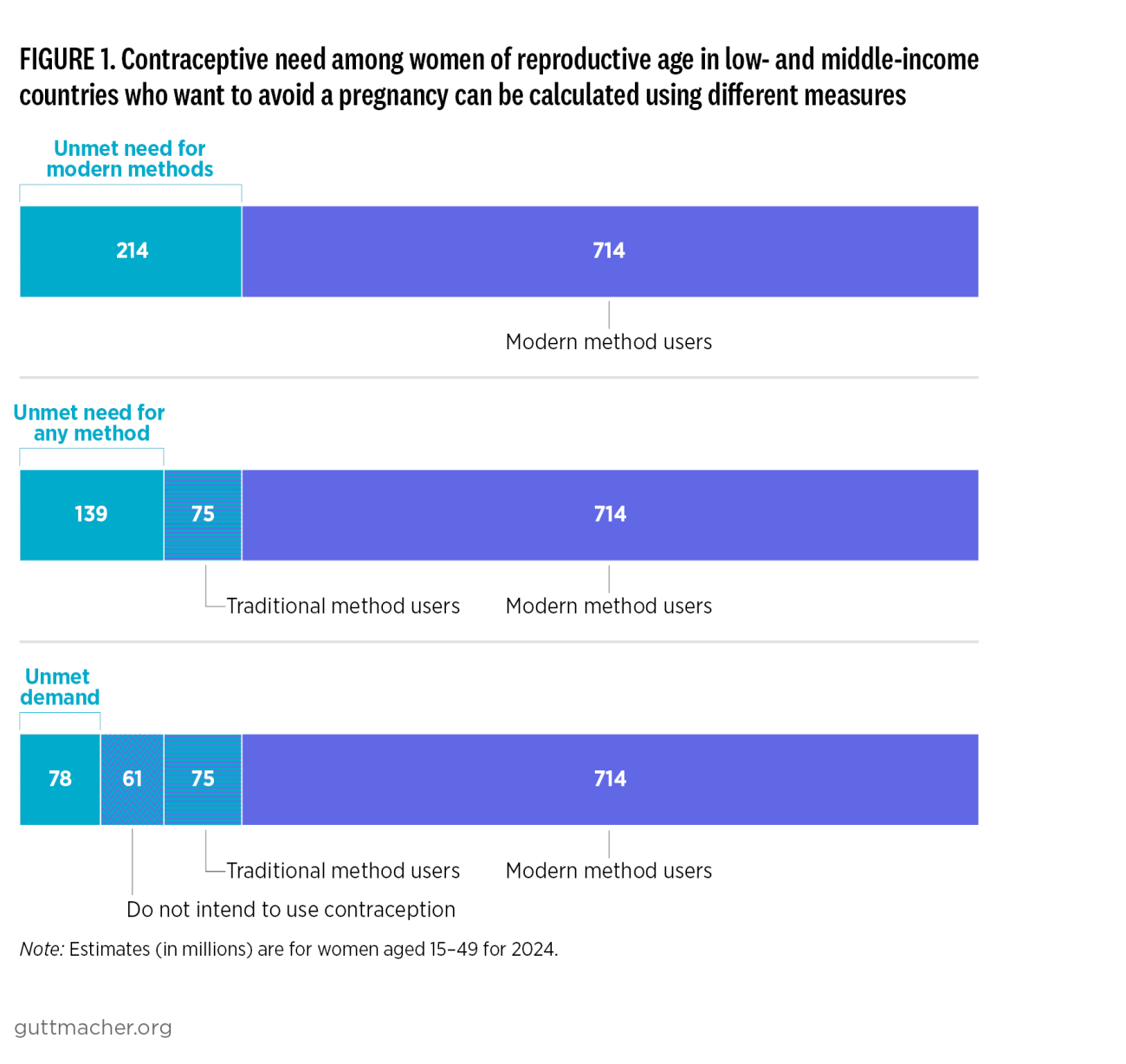
New approach: The 2024 study provides three different ways to measure unmet need, from narrowest to broadest. The narrowest definition is called “unmet demand”1 and focuses specifically on women who want to avoid pregnancy and say they are interested in or open to using contraception in the future. This makes the estimates more grounded in women’s own preferences.
Definitions of Unmet Need for Contraception

Narrowest (unmet demand): Women who want to avoid pregnancy, are not using any contraceptive method, and say they intend to use contraception in the future or are open to future use 
This new definition is featured in this report. 

Intermediate (unmet need for any method): Women who want to avoid pregnancy and are not using any contraceptive method (modern or traditional)

Broadest (unmet need for modern methods): Women who want to avoid pregnancy and are not using a modern contraceptive method

The broadest definition, which counts all women wanting to avoid pregnancy and not using modern methods, aligns with the one used in previous Adding It Up studies and is included in global monitoring systems, such as the United Nations’ Sustainable Development Goals and the FP2030 Measurement Framework. The broadest definition is important for considering the maximum recommended investment, but it is not the most appropriate estimate of actual need for contraception.

Estimates in this report are based on the narrowest measure: unmet demand. Focusing on this group helps prioritize limited resources, while recognizing that broader investments will ultimately be needed to reach the many other women who also face barriers to contraceptive care.

Current Use of Contraception and Pregnancy Outcomes

  • In LMICs, 714 million women are currently using modern contraception and a further 75 million are relying on traditional methods. The types of modern contraceptive methods currently used range widely. For example, 47% of modern method users rely on short-acting methods, 21% on long-acting reversible methods and 31% on sterilization.
  • Contraceptive use of any method (including traditional methods) among women who want to avoid pregnancy is higher among all women aged 15–49 (85%) than among adolescents alone (66% of those aged 15–19).
  • Out of 928 million women of reproductive age in 128 LMICs who want to avoid pregnancy, approximately 78 million have an unmet demand for contraception.
  • Unmet demand for contraception among women who want to avoid pregnancy is about three times as high among adolescents aged 15–19 (25%) as it is among all women aged 15–49 (8%).
Figure 1. Contraceptive need among women of reproductive age in low- and middle-income countries who want to avoid a pregnancy can be calculated using different measures
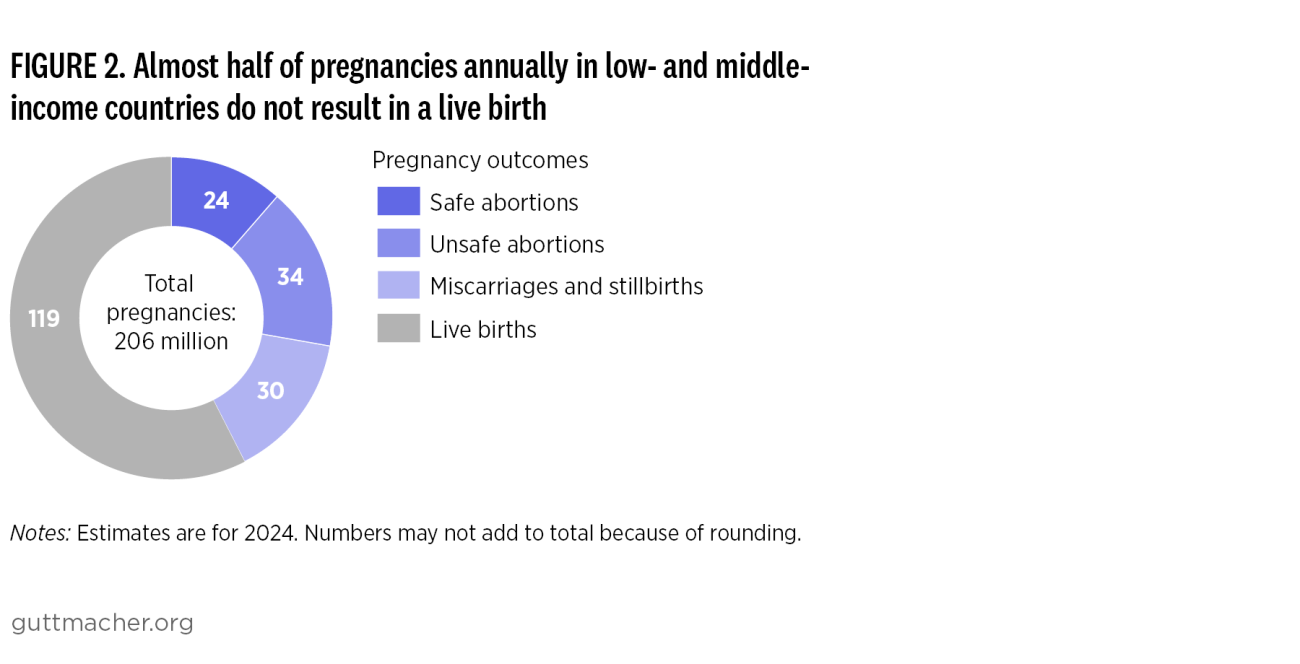
  • Out of 206 million pregnancies that occur in LMICs each year, an estimated 119 million (58%) result in a live birth. The remaining 87 million pregnancies result in abortions, miscarriages and stillbirths. Women need to be able to access care for all pregnancy outcomes.
  • Each year, 96 million unintended pregnancies occur in LMICs, accounting for 47% of all pregnancies in those countries. The majority (59%) of unintended pregnancies end in abortions and 29% end in unplanned births.
Figure 2. Almost half of pregnancies annually in low- and middle-income countries do not result in a live birth

Needs for Sexual and Reproductive Health Services

In addition to unmet need for contraception, women in LMICs have a range of other SRH needs that are not being fully met.

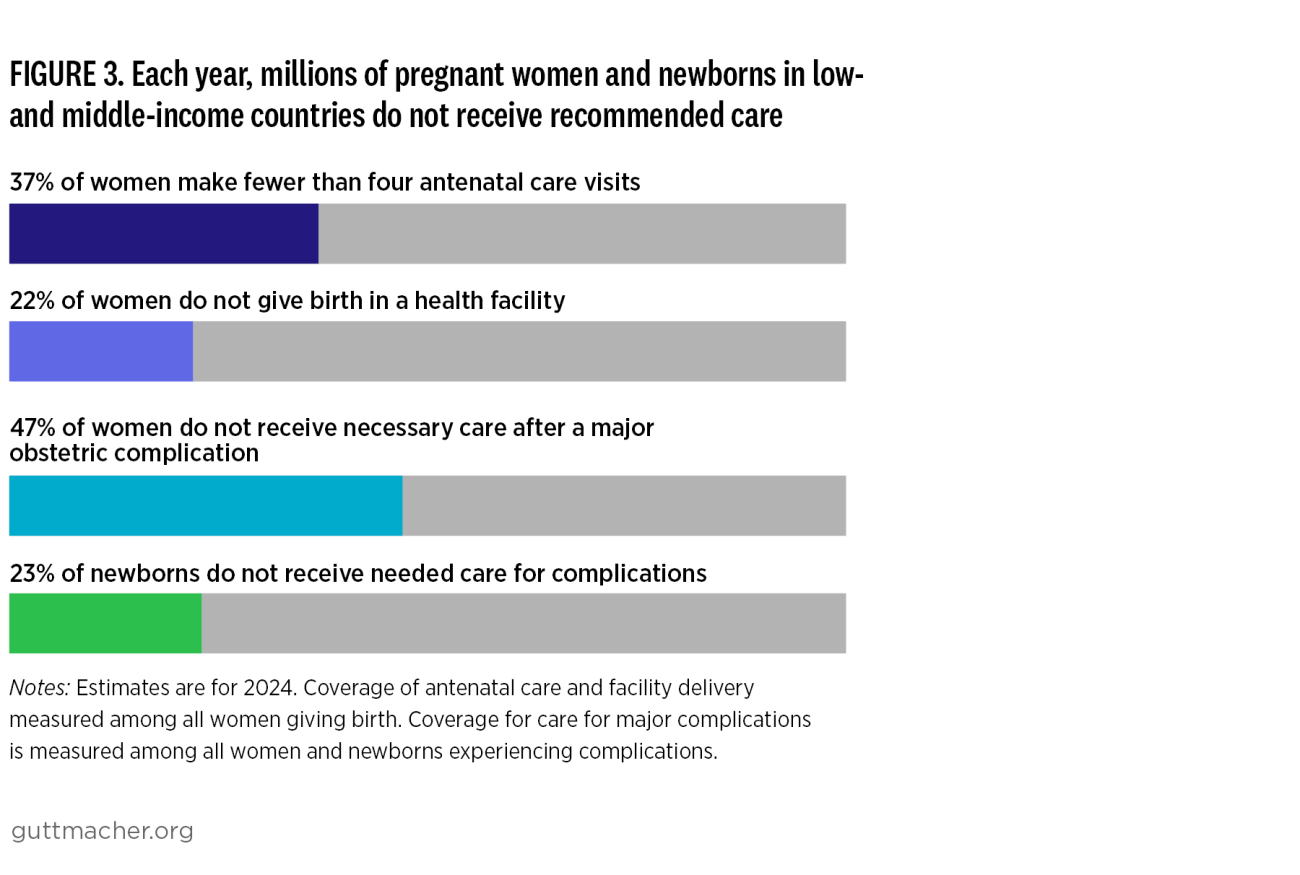
  • Insufficient access to maternal and newborn health care puts women and infants at risk. Each year, 119 million women in LMICs give birth and many do not receive recommended care in accordance with World Health Organization guidelines.
    • 44 million make fewer than four antenatal care visits
    • 26 million do not give birth in a health facility
    • 13 million do not receive necessary care after a major obstetric complication
  • The use of maternal health services varies widely and is lowest in the poorest countries. For example, only 61% of women in low-income countries give birth in a health facility, compared with 95% in upper-middle–income countries.
  • Furthermore, each year in LMICs:
    • 6 million newborns do not receive necessary care for infections and other neonatal health problems
    • 34 million women have unsafe abortions
    • 247,000 women die from causes related to pregnancy, abortion and childbirth
    • 143 million women do not receive the treatment they need for chlamydia, gonorrhea, syphilis and trichomoniasis
FIGURE 3. Each year, millions of pregnant women and newborns in low- and middle-income countries do not receive recommended care

Impact of Expanded and Improved SRH Services

Meeting contraceptive need has enormous benefits for women’s health. Those benefits are multiplied when combined with meeting their needs for care during pregnancy and childbirth, as well as the needs of their newborns.

  • Unintended pregnancies and unsafe abortions in LMICs would drop by about one-third if all women with an unmet demand used modern contraception and all pregnant women received care that meets international standards. By meeting all SRH care needs, maternal deaths would drop by about two-thirds.
  • If all mothers and their newborns received recommended care, newborn deaths would drop by 66%, and new HIV infections among babies six weeks and younger would drop by 88%.
  • Cases of infertility-causing pelvic inflammatory disease from untreated chlamydia or gonorrhea would be eliminated if all women infected with these two STIs were given effective and timely treatment.

Important note about these estimates

The estimates on costs and impacts of meeting all needs for maternal and newborn health care in this report are based on access to the relevant services, without accounting for whether health care facilities have the necessary equipment, supplies and capacity to provide these services.

The 2024 Adding It Up study features new calculations using data from the Lives Saved Tool, which accounts for how ready health facilities are to offer services.2 When factoring in whether facilities are equipped to provide quality care, significantly fewer people would receive these services.

For example, when estimating effective coverage of health services:

  • 75% of women would not receive care for major obstetric complications, compared with 47% in our current coverage estimates.
  • 36% of newborns would not receive needed care for complications, compared with 23% in our current coverage estimates.

As a result of health facilities lacking the necessary capacity, the 2024 study likely overestimates how many people could receive quality SRH services. Because of limited data available across LMICs, however, these estimates of effective coverage were not factored into the impacts and costs included in this report.

Bottom line: Meeting needs for pregnancy-related health care requires more than providing access, it also involves ensuring health facilities are equipped and ready to provide these essential services.

The Investment Case for Meeting All SRH Needs in LMICs

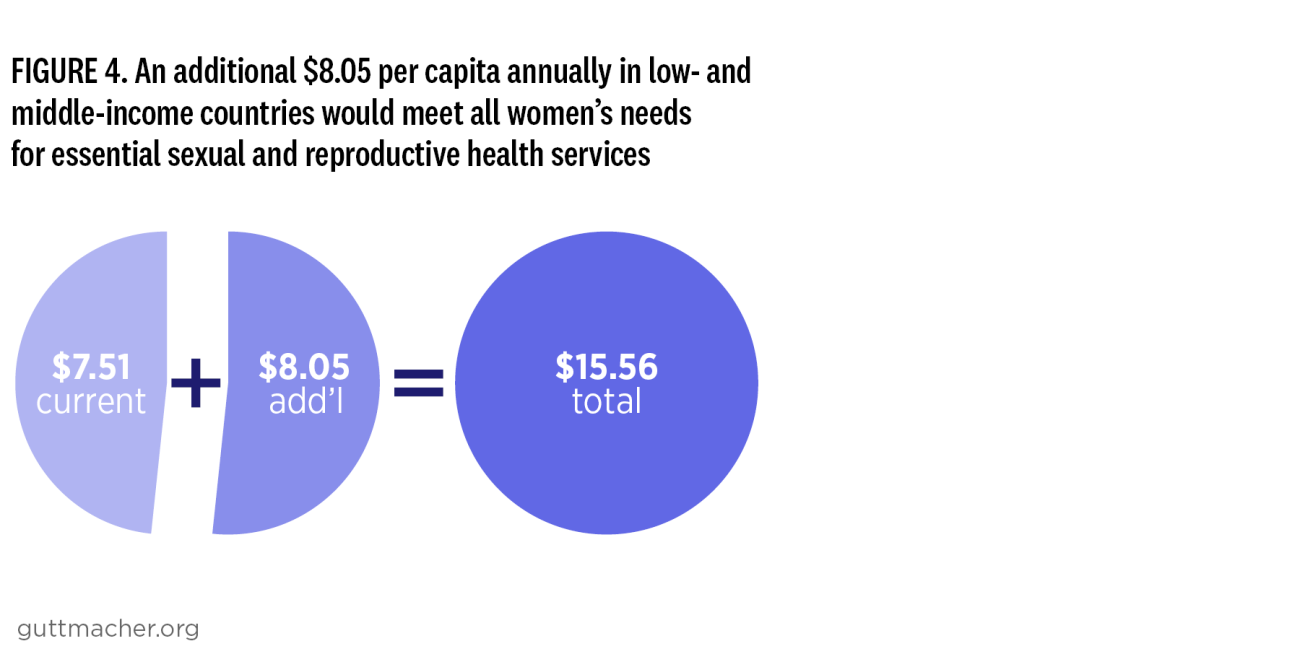
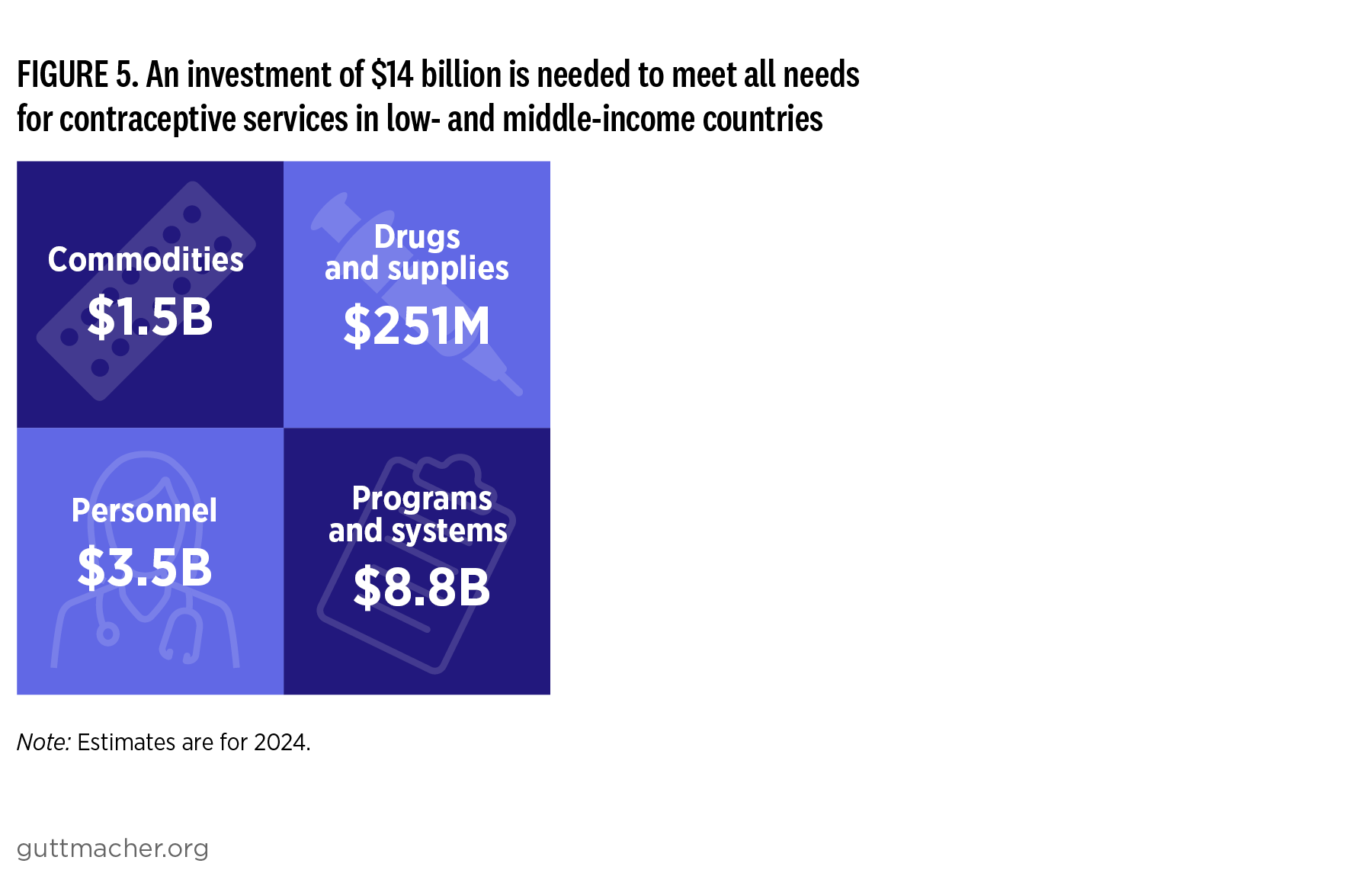
A package of SRH care that would meet all needs for women in LMICs—unmet demand for contraception, all maternal and newborn care, abortion services and treatment for the four major curable STIs—would cost $104 billion annually. This includes $14.0 billion for all contraceptive care, $86.7 billion for pregnancy-related and newborn care, and $3.7 billion for STI care.

This total represents a $54 billion annual increase, more than double the $50.4 billion cost of current SRH care in the 128 LMICs. On a per capita basis, the increase is just $8.05 per year.

Figure 4. An additional $8.05 per capita annually in low- and middle-income countries would meet all women's needs for essential sexual and reproductive health services

With an investment in a comprehensive package of SRH services:

  • all women of reproductive age would receive the pregnancy-related and STI care that they need;
  • all newborns would receive essential care just after birth; and
  • all women would receive the contraceptive services they need to decide whether and when to have children.

These gains would reduce the substantial health system costs in LMICs and offer a high return on investment. In addition, the interventions in this package of services have proven to be feasible to implement in diverse settings around the world.

The total cost of SRH care decreases when more women who want to use contraception are able to do so. The decrease in unintended pregnancies that would result from an increase in contraceptive use means large reductions in the need for services such as abortion and postabortion care, antenatal and delivery care, and neonatal care.

Achieving this vision requires addressing a critical funding challenge for contraceptive care needs.

The Gap in Financing for Contraceptive Care

Despite persistent unmet contraceptive need in LMICs, donor investments in contraceptive care are declining. Without immediate resource mobilization, the gap between available funding and the $14.0 billion needed annually will continue to widen.

  • It currently costs $9.25 billion to provide contraceptive care in LMICs, including $4.61 billion in direct costs (commodities, drug supplies and personnel costs).
  • To meet all unmet demand for contraceptive care in LMICs, $4.80 billion in additional investment is needed.
  • It would cost $2.09 per capita annually to meet all contraceptive need across 128 LMICs by providing services to current users and those with an unmet demand.


Figure 5. An investment of $14 billion is needed to meet all needs for contraceptive services in low- and middle-income countries

Savings from Investing in Contraceptive Services

Every dollar spent on contraceptive services beyond the current level would save $2.48 in the cost of maternal, newborn and abortion care because use of contraceptives reduces the number of unintended pregnancies.

Enabling women to have children when they want them and to deliver healthy newborns safely also boosts national economies as women gain greater access to education and participate more fully in the workforce.

  IMMEDIATE RETURN:  $2.48 saved for every $1 invested  LONG-TERM BENEFITS:      More women in education     Increased workforce participation     Stronger national economies

Methodology

The Adding It Up series of studies estimates the need for, costs and impacts of sexual and reproductive health services in 128 LMICs, focusing on contraceptive services, pregnancy-related and newborn care, and treatment for major curable STIs. A key methodological advancement in the 2024 Adding It Up study is examining contraceptive need using three definitions that progressively center women's preferences and future intentions. The analysis employs a scenario-based approach that compares current service levels with hypothetical scenarios of meeting all contraceptive needs, using nationally representative survey data including Demographic and Health Surveys, UNICEF Multiple Indicator Cluster Surveys and other national surveys.

Cost estimates were generated using a bottom-up, ingredients-based approach that covers both direct costs (personnel time, contraceptive commodities, medications, diagnostic tests and supplies) and indirect programs and systems costs (program management, staff supervision, infrastructure, commodity supply systems and health information systems). All estimates are presented as annual costs in 2024 US dollars and assume that additional investments would achieve immediate impacts. Estimates were generated for all 128 LMICs as a whole and by geographic regions and country-level income groups; country-specific profiles are available, along with detailed information on the methodology.3

Suggested Citation

Sully EA et al., Adding It Up 2024: Investing in Sexual and Reproductive Health in Low- and Middle-Income Countries, New York: Guttmacher Institute, 2025, https://www.guttmacher.org/report/adding-it-up-2024-investing-sexual-and-reproductive-health-low-and-middle-income-countries.

DOI: https://doi.org/10.1363/2025.300735

Acknowledgments

This report was written by Elizabeth A. Sully, Jessica D. Rosenberg, Ana Dilaverakis Fernandez and Chelsea Polis, all of the Guttmacher Institute, and Mira Tignor and Christina Geddes, formerly of the Guttmacher Institute. Chris Olah edited the report.

The authors thank Eva Weissman, independent consultant, for her contributions on interventions and for evaluating and compiling direct cost data. They also thank Jacqui Darroch, independent consultant, for her guidance on many aspects of the Adding It Up analysis. They also thank Adebiyi Adesina, independent consultant and formerly of the Guttmacher Institute, for guidance on inflation approaches and costing process review as well as Monica Giuffrida, formerly of the Guttmacher Institute, for data compilation and processing, and Anna Popinchalk, formerly of the Guttmacher Institute, for work on analysis. They also acknowledge the following Guttmacher colleagues (in alphabetical order): Suzette Audam, for data compilation and processing; Jonathan Bearak, for abortion and unintended pregnancy estimates; Jewel Gausman, for assistance with pregnancy-related and newborn care interventions; Meltem Odabaş, for assistance with code review; Onikepe Owolabi, for her guidance and medical expertise on treatment assumptions; and Lisa Remez, for her contributions to the drafting process. 

We thank Evelyn Rivera and Suzana Cavenaghi, independent consultants, for data processing; Vladimíra Kantorová, Population Division, United Nations Department of Economic and Social Affairs, for guidance on country-specific estimates of family planning indicators; and John Stover, Avenir Health, for guidance on data and estimation from the Spectrum AIDS Impact Model.

This report was supported by the Children's Investment Fund Foundation, Gates Foundation, Global Affairs Canada and the Norwegian Agency for Development Cooperation. The findings and conclusions contained within are those of the authors and do not necessarily reflect positions or policies of the donors. 

Footnotes

*The Adding It Up study follows the World Health Organization’s recommendation to classify use of herbs, charms and vaginal douching as using no method because there is no scientific basis for the efficacy of these methods in preventing pregnancy.

References

1. Moreau C et al., Measuring unmet need for contraception as a point prevalence, BMJ Global Health, 2019, 4(4):e001581, https://doi.org/10.1136/bmjgh-2019-001581.

2. Institute for International Programs, Johns Hopkins Bloomberg School of Public Health, Johns Hopkins University, Lives Saved Tool, Spectrum Version 6.36, Apr. 19, 2024, https://www.livessavedtool.org/listspectrum.

3. Rosenberg JD et al., Adding It Up 2024: Investing in Sexual and Reproductive Health in Low- and Middle-Income Countries—Methodology Report, New York: Guttmacher Institute, 2025, available at https://osf.io/hrw6f.

Share

View in:

English , Español , Français

Read More

Initiative

Adding It Up: Investing in Sexual and Reproductive Health

Policy Analysis

It Is Time to Take a New Approach to Measuring Contraceptive Need Globally: Adopting a Rights-Based Measure in Adding It Up 2024

Research Article

Who pays and what pays off in sexual and reproductive health? A review of the cost and cost-effectiveness of interventions and implications for future funding and markets

The Lancet

Topic

Global

  • Abortion: Cost
  • Our work: Adding It Up
  • Contraception: Costs and Benefits
  • Pregnancy
  • Teens

Geography

  • Global

Tags

Adding It Up
Guttmacher Institute

Center facts. Shape policy.
Advance sexual and reproductive rights.®

Donate Now
Newsletter Signup  Contact Us 
  • X
  • Facebook
  • Instagram
  • Youtube
  • LinkedIn
  • Contact

Footer

  • Privacy Policy
  • Accessibility Statement
© 2025 Guttmacher Institute. The Guttmacher Institute is registered as a 501(c)(3) nonprofit organization under the tax identification number 13-2890727. Contributions are tax deductible to the fullest extent allowable.