
Guttmacher Institute

Search

  • Facebook
  • Instagram
  • Youtube
  • LinkedIn
  • Contact

Highlights

  • Reproductive Health Impact Study
  • Adding It Up
  • Abortion Worldwide
  • Guttmacher-Lancet Commission
  • US policy resources
  • State policy resources
  • International Perspectives on Sexual and Reproductive Health (1975–2020)
  • Perspectives on Sexual and Reproductive Health (1969–2020)

Reports

  • Global
  • United States

Articles

  • Global research
  • US research
  • Policy analysis
  • Guttmacher Policy Review
  • Opinion

Fact Sheets

  • Global
  • United States
  • US State Laws and Policies

Tools

  • Interactive Map: US Abortion Policies and Access After Roe
  • Family Planning Investment Impact Calculator
  • Monthly Abortion Provision Study Dashboard
  • State legislation tracker
  • Public-use data sets

Global

  • Abortion
  • Contraception
  • Pregnancy
  • Teens

US

  • Abortion
  • Contraception
  • Pregnancy
  • Teens

Our Work by Geography

  • Global
  • Africa
  • Asia
  • Europe
  • Latin America & the Caribbean
  • Northern America
  • Oceania

Who We Are

  • About
  • Staff
  • Board
  • Job opportunities
  • Newsletter
  • History
  • Contact
  • Conflict of Interest Policy

Media

  • Media office
  • News releases

Support Our Work

  • Make a gift today
  • Monthly Giving Circle
  • Ways to Give
  • Guttmacher Guardians
  • Guttmacher Legacy Circle
  • Financials
  • Impact Report 2025

Awards & Scholarships

  • Darroch Award
  • Richards Scholarship
  • Bixby Fellowship
Donate
Guttmacher Institute
Donate

Highlights

  • Reproductive Health Impact Study
  • Adding It Up
  • Abortion Worldwide
  • Guttmacher-Lancet Commission
  • US policy resources
  • State policy resources
  • International Perspectives on Sexual and Reproductive Health (1975–2020)
  • Perspectives on Sexual and Reproductive Health (1969–2020)

Reports

  • Global
  • United States

Articles

  • Global research
  • US research
  • Policy analysis
  • Guttmacher Policy Review
  • Opinion

Fact Sheets

  • Global
  • United States
  • US State Laws and Policies

Tools

  • Interactive Map: US Abortion Policies and Access After Roe
  • Family Planning Investment Impact Calculator
  • Monthly Abortion Provision Study Dashboard
  • State legislation tracker
  • Public-use data sets

Global

  • Abortion
  • Contraception
  • Pregnancy
  • Teens

US

  • Abortion
  • Contraception
  • Pregnancy
  • Teens

Our Work by Geography

  • Global
  • Africa
  • Asia
  • Europe
  • Latin America & the Caribbean
  • Northern America
  • Oceania

Who We Are

  • About
  • Staff
  • Board
  • Job opportunities
  • Newsletter
  • History
  • Contact
  • Conflict of Interest Policy

Media

  • Media office
  • News releases

Support Our Work

  • Make a gift today
  • Monthly Giving Circle
  • Ways to Give
  • Guttmacher Guardians
  • Guttmacher Legacy Circle
  • Financials
  • Impact Report 2025

Awards & Scholarships

  • Darroch Award
  • Richards Scholarship
  • Bixby Fellowship
Donate
  • Facebook
  • Instagram
  • Youtube
  • LinkedIn
  • Contact
Report
March 2026

Full-Year Estimates Show Overall Stability in Abortion Incidence, Decreased Travel and Increased Telehealth Provision

An image of the United States with data lines and roads going through it.

Author(s)

Isaac Maddow-Zimet and Kimya Forouzan

Reproductive rights are under attack. Will you help us fight back with facts?

Donate

This report presents new full-year estimates of the incidence of clinician-provided abortion care and travel across state lines for abortion from Guttmacher’s Monthly Abortion Provision Study. For the first time, these include estimates of telehealth provision to residents of states with total bans; the report also updates prior year estimates to include these states.

By the end of 2025, 13 states had total abortion bans (with limited exceptions) in effect, and six states had six- or twelve-week abortion bans. In addition, a series of blocked and reinstated abortion restrictions in Missouri created major obstacles for people seeking in-person care there, despite a 2024 state constitutional amendment protecting abortion rights. Many residents of states with severe restrictions or total bans obtained care via telehealth from providers in states with shield law protections while others traveled out of state for care.

Taken together, the estimates in this report paint a picture of ongoing shifts in how people—and particularly residents of states with total bans—are accessing abortion care as the US policy and provision landscape continues to change.
What is and is not included in our estimates

The Monthly Abortion Provision Study estimates the number of clinician-provided abortions that take place every month in each US state and nationally. The study collects data on procedural and medication abortions provided at brick-and-mortar health facilities (such as clinics or doctor’s offices), as well as medication abortions provided via telehealth. Study respondents are asked to exclude advance provision of medication abortion pills from the data they provide; estimates also exclude the limited number of abortions provided under exceptions to total bans, and abortions that are not provided by US clinicians (including those provided through community health networks, international clinics, websites or other means). These exclusions mean that these findings represent an underestimate of the total number of abortions nationally.

National Incidence of Clinician-Provided Abortion Was Stable Between 2024 and 2025

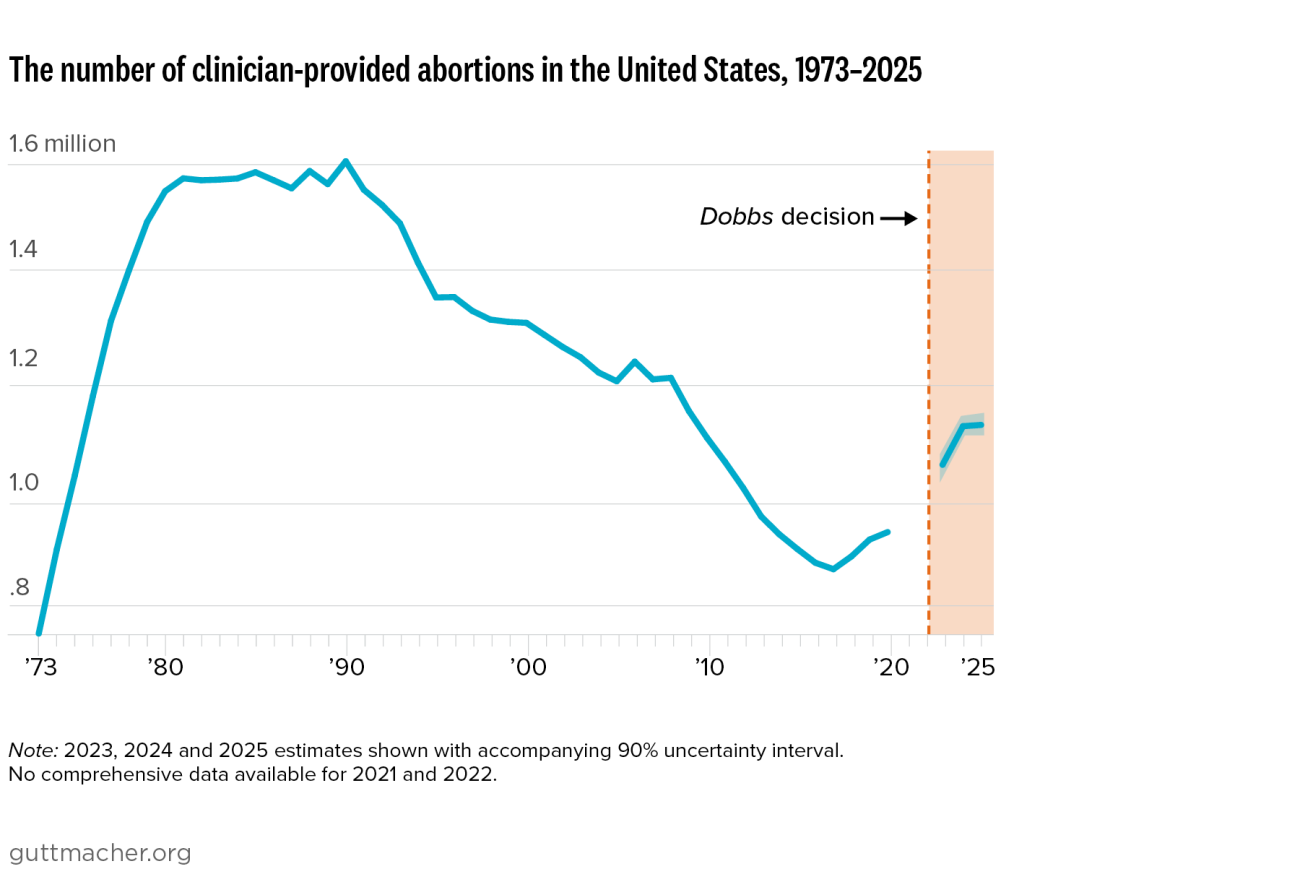
There were an estimated 1,126,000 abortions provided by clinicians in the United States in 2025, largely unchanged from the estimated 1,124,000 provided in 2024.* This is the highest number of abortions provided in the United States since 2009; however, it is still well below the historical peak of slightly over 1.6 million abortions in 1990.

The number of clinician-provided abortions in the United States, 1973–2025

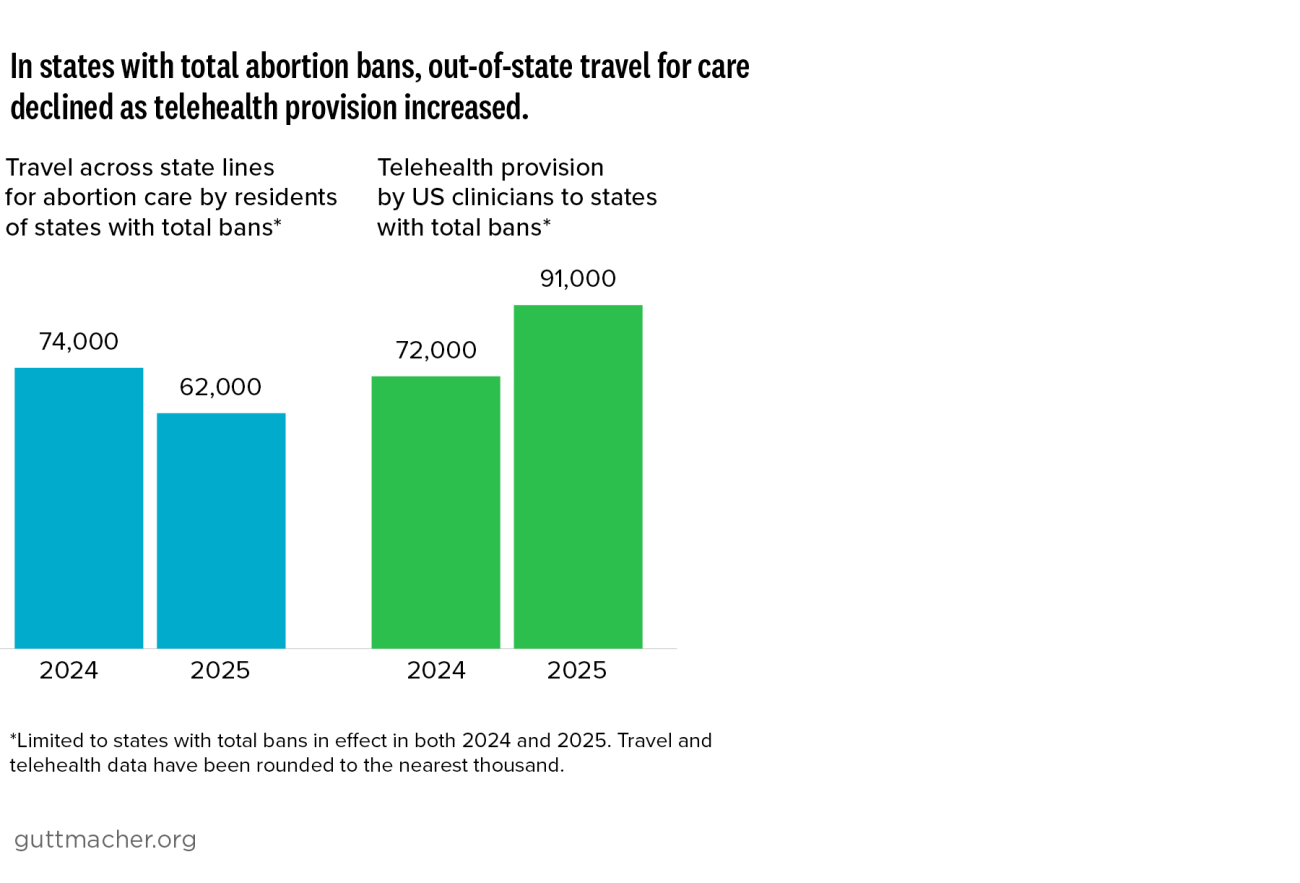
Although overall numbers remained stable nationally, there were continued shifts in where abortions occurred: in states without total bans, the number of abortions declined slightly, from 1,049,000 to 1,036,000; while in states with total bans, telehealth provision continued to increase (from 74,000 to 91,000, see the Appendix Table for state-specific shifts).

As Telehealth Provision to Ban States Increased, Travel Across State Lines for Care Continued to Decline

Nationally, 142,000 people traveled across state lines to obtain an abortion in 2025, a decline from the 154,000 people who traveled across state lines for abortion care in 2024, and down from a peak of approximately 170,000 in 2023. This decline was almost entirely driven by a decline in travel among residents of states with total bans: while in 2024, 74,000 people living in states with total bans† traveled out of their state to access care, this dropped to 62,000 in 2025.

This decline in travel out of state for care coincided with a large increase in telehealth provision in these same states (from approximately 72,000 to 91,000), provided by clinicians residing in states with telehealth shield laws. Taken together, these estimates suggest a substantial shift in the way people in states with total bans access abortion care, with fewer people traveling out of state and more accessing care via telehealth.

In states with total abortion bans, out-of-state travel for care declined as telehealth provision increased.

Many People Are Still Traveling Across State Lines for Care

Despite this decline, travel across state lines remains a major avenue for accessing abortion care for people living in restrictive settings. The 62,000 people who traveled for care from states with total bans in 2025 is more than double the number who traveled from these states prior to Dobbs (which ranged from 19,000 to 25,000 in 2013‒2020). This figure also does not include those who traveled out of states with six- or twelve-week bans or with other major obstacles to in-clinic provision. (In 2025, an additional 47,000 people from these states‡ traveled across state lines to obtain care.)

In many states with more protective abortion policies, care for patients traveling from out of state continues to represent a significant portion of the state’s abortion provision:

  • In Illinois, 32,000 abortions were provided to out-of-state residents, accounting for almost a quarter of the 142,000 people nationwide who traveled across state lines for care in 2025.
  • In North Carolina, almost 18,000 abortions were provided in 2025 to patients traveling from out of state (similar to the number provided in 2024 and an increase from 16,000 in 2023). This shift was likely the result of an increase in travel from the Southeast in the wake of Florida’s six-week gestational duration ban, and occurred despite significant restrictions in North Carolina, including a 12-week ban and a 72-hour waiting period.
  • In New Mexico and Kansas, around two-thirds of all abortions provided in each state were to people traveling from outside the state. Nevertheless, there were continued declines in the number of abortions provided to out-of-state residents from 2024 to 2025 (from 13,000 to 10,000 in New Mexico, and from 16,000 to 14,000 in Kansas).
  • In Virginia, around a fifth of all abortions provided were to out-of-state residents (9,000 in 2025). This was similar to the number provided in 2024 and a sharp increase from 2023 (when 5,000 abortions were provided to out-of-state residents).

Both Travel for Care and Telehealth Provision Need Ongoing Support

Telehealth across state lines has played an increasingly critical role in ensuring access to abortion care in a national landscape where many states have total bans or other restrictive policies. This care has been facilitated by states’ adoption of shield laws protecting telehealth provision, and by the providers whose resilience has helped establish extensive care networks.

At the same time, Guttmacher estimates show that while interstate travel has declined from its peak in 2023, large numbers of patients are still traveling across state lines for care. When abortion is banned and restricted in their own communities, there will always be individuals who need or prefer to travel for in-person care—particularly people later in pregnancy and those who need or prefer procedural care. As with telehealth abortion provision, out-of-state travel at such a large scale has been made possible through both policy changes and extensive care networks. In particular, abortion funds and practical support organizations have worked to ensure that patients can still access the care they need across state lines, despite financial and logistical barriers. These efforts have been aided by states that have allocated funds for patients’ medical and logistical needs, as well as states that have provided additional legal protections for abortion funds and practical support groups. 

Policy innovations facilitating interstate telehealth

Shield laws minimize legal risk to patients, health care providers and those who assist people seeking certain types of legally protected sexual and reproductive health care. Eight states (California, Colorado, Massachusetts, Maine, New York, Rhode Island, Vermont and Washington) extend these protections regardless of where the patient is located, allowing clinicians in shield law states to offer abortion care via telehealth to patients in other states, including states with total abortion bans.

Extending shield laws to telehealth provision is vital to ensuring that patients can continue to access the care they need, especially if they live in states with total abortion bans. Additionally, there are other critical ways that states can strengthen their shield laws to protect health care providers and patients:

  • Strengthen enforcement mechanisms for shield laws. Shield law protections often depend on coordination among various governmental actors and strengthening enforcement mechanisms is a key to ensuring that shield law providers can withstand the growing attacks on their work. For example, a law in Washington state requires increased notification to ensure noncooperation with out-of-state warrants, subpoenas or court orders related to protected health care services, including abortion and gender-affirming care. Another law in Colorado requires increased notifications (including an affirmation under penalty of perjury) that out-of-state subpoenas are not related to legally protected health care activities, including abortion.
  • Enact reciprocity statutes. States should consider expanding shield law protections across multiple states by enacting reciprocity statutes, such as the one recently enacted in Vermont. Such laws allow providers to more comfortably provide care across state lines via telehealth by ensuring that their rights under shield laws are also respected in other shield law states.  
  • Protect provider information. As the attacks on shield law providers have continued to grow, ensuring that provider information is protected can help limit harms. For example, seven states have enacted laws that allow health care providers to list their facility names, rather than their own names, on drug labels for medication abortion. These laws allow providers to more safely prescribe medication to patients in states with total bans by protecting their personal information from criminal or civil investigations originating in those states. 
  • Protect patient information. Similarly, states should enact laws that protect patient information as the threat of pregnancy criminalization continues to grow. For example, states have passed legislation that protects consumer data related to reproductive health care, including online searches for resources. States should also consider laws that extend drug labeling privacy protections to patients as well as providers. 
  • Protect mifepristone. States should also consider enacting legal protections for mifepristone access. For example, states can pass legislation that protects the state’s supply of the drug and frames prescription of previously approved drugs as unadulterated and in compliance with misbranding laws, even if the Food and Drug Administration revokes approval of mifepristone. 

Policy innovations facilitating out-of-state travel

States should also take steps to support patients who need to travel for care. As the travel landscape has evolved since Dobbs, one constant is the vital role that abortion funds and practical support networks play to ensure that patients are able to navigate the significant barriers to travelling for care—including up-front costs, transportation, lodging, childcare and more.

States should support these critical organizations and networks through legislative action and policy change:

  • Directly fund travel and logistical costs. Some states have passed legislation that directly funds transportation and logistical support for people traveling for abortion care. Just this year, Illinois created a trust to help cover the logistical costs of abortion patients, in response to the large numbers of patients traveling to Illinois for care. Connecticut’s 2025 budget appropriations bill created a “Safe Harbor Fund,” that contributes to nonprofits providing funding for reproductive health care services, as well as collateral costs such as transportation, lodging, meals and more. 
  • Expand shield law protections. In addition to protecting providers, shield laws can also offer protections for abortion funds, practical support groups, and other helpers, and these protections should continue to be expanded. For example, Washington recently amended its shield law, expanding the definition of “assistance” to clearly encompass much of the work of abortion funds and practical support organizations. Shield laws can also address other needs of funds and practical support organizations—for example, by explicitly protecting them from out-of-state investigations or information requests and from potential liability associated with travel facilitation. Lastly, states should also consider extending shield law protections to individuals with other professional licenses who support those accessing abortion care, such as attorneys and social workers.
  • Establish data privacy protections for platforms used by abortion funds. States should also consider bolstering other key protections. For example, while many states have passed data privacy protections, both as stand-alone bills and within shield laws, these efforts can be expanded to encompass other platforms that abortion funds employ, such as those used to transfer funds to patients and providers.

While the policy proposals listed above are vital for ensuring equitable access to care going forward, the relationship between the carceral system and the medical system continues to lead to the criminalization of those seeking health care. In a national landscape of increased restrictions, states must take steps to ensure that patients are safe from criminalization and can exercise their human rights to bodily autonomy, dignity and health. This can include repealing laws that can lead to the criminalization of pregnant people, passing legislation affirming that people cannot be criminalized for pregnancy outcomes, including for self-managing their abortions, and working to change institutional policies that increase the risk of criminalization.

Conclusion

Recent shifts in abortion provision, travel and telehealth reflect the ingenuity and resilience of patients, providers and support networks in an increasingly challenging and hostile legal landscape. Ultimately, patients should be able to access abortion care in their own communities, using the method of their choice and in the setting of their choice. In the current policy landscape however, it is essential that states defend multiple routes of access to care, both for those patients who are best served by telehealth medication abortion and for those who need or prefer to travel for in-person care.

Methodology

Estimates presented in this report are from the Monthly Abortion Provision Study, a project estimating the number of clinician-provided abortions in each US state since January 2023. It collects data on procedural and medication abortions provided at brick-and-mortar health facilities (such as clinics or doctor’s offices), as well as medication abortions provided by US telehealth providers (including those provided to residents of states with total bans). Abortions are counted as having been provided in the state in which a patient had a procedure or where pills were received.

Estimates are generated by a statistical model that combines data collected from ongoing monthly samples of US abortion providers with historical data on the caseloads of US providers; underlying code for this model and a detailed methodology appendix are available at https://osf.io/k4x7t/overview.

Suggested Citation

Maddow-Zimet I and Forouzan K, Full-Year Estimates Show Overall Stability in Abortion Incidence, Decreased Travel and Increased Telehealth Provision, 2026, New York: Guttmacher Institute, https://www.guttmacher.org/report/full-year-estimates-show-overall-stability-abortion-incidence-decreased-travel-increased-telehealth-provision.
DOI: https://doi.org/10.1363/2026.300866

Acknowledgments

Research support for the Monthly Abortion Provision Study was provided by Guttmacher Institute colleagues Ava Braccia, Mariah Menanno, Lauren Mitchell, Cici Osias and Samira Sackietey. This report was edited by Ian Lague; Aliyah Simon-Felix and Krystal Leaphart provided fact-checking support.

The authors gratefully acknowledge the work of staff at facilities and organizations that provide abortion care for their participation and for supplying data for this study. The authors also wish to thank MiQuel Davies, National Network of Abortion Funds; Erin Grant, Abortion Care Network; Julie F. Kay, Reproductive Futures; and Dr. Jamila Perritt, Physicians for Reproductive Health, for their insights and policy recommendations.

Footnotes

*The 90% uncertainty intervals for estimated counts of abortions and travel across state lines can be found in attached Appendix Table.

†Limited to states with total bans in effect for both 2024 and 2025, for comparability.

‡Florida, Iowa, Georgia, North Carolina, Nebraska and South Carolina; Missouri is also included in this estimate, because substantial obstacles remain to providing in-person care in the state and many residents continue to travel to obtain care elsewhere.

Share

Additional Downloads

  • Appendix Tables Abortions and travel for care in US states, 2023, 2024 and 2025.xlsx

Read More

Initiative

Monthly Abortion Provision Study

Resource

Interactive Map: US Abortion Policies and Access After Roe

Topic

United States

  • Abortion

Geography

  • Northern America: United States

Tags

provision study
Guttmacher Institute

Center facts. Shape policy.
Advance sexual and reproductive rights.®

Donate Now
Newsletter Signup  Contact Us 
  • Facebook
  • Instagram
  • Youtube
  • LinkedIn
  • Contact

Footer

  • Privacy Policy
  • Accessibility Statement
© 2026 Guttmacher Institute. The Guttmacher Institute is registered as a 501(c)(3) nonprofit organization under the tax identification number 13-2890727. Contributions are tax deductible to the fullest extent allowable.