
Guttmacher Institute

Search

  • Facebook
  • Instagram
  • Youtube
  • LinkedIn
  • Contact

Highlights

  • Reproductive Health Impact Study
  • Adding It Up
  • Abortion Worldwide
  • Guttmacher-Lancet Commission
  • US policy resources
  • State policy resources
  • International Perspectives on Sexual and Reproductive Health (1975–2020)
  • Perspectives on Sexual and Reproductive Health (1969–2020)

Reports

  • Global
  • United States

Articles

  • Global research
  • US research
  • Policy analysis
  • Guttmacher Policy Review
  • Opinion

Fact Sheets

  • Global
  • United States
  • US State Laws and Policies

Tools

  • Interactive Map: US Abortion Policies and Access After Roe
  • Safe Abortion Calculator
  • Family Planning Investment Impact Calculator
  • Monthly Abortion Provision Study Dashboard
  • Public-use data sets

Global

  • Abortion
  • Contraception
  • Pregnancy
  • Teens

US

  • Abortion
  • Contraception
  • Pregnancy
  • Teens

Our Work by Geography

  • Global
  • Africa
  • Asia
  • Europe
  • Latin America & the Caribbean
  • Northern America
  • Oceania

Who We Are

  • About
  • Staff
  • Board
  • Job opportunities
  • Newsletter
  • History
  • Contact
  • Conflict of Interest Policy

Media

  • Media office
  • News releases
  • Videos

Support Our Work

  • Make a gift today
  • Monthly Giving Circle
  • Ways to Give
  • Guttmacher Guardians
  • Guttmacher Legacy Circle
  • Financials
  • Impact Report 2025

Awards & Scholarships

  • Darroch Award
  • Richards Scholarship
  • Bixby Fellowship
Donate
Guttmacher Institute
Donate

Highlights

  • Reproductive Health Impact Study
  • Adding It Up
  • Abortion Worldwide
  • Guttmacher-Lancet Commission
  • US policy resources
  • State policy resources
  • International Perspectives on Sexual and Reproductive Health (1975–2020)
  • Perspectives on Sexual and Reproductive Health (1969–2020)

Reports

  • Global
  • United States

Articles

  • Global research
  • US research
  • Policy analysis
  • Guttmacher Policy Review
  • Opinion

Fact Sheets

  • Global
  • United States
  • US State Laws and Policies

Tools

  • Interactive Map: US Abortion Policies and Access After Roe
  • Safe Abortion Calculator
  • Family Planning Investment Impact Calculator
  • Monthly Abortion Provision Study Dashboard
  • Public-use data sets

Global

  • Abortion
  • Contraception
  • Pregnancy
  • Teens

US

  • Abortion
  • Contraception
  • Pregnancy
  • Teens

Our Work by Geography

  • Global
  • Africa
  • Asia
  • Europe
  • Latin America & the Caribbean
  • Northern America
  • Oceania

Who We Are

  • About
  • Staff
  • Board
  • Job opportunities
  • Newsletter
  • History
  • Contact
  • Conflict of Interest Policy

Media

  • Media office
  • News releases
  • Videos

Support Our Work

  • Make a gift today
  • Monthly Giving Circle
  • Ways to Give
  • Guttmacher Guardians
  • Guttmacher Legacy Circle
  • Financials
  • Impact Report 2025

Awards & Scholarships

  • Darroch Award
  • Richards Scholarship
  • Bixby Fellowship
Donate
  • Facebook
  • Instagram
  • Youtube
  • LinkedIn
  • Contact
Report
July 2026

Patterns of Travel for Abortion Care Continued to Shift in 2025

United States map made of highlighter yellow arrows on ombre purple background

Author(s)

Isaac Maddow-Zimet and Kimya Forouzan

Reproductive rights are under attack. Will you help us fight back with facts?

Donate

Travel across state lines remains a major avenue of access to abortion care in the United States. In 2025, more than 140,000 people traveled outside of their state of residence to obtain abortion care, with two-thirds (98,000) traveling from states with total, six-, or twelve-week bans.* At the same time, major state policy changes and the growth of access to telehealth services have had a potentially large impact on flows of travel for abortion care across the country.

This report presents detailed new data from Guttmacher’s Monthly Abortion Provision Study on travel between states for abortion care in 2025 and explores shifts over the past three years in how people are accessing care and where they obtain it. In particular, it focuses on two states—Texas and Florida—as case studies emblematic of the way increases in telehealth provision and new state bans continue to reshape travel in the South and Southeast.

Despite Increases in Telehealth Access, Many Texans Continue to Travel Substantial Distances to Access Care

Like many other states with total bans on abortion provision or severe restrictions, Texas has seen a major increase in abortion care accessed via telehealth from shield law providers. (Shield laws offer legal protections for clinicians to prescribe and mail abortion pills directly to patients in states with total abortion bans or telehealth restrictions.) In 2025, approximately 42,000 Texans accessed telehealth abortion care under the protection of shield laws, a substantial increase from the 12,400 who did so in 2023. Telehealth plays a particularly critical role in Texas because accessing in-person care can be exceptionally difficult for Texas residents: the provision of abortion care is completely banned in the state, with limited exceptions, and three of the four states bordering Texas (Arkansas, Louisiana and Oklahoma) also have total abortion bans in place. Because of Texas’s size, even the closest clinics in New Mexico (where abortion access is protected) are hundreds of miles away for the millions of people living in Central, Southern and Eastern Texas.

As telehealth provision in Texas increased from 2023 to 2025, the number of Texans travelling for care outside of the state dropped by more than 10,000 (see Figure 1). Although this was the largest decrease seen in any state, the pattern of increased telehealth and decreased travel was mirrored across every single Southern state with a total ban on abortion provision in effect in 2025.
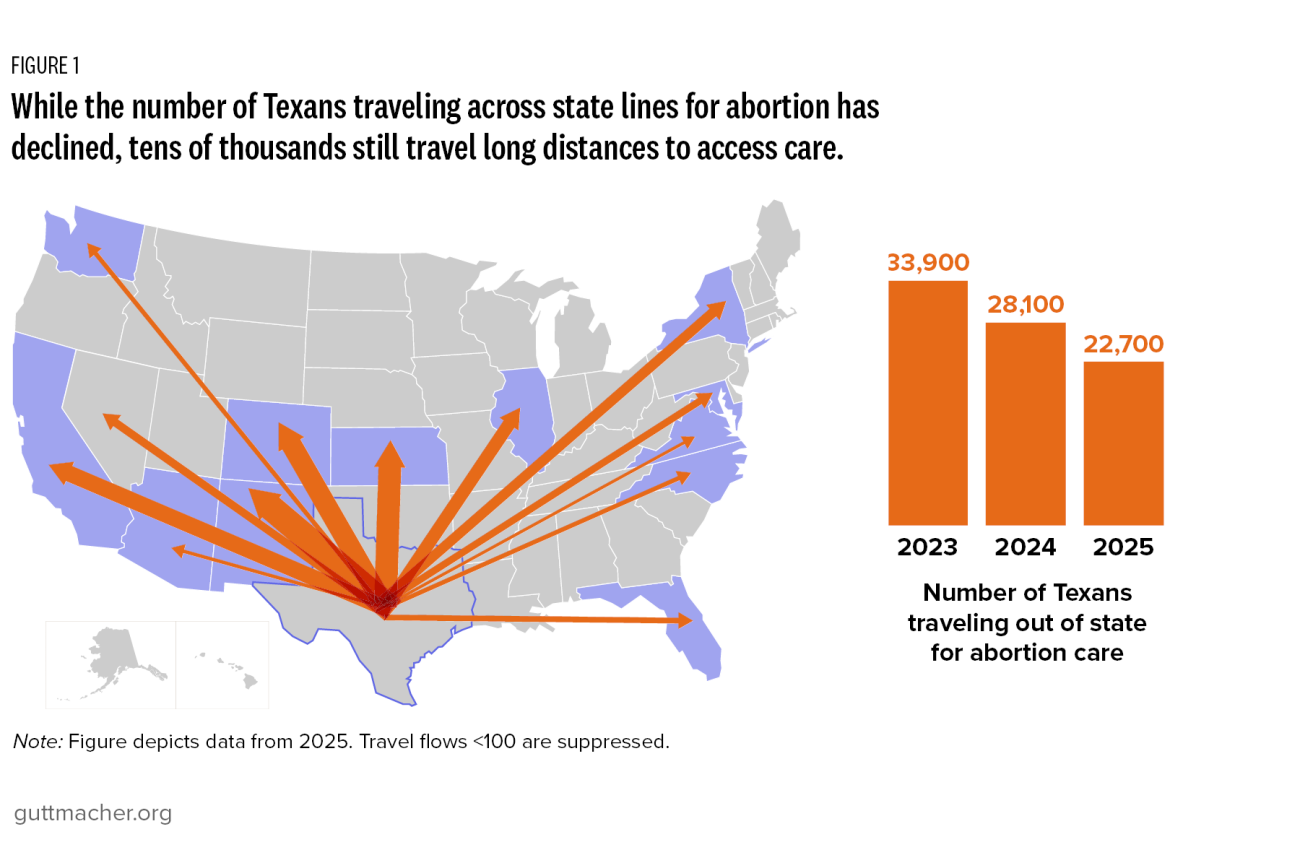
While the number of Texans traveling across state lines for abortion has declined, tens of thousands still travel long distances to access care.

Tens of thousands of Texans, however, still travel for care. In 2025, almost 23,000 Texans traveled to access abortion care in other states; a plurality of this group traveled to New Mexico (42%), followed by Kansas (23%), but many traveled hundreds of miles farther, to states like Colorado (where 3,380 Texans traveled for care in 2025), California (1,480), Illinois (810) and even as far as New York (470).

Florida’s Six-Week Ban Had Major Impacts Throughout the Southeast

In May of 2024, Florida implemented a six-week abortion ban that sharply limited access to in-person care. While some people are able to recognize their pregnancy and get an appointment at a clinic within six weeks of their last period, many others don’t yet realize they’re pregnant or encounter other obstacles to getting care within such a short window of time.

Obtaining care in-person in Florida is made even more difficult by other legal restrictions in the state: in particular, patients are required to travel to the abortion-providing facility twice, twenty-four hours apart—once for in-person counseling and a second time for the abortion itself. Additionally, many patients cannot use their insurance (either private plans purchased through health exchanges or state Medicaid) to cover the cost of their abortion, and minors are required to obtain both parental notification and consent in order to access abortion care.

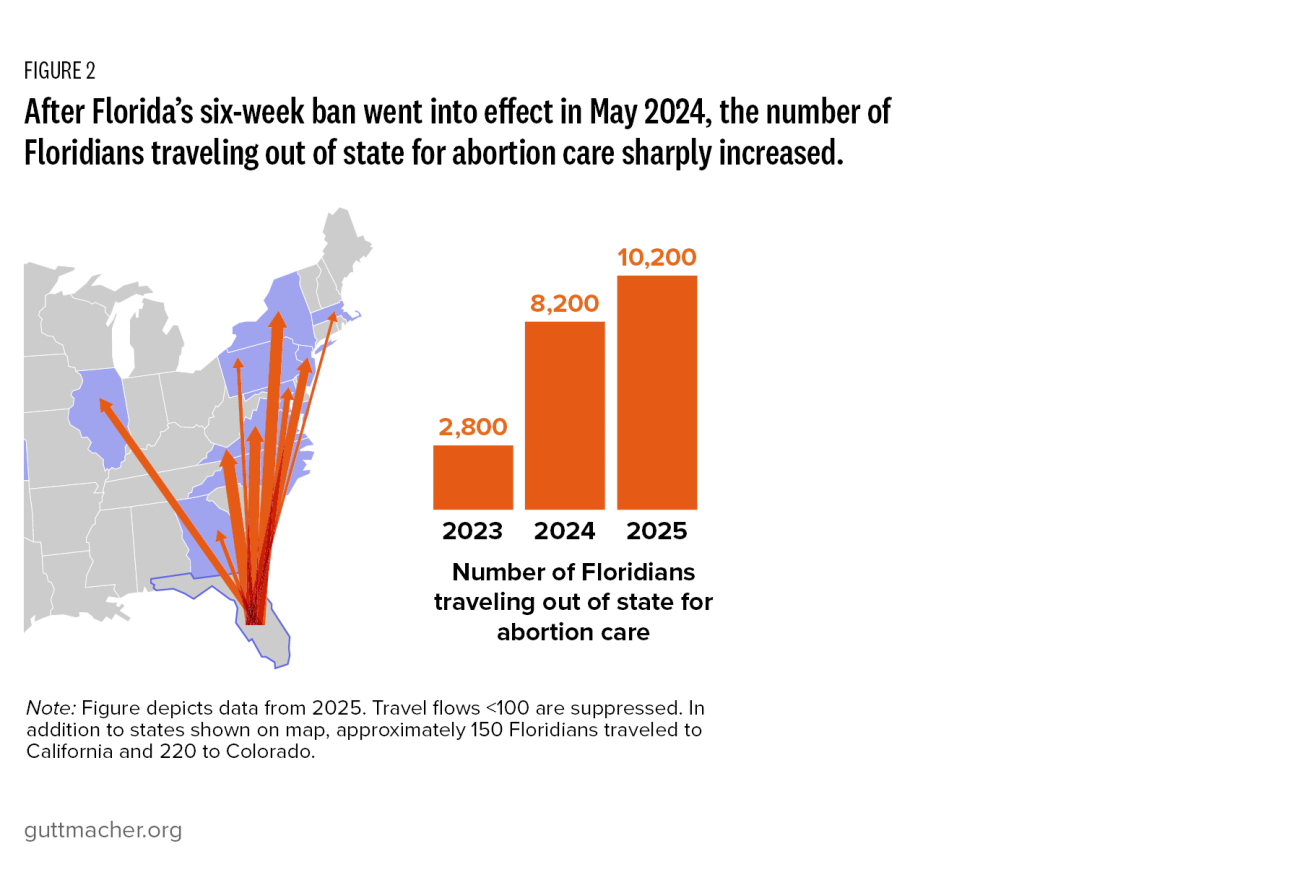
After the six-week ban went into effect, there were steep declines in abortion provision in Florida, which largely continued into 2025. Over this same period, however, there were sharp increases in Floridians traveling out of state for care (see Figure 2). In 2023—when access was already limited in the state due to a 15-week ban and other restrictions—around 2,800 Floridians traveled to other states for abortion care. In 2024, that number more than doubled, to approximately 8,200, and in 2025 continued to increase, to an estimated 10,200.

After Florida’s six-week ban went into effect in May 2024, the number of Floridians traveling out of state for abortion care sharply increased.

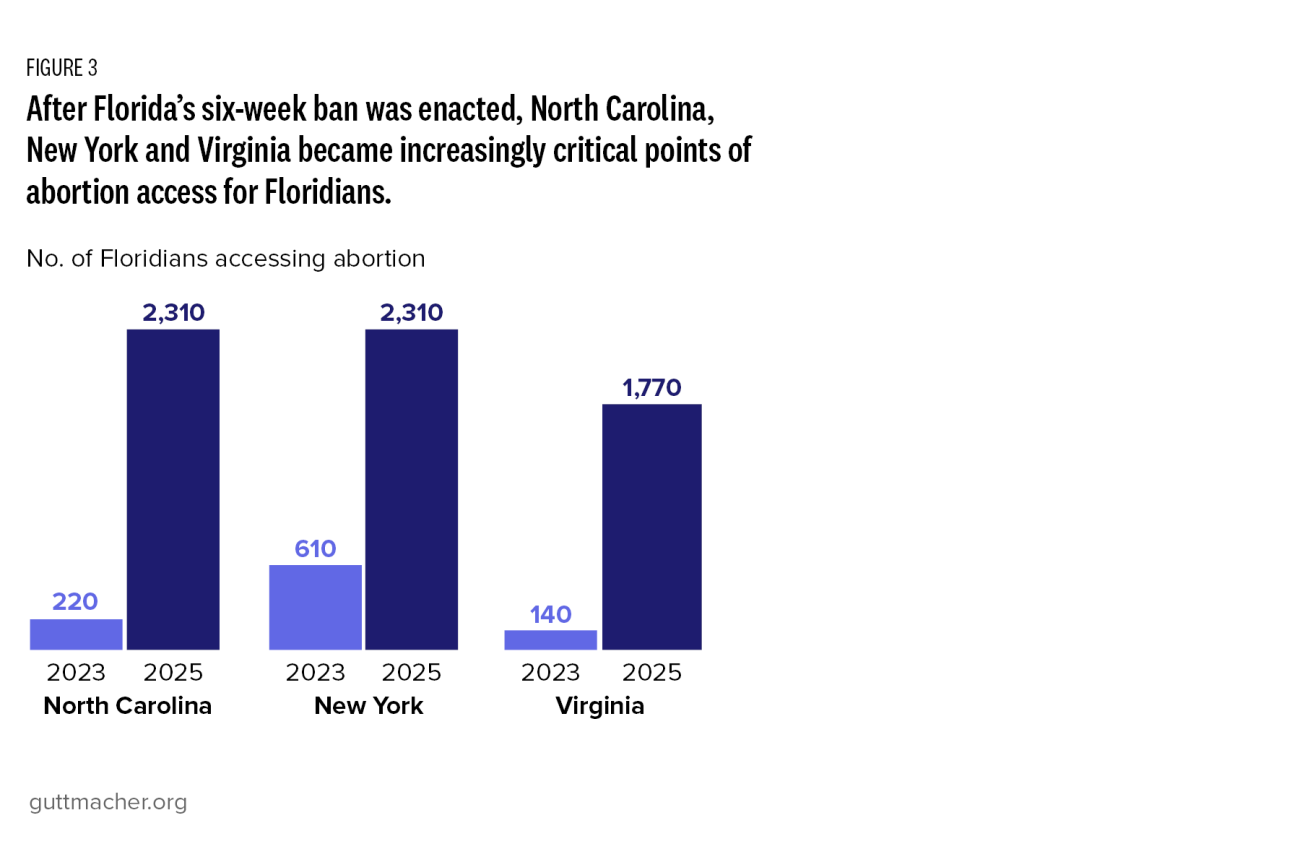
Floridians who left the state for care traveled along the Eastern Seaboard, as well as (in somewhat smaller numbers) to Illinois, California and Colorado. For Florida residents, North Carolina is the closest state with access to in-person care past six weeks, and the number of Floridians traveling to North Carolina increased more than ten-fold after the six-week ban went into effect (from 220 in 2023 to 2,310 in 2025; see Figure 3). This pattern developed despite other abortion restrictions in North Carolina that present particular barriers for interstate travelers. In addition to a 12-week gestational ban, North Carolina has a 72-hour waiting period, which means that people seeking abortion care need to make two trips to the state or stay for multiple days, which can increase costs substantially.

After Florida’s six-week ban was enacted, North Carolina, New York and Virginia became increasingly critical points of abortion access for Floridians.

Likely in part because of these barriers, many Floridians bypassed North Carolina for Virginia, which saw a more than 12-fold increase in travel for care from Florida (from 140 in 2023 to 1,770 in 2025). And many Floridians traveled even farther; the number of Florida residents accessing care in New York increased from approximately 600 in 2023 to approximately 2,300 in 2025. New York is more than 1,000 miles away for most Floridians, but as distances to the closest clinic increase, flight costs may become more salient than driving distances. People may also travel farther to places where they have friends or family that can support or offer them lodging.

Like many other states with severe restrictions or total bans, Florida also saw a sharp increase over this period in abortions provided via telehealth from states with shield law protections (from 3,400 to 19,700). Without this option, it is likely that even more Floridians would have been forced to travel out of state or forgo care entirely. And despite Florida’s abortion restrictions, many Floridians continued to access care at clinics in the state; in 2025, more than 44,000 Floridians accessed abortion care within six weeks' gestation at brick-and-mortar clinics in Florida.

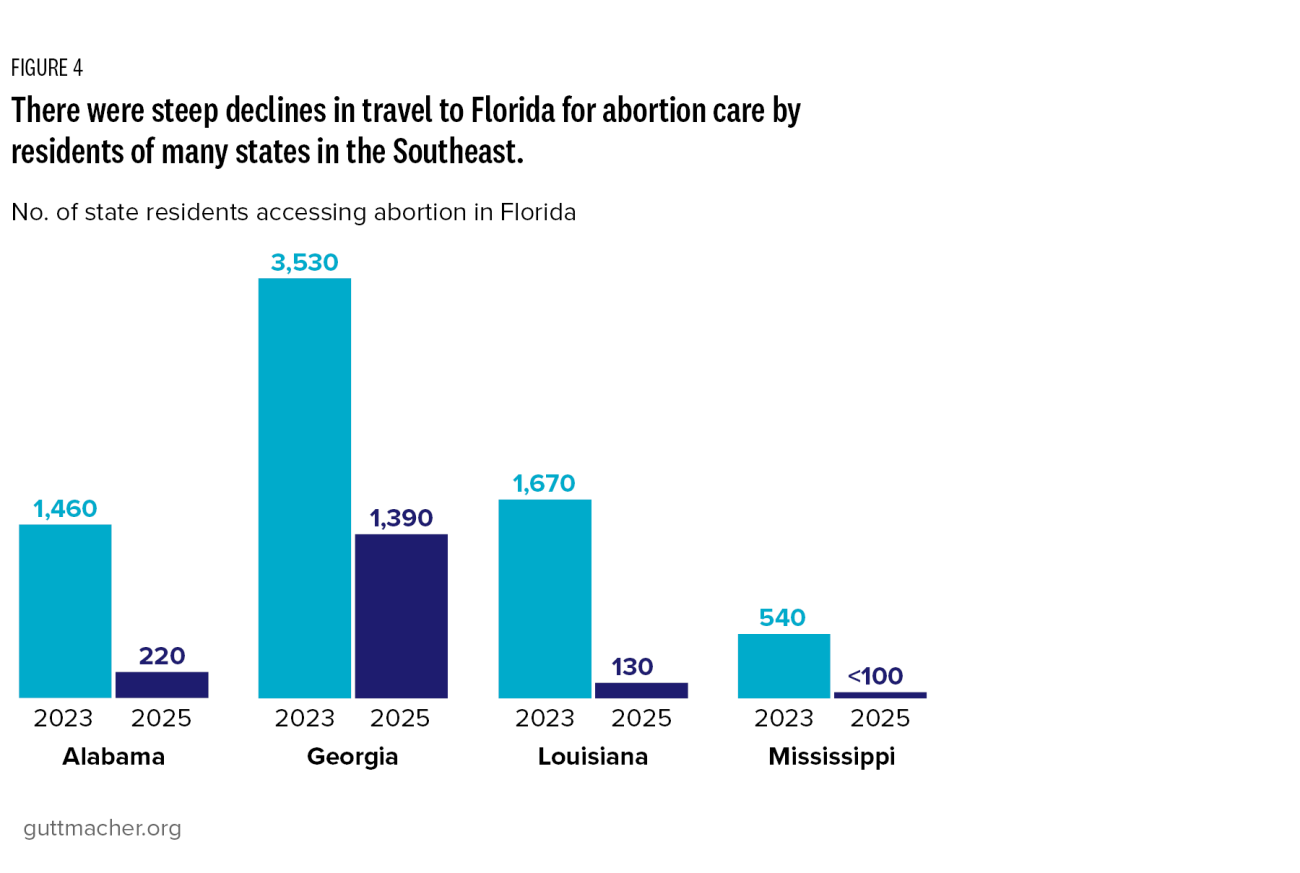
Florida’s six-week ban also had larger impacts on travel throughout the Southeast. Before the ban went into effect, Florida was one of the few places in the region with access to in-person care past six weeks—and it was a critical point of access in 2023 for residents of states like Alabama, Georgia, Louisiana and Mississippi (see Figure 4). In the first full year after Florida’s six-week ban went into effect, however, travel for care from those states sharply declined. These Southern states, like those in other regions, were also subject to a range of additional factors that may have contributed during this period to declines in travel for care. In addition to Florida’s six-week ban narrowing geographic options for travel, many of these states also saw sharp increases in telehealth abortion provided by clinicians from shield law states. At the same time, there were increased strains on funding networks for abortion seekers. These and other factors likely worked in concert to shift how and where people access care.

There were steep declines in travel to Florida for abortion care by residents of many states in the Southeast.

Both Telehealth and Interstate Travel Remain Critical Avenues for Access

The case studies presented here illustrate two major contributors to shifts in travel for abortion care in recent years in the United States: the growth of telehealth access and narrowing options for in-person care past six weeks in the South and Southeast.

Telehealth has become an increasingly common mode of access for abortion care nationally, and has played a particularly critical role in states with total, six-, or twelve- week bans on abortion provision. In 2025, there were approximately 142,000 abortions provided via telehealth to these states, with the plurality (42,000) provided to residents of Texas. For many people, telehealth has likely preempted the need to travel several hundred miles for care, with its attendant financial and logistical burdens. This shift has not gone unnoticed by anti-abortion lawmakers: in 2025, Texas passed House Bill 7, a law that allows private citizens to bring lawsuits against clinicians for manufacturing, mailing or distributing medication abortion pills to individuals in the state. This law is part of a growing trend of states seeking to criminalize or create civil penalties for the sale, purchase or distribution of medication abortion pills. Halfway through 2026, 21 states have introduced 58 such bills, and four have been enacted (in Iowa, Mississippi, Oklahoma and South Dakota). These laws are largely being proposed in states that already have total abortion bans, and their purpose appears to be increasing the threat of liability for shield law providers. Although these providers have so far been able to weather such attacks, this growing trend in state abortion law underscores the pivotal role of telehealth in preserving and expanding abortion access in states with total bans.

In Texas, however, as in many other states with total or early gestational bans, many people continue to travel out of state for care. The reasons that people travel for abortion care—even in the context of broadening access to telehealth services—are complex and multifaceted. Some people may be unaware that telehealth is an option for them; even pre-Dobbs, most people did not know the legal status of abortion in their state, and the legal landscape has become only more complicated in the years since. Others may prefer or need to access in-person care at a clinic—either because they are later in pregnancy (many telehealth providers offer care only up to 11‒14 weeks' gestation); prefer or need procedural care; or want an in-person care experience.

At the same time, options for in-person care have sharply narrowed in much of the Southeast due to Florida’s six-week abortion ban, which has contributed to the greater distances people need to travel for in-person care. These changes likely have a disproportionate impact on groups that already face broader barriers to health care access and specific barriers to abortion care. For example, Floridians under age 18 who are unable to involve a parent have no closer options for in-person abortion care than the District of Columbia, due to parental notification laws in the closer states of Georgia, South Carolina, North Carolina and Virginia. Travel also requires significant resources, beyond the cost of the abortion itself, and while many are able to rely on abortion funds, practical support networks and others to fill gaps and provide support, it can still represent a substantial burden. (In 2025, the member funds of the National Network of Abortion Funds distributed almost $15 million in practical support to more than 25,000 people accessing abortion care; however, funding costs increased substantially from 2024, and it is not uncommon for funds to intermittently pause support due to funding constraints.)

Travel patterns across the United States will likely continue to shift in coming years, as policy changes in one state have ripple effects in many others. In the dynamic landscape of abortion policy, it is critical to preserve multiple routes of access: strengthening both the telehealth protections and the travel support infrastructure that together enable many people living in states with total bans or restrictions to continue to access essential abortion care.

Methodology

Estimates presented in this report are from the Monthly Abortion Provision Study, a project estimating the number of clinician-provided abortions in each US state since January 2023. It collects data on procedural and medication abortions provided at brick-and-mortar health facilities (such as clinics or doctor’s offices), as well as medication abortions provided by US telehealth providers (including those provided to residents of states with total bans). Abortions are counted as having been provided in the state in which a patient had a procedure or where pills were received.

Estimates are generated by a statistical model that combines data collected from ongoing monthly samples of US abortion providers with historical data on the caseloads of US providers; underlying code for this model and a detailed methodology appendix are available at https://osf.io/k4x7t/overview.

Suggested Citation

Maddow-Zimet I and Forouzan K, Patterns of Travel for Abortion Care Continued to Shift in 2025, New York: Guttmacher Institute, 2026, https://www.guttmacher.org/report/patterns-travel-abortion-care-continued-shift-2025.

DOI: https://doi.org/10.1363/2026.300933

Acknowledgments

Research support for the Monthly Abortion Provision Study was provided by Guttmacher Institute colleagues Ava Braccia, Mariah Menanno, Lauren Mitchell, Cici Osias, Ruhi Rao, Samira Sackietey and Aliyah Simon-Felix. This report was edited by Ian Lague; Rachel Jones, Aliyah Simon-Felix and Priyanka Sookhai provided fact-checking support.

The authors gratefully acknowledge the work of staff at facilities and organizations that provide abortion care for their participation and for supplying data for this study.

Footnotes

*In addition, many other states have significant obstacles to in-clinic provision that lead people to seek care across state lines; in Missouri, for example, close to 12,000 people traveled out of state for abortion care in 2025.

Share

Read More

Policy Analysis

Attacks on Shield Laws Are the Next Step in Criminalizing Abortion Care

Fact Sheet

How Innovative Uses of Telehealth Can Support Abortion Access

State Laws and Policies

Shield Laws Related to Sexual and Reproductive Health Care

Initiative

Monthly Abortion Provision Study

Resource

Interactive Map: US Abortion Policies and Access After Roe

Topic

United States

  • Abortion

Geography

  • Northern America: United States

Tags

provision study
Guttmacher Institute

Center facts. Shape policy.
Advance sexual and reproductive rights.®

Donate Now
Newsletter Signup  Contact Us 
  • Facebook
  • Instagram
  • Youtube
  • LinkedIn
  • Contact

Footer

  • Privacy Policy
  • Accessibility Statement
© 2026 Guttmacher Institute. The Guttmacher Institute is registered as a 501(c)(3) nonprofit organization under the tax identification number 13-2890727. Contributions are tax deductible to the fullest extent allowable.