Guttmacher Institute

Search

  • Facebook
  • Instagram
  • Youtube
  • LinkedIn
  • Contact

Highlights

  • Reproductive Health Impact Study
  • Adding It Up
  • Abortion Worldwide
  • Guttmacher-Lancet Commission
  • US policy resources
  • State policy resources
  • International Perspectives on Sexual and Reproductive Health (1975–2020)
  • Perspectives on Sexual and Reproductive Health (1969–2020)

Reports

  • Global
  • United States

Articles

  • Global research
  • US research
  • Policy analysis
  • Guttmacher Policy Review
  • Opinion

Fact Sheets

  • Global
  • United States
  • US State Laws and Policies

Tools

  • Interactive Map: US Abortion Policies and Access After Roe
  • Family Planning Investment Impact Calculator
  • Monthly Abortion Provision Study Dashboard
  • State legislation tracker
  • Public-use data sets

Global

  • Abortion
  • Contraception
  • Pregnancy
  • Teens

US

  • Abortion
  • Contraception
  • Pregnancy
  • Teens

Our Work by Geography

  • Global
  • Africa
  • Asia
  • Europe
  • Latin America & the Caribbean
  • Northern America
  • Oceania

Who We Are

  • About
  • Staff
  • Board
  • Job opportunities
  • Newsletter
  • History
  • Contact
  • Conflict of Interest Policy

Media

  • Media office
  • News releases

Support Our Work

  • Make a gift today
  • Monthly Giving Circle
  • Ways to Give
  • Guttmacher Guardians
  • Guttmacher Legacy Circle
  • Financials
  • Impact Report 2025

Awards & Scholarships

  • Darroch Award
  • Richards Scholarship
  • Bixby Fellowship
Donate
Guttmacher Institute
Donate

Highlights

  • Reproductive Health Impact Study
  • Adding It Up
  • Abortion Worldwide
  • Guttmacher-Lancet Commission
  • US policy resources
  • State policy resources
  • International Perspectives on Sexual and Reproductive Health (1975–2020)
  • Perspectives on Sexual and Reproductive Health (1969–2020)

Reports

  • Global
  • United States

Articles

  • Global research
  • US research
  • Policy analysis
  • Guttmacher Policy Review
  • Opinion

Fact Sheets

  • Global
  • United States
  • US State Laws and Policies

Tools

  • Interactive Map: US Abortion Policies and Access After Roe
  • Family Planning Investment Impact Calculator
  • Monthly Abortion Provision Study Dashboard
  • State legislation tracker
  • Public-use data sets

Global

  • Abortion
  • Contraception
  • Pregnancy
  • Teens

US

  • Abortion
  • Contraception
  • Pregnancy
  • Teens

Our Work by Geography

  • Global
  • Africa
  • Asia
  • Europe
  • Latin America & the Caribbean
  • Northern America
  • Oceania

Who We Are

  • About
  • Staff
  • Board
  • Job opportunities
  • Newsletter
  • History
  • Contact
  • Conflict of Interest Policy

Media

  • Media office
  • News releases

Support Our Work

  • Make a gift today
  • Monthly Giving Circle
  • Ways to Give
  • Guttmacher Guardians
  • Guttmacher Legacy Circle
  • Financials
  • Impact Report 2025

Awards & Scholarships

  • Darroch Award
  • Richards Scholarship
  • Bixby Fellowship
Donate
  • Facebook
  • Instagram
  • Youtube
  • LinkedIn
  • Contact
Fact Sheet
March 2026

Abortion in the United States

This fact sheet highlights key data points related to abortion in the United States, drawing on the Guttmacher Institute’s long-standing efforts to document abortion numbers and rates, characteristics of people having abortions and related indicators.

The US abortion policy landscape continues to evolve in the wake of the Supreme Court’s June 2022 decision in Dobbs v. Jackson Women’s Health Organization, which overturned Roe v. Wade. The latest information on abortion policies in effect in each state—including total abortion bans and other restrictions—can be found on Guttmacher’s interactive abortion policy map.

Numbers and Rates

  • An estimated 1,126,000 abortions were provided by US clinicians in 2025, largely unchanged from 2024, when there were 1,124,000 clinician-provided abortions, and an increase of 21% from 2020, the last year of comprehensive national estimates before Dobbs.1 This count includes medication abortions provided via telemedicine by US clinicians, including those provided under the protection of shield laws to patients in states with total bans. It does not include self-managed abortions, such as those using medications mailed from pharmacies outside the United States or sourced from community networks. Evidence suggests self-managed abortions have increased since Dobbs.2
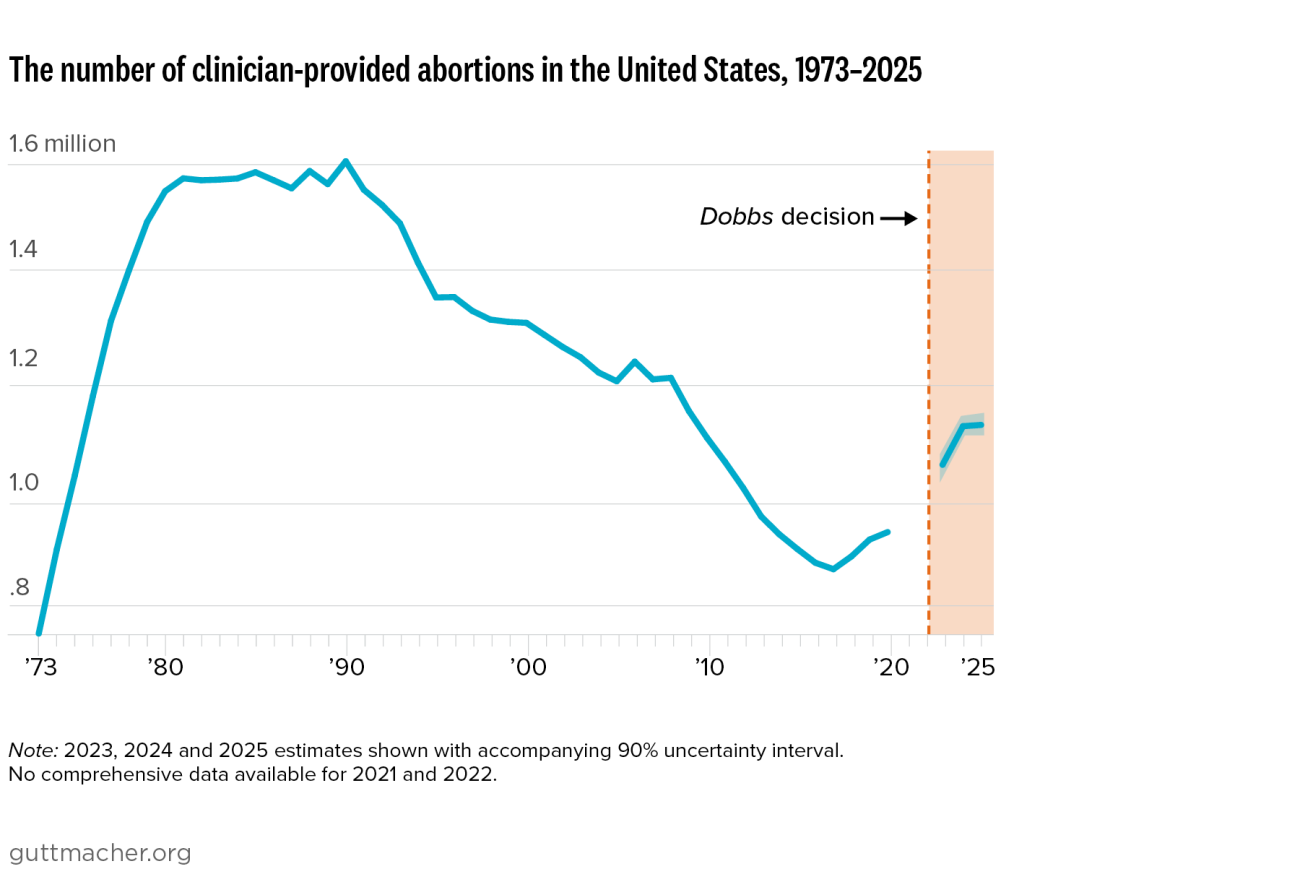
The number of clinician-provided abortions in the United States, 1973–2025
  • The abortion rate in 2025 was 16.7 abortions per 1,000 women aged 15–44. This is the same as the rate for 2024, a 5% increase from 2023 (when the abortion rate was 15.9), and a 16% increase from the 2020 rate.3
  • Current national and state abortion counts are available from Guttmacher’s Monthly Abortion Provision Study. US abortion incidence data for 1973–2020 are available here.

Providers

  • At the end of 2025, 753 brick-and-mortar clinics were providing abortion services in the United States, a 2% decline from March 2024 when there were 765 such clinics and a 7% decline from 807 in 2020.4
  • As of December 2025, there were no clinics providing abortion care in the 13 states with total abortion bans in effect at that time. These states had 62 clinics in 2020.4
  • In the remaining 37 states (and the District of Columbia), where abortion was not completely banned, there were 8 more brick-and-mortar clinics operating in December 2025 than in 2020, a 1% increase.4
  • Online-only, or virtual, clinics have come to play an important role in abortion access. In 2025, they accounted for 24% of clinician-provided abortions in the United States, an increase from 20% in 2024 and 12% in 2023.5

Out-of-State Travel

Abortion bans and other restrictions imposed or enforced after Dobbs have led to a surge in people traveling from states where abortion is banned or heavily restricted to seek care in states where abortion is available.6

  • Travel across state lines for abortion care peaked in 2023, when more than 169,000 US abortion patients traveled to other states to obtain care, representing 16% of all abortions in the United States. Half as many (81,000) did so in 2020.7
  • Since 2023, the incidence of travel across state lines for care has been declining, though it remains historically high. In 2025, approximately 142,000 people crossed state lines to access abortion care, representing an 8% decline from 2024 when 154,000 people traveled out of state, and a 16% decline from the peak in 2023.
  • Nationally, 13% of all abortion patients in 2025 traveled out of state to obtain care.1

Medication Abortion

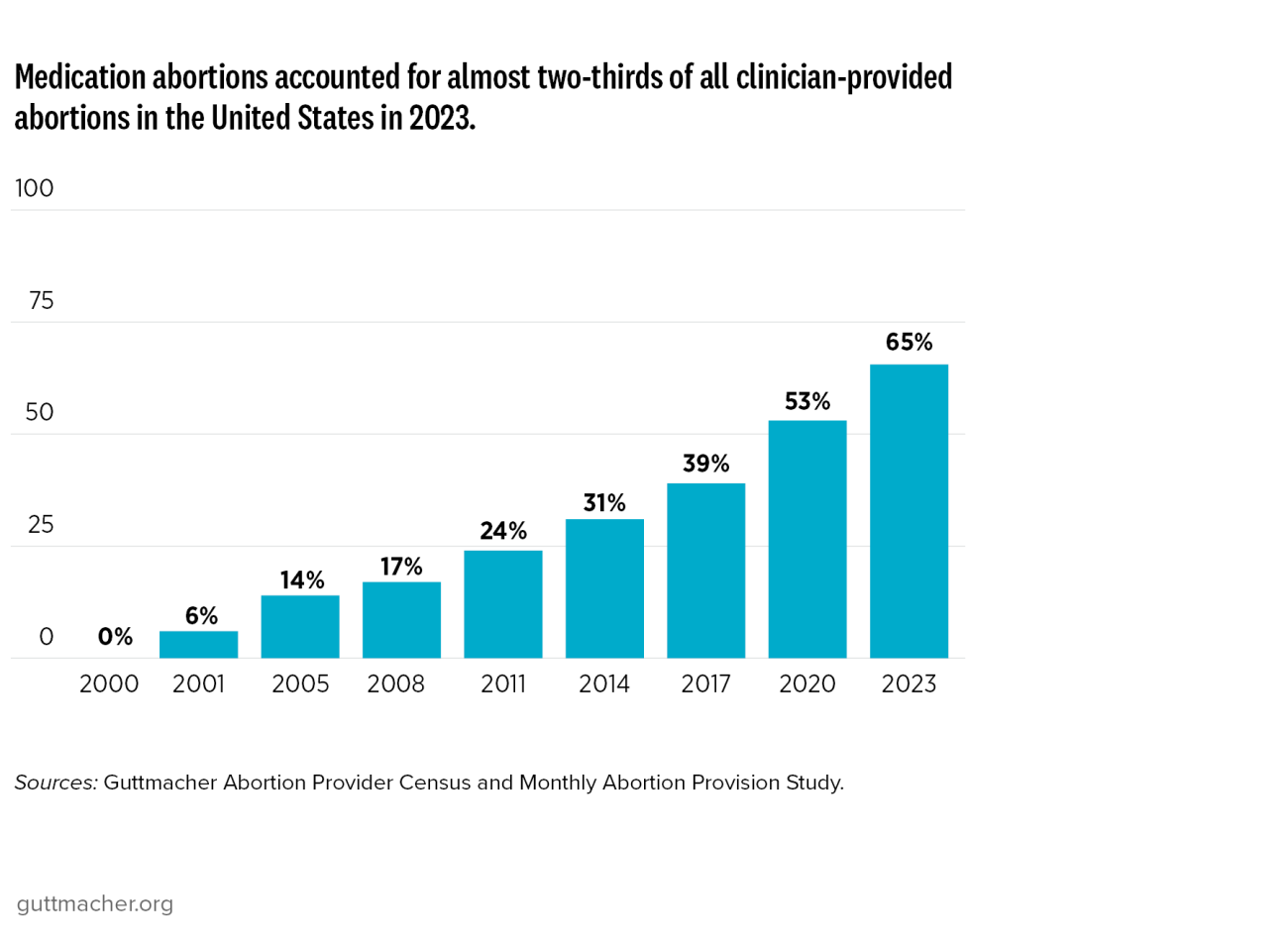
In 2023, medication abortion accounted for 65% of all clinician-provided abortions in the United States; by contrast, this method accounted for 53% of abortions in 2020.8 At the state level, medication abortion accounted for the majority of abortions in nearly all US states without a total ban, ranging from 44% in Washington, DC and 46% in Ohio to 84% in Montana and 95% in Wyoming.9 These estimates do not include self-managed abortions.

Medication abortions accounted for almost two-thirds of all clinician-provided abortions in the United States in 2023.

Characteristics of People Obtaining Abortions

The most recent data on the characteristics of people having clinician-provided abortions in the United States were collected in June 2021–July 2022 and represent the population of people obtaining abortions in the year prior to the Dobbs decision. The profile of people accessing abortion care may have changed since then.

  • Among people obtaining an abortion, nearly two-thirds were in their 20s: 33% were aged 20–24 and 28% were 25–29.10
  • Adolescents made up 10% of people obtaining an abortion; 2% of people obtaining an abortion were 17 or younger.10
  • Similar proportions of people obtaining an abortion were Black (29%), Latinx (30%) or non-Hispanic White (30%). Four percent were Asian and 7% identified as another race or ethnicity or as more than one race.10
  • Approximately 55% of people who obtained an abortion had previously had at least one birth.10
  • Sixteen percent of people having abortions identified as non-heterosexual: 12% identified as bisexual, 2% as pansexual, 0.3% as lesbian and 2% as something else.11
  • More than 1% of people accessing abortion care reported their gender identity as something other than woman or female.11
  • Some 41% of people obtaining abortions had an income below the federal poverty level (FPL) and 30% had incomes between 100% and 199% of the FPL.10
  • Approximately one in four women are expected to have an abortion by age 45, given 2020 abortion rates.12
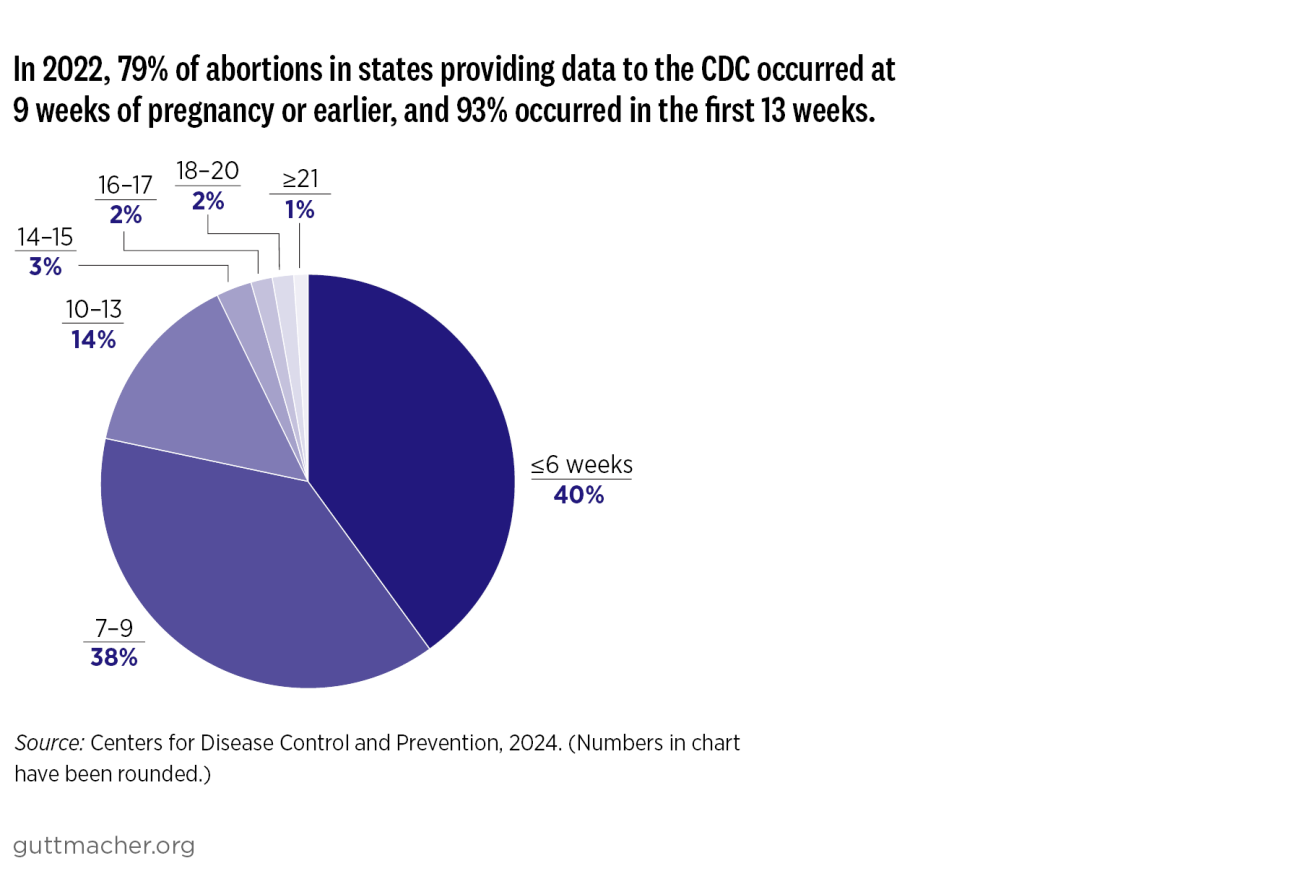
  • According to data from the Centers for Disease Control and Prevention (CDC), in 2022: 40% of abortions were obtained at six weeks’ gestation or earlier, 53% at 7–13 weeks’ gestation, and 7% at 14 weeks’ gestation or later.13
In 2022, 79% of abortions in states providing data to the CDC occurred at 9 weeks of pregnancy or earlier, and 93% occurred in the first 13 weeks.

Insurance Coverage and Payment

Most individuals who obtained abortion care in 2021–2022 had some form of health insurance. But insurance does not necessarily cover abortion services, and even when it does, patients may not be able to use available coverage.

  • More than three-quarters (78%) of people accessing clinician-provided abortion care had health insurance: 45% had Medicaid coverage, 27% had private insurance and 6% were insured through the Affordable Care Act’s exchanges. Twenty-two percent did not have health insurance.10
  • More than half (53%) of people paid out of pocket for their abortion in 2021–2022.10
  • Medicaid was the second most common method of payment and was used by 30% of people obtaining abortions. Thirteen percent of people used private insurance to pay for abortion care, and 15% relied on financial assistance (such as donations from abortion funds) to pay for some or all of the cost of their care.10

1. Maddow-Zimet I and Forouzan K, Full-Year Estimates Show Overall Stability in Abortion Incidence, Decreased Travel and Increased Telehealth Provision, New York: Guttmacher Institute, 2026, https://www.guttmacher.org/report/full-year-estimates-show-overall-stability-abortion-incidence-decreased-travel-increased-telehealth-provision.

2. Aiken ARA et al., Provision of medications for self-managed abortion before and after the Dobbs v. Jackson Women’s Health Organization decision, JAMA, 2024, 331(18):1558–1564, https://jamanetwork.com/journals/jama/article-abstract/2816817.

3. Guttmacher Institute, Special tabulations of data from the Monthly Abortion Provision Study, 2025, https://www.guttmacher.org/monthly-abortion-provision-study. Population estimates of the number of women aged 15–44 for 2020, 2023 and 2024 are Vintage 2024 estimates accessed via CDC Wonder; because population estimates by single year of age and sex are not yet available for 2025, these were estimated by applying the proportion of women aged 15–44 in 2024 to Vintage 2025 Census population estimates.  

4. Jones RK, Braccia A and Stoskopf-Ehrlich E, Number of Brick-and-Mortar Abortion Clinics Declined Slightly between 2024 and 2025, New York: Guttmacher Institute, 2026, https://www.guttmacher.org/report/abortion-clinics-united-states-2024-2025.

5.  Guttmacher Institute, Special tabulations of data from the Monthly Abortion Provision Study, 2024, https://www.guttmacher.org/monthly-abortion-provision-study.

6. Forouzan K, Friedrich-Karnik A and Maddow-Zimet I, The high toll of US abortion bans: nearly one in five patients now traveling out of state for abortion care, Policy Analysis, New York: Guttmacher Institute, 2023, https://www.guttmacher.org/2023/12/high-toll-us-abortion-bans-nearly-on….

7. Maddow-Zimet I and Kost K, Even before Roe was overturned, nearly one in 10 people obtaining an abortion traveled across state lines for care, Policy Analysis, New York: Guttmacher Institute, 2022, https://www.guttmacher.org/article/2022/07/even-roe-was-overturned-nearly-one-10-people-obtaining-abortion-traveled-across. 

8. DoCampo I, Jones RK and Maddow-Zimet I, The role of medication abortion provision in US states without total abortion bans, Perspectives on Sexual and Reproductive Health, 2023 57: 3–7, https://doi.org/10.1111/psrh.12294. 

9. Friedrich-Karnik A, DoCampo I and Gibson C, Medication abortion remains critical to state abortion provision as attacks on access persist, Policy Analysis, New York: Guttmacher Institute, 2025, https://www.guttmacher.org/2025/02/medication-abortion-remains-critical-state-abortion....

10. Jones RK, Medicaid’s role in alleviating some of the financial burden of abortion: findings from the 2021–2022 Abortion Patient Survey, Perspectives on Sexual and Reproductive Health, 2024, 56(3):244-254,  https://doi.org/10.1111/psrh.12250.

11. Chiu D, Stoskopf-Ehrlich E and Jones RK, As many as 16% of people having abortions do not identify as heterosexual women, Policy Analysis, New York: Guttmacher Institute, 2023, https://www.guttmacher.org/2023/06/many-16-people-having-abortions-do-n….

12. Jones RK, An estimate of lifetime incidence of abortion in the United States using the 2021–2022 Abortion Patient Survey, Contraception, 2024, 135:110445,  https://www.contraceptionjournal.org/article/S0010-7824(24)00108-2/full….

13. Kortsmit K et al., Abortion surveillance—United States, 2021, MMWR Surveillance Summaries, 2023, Vol. 72, No. 9, https://www.cdc.gov/mmwr/volumes/72/ss/ss7209a1.htm?s_cid=ss7209a1_w.

References

1. Maddow-Zimet I and Forouzan K, Full-Year Estimates Show Overall Stability in Abortion Incidence, Decreased Travel and Increased Telehealth Provision, New York: Guttmacher Institute, 2026, https://www.guttmacher.org/report/full-year-estimates-show-overall-stability-abortion-incidence-decreased-travel-increased-telehealth-provision.

2. Aiken ARA et al., Provision of medications for self-managed abortion before and after the Dobbs v. Jackson Women’s Health Organization decision, JAMA, 2024, 331(18):1558–1564, https://jamanetwork.com/journals/jama/article-abstract/2816817.

3. Guttmacher Institute, Special tabulations of data from the Monthly Abortion Provision Study, 2025, https://www.guttmacher.org/monthly-abortion-provision-study. Population estimates of the number of women aged 15–44 for 2020, 2023 and 2024 are Vintage 2024 estimates accessed via CDC Wonder; because population estimates by single year of age and sex are not yet available for 2025, these were estimated by applying the proportion of women aged 15–44 in 2024 to Vintage 2025 Census population estimates.  

4. Jones RK, Braccia A and Stoskopf-Ehrlich E, Number of Brick-and-Mortar Abortion Clinics Declined Slightly between 2024 and 2025, New York: Guttmacher Institute, 2026, https://www.guttmacher.org/report/abortion-clinics-united-states-2024-2025.

5.  Guttmacher Institute, Special tabulations of data from the Monthly Abortion Provision Study, 2024, https://www.guttmacher.org/monthly-abortion-provision-study.

6. Forouzan K, Friedrich-Karnik A and Maddow-Zimet I, The high toll of US abortion bans: nearly one in five patients now traveling out of state for abortion care, Policy Analysis, New York: Guttmacher Institute, 2023, https://www.guttmacher.org/2023/12/high-toll-us-abortion-bans-nearly-on….

7. Maddow-Zimet I and Kost K, Even before Roe was overturned, nearly one in 10 people obtaining an abortion traveled across state lines for care, Policy Analysis, New York: Guttmacher Institute, 2022, https://www.guttmacher.org/article/2022/07/even-roe-was-overturned-nearly-one-10-people-obtaining-abortion-traveled-across. 

8. DoCampo I, Jones RK and Maddow-Zimet I, The role of medication abortion provision in US states without total abortion bans, Perspectives on Sexual and Reproductive Health, 2023 57: 3–7, https://doi.org/10.1111/psrh.12294. 

9. Friedrich-Karnik A, DoCampo I and Gibson C, Medication abortion remains critical to state abortion provision as attacks on access persist, Policy Analysis, New York: Guttmacher Institute, 2025, https://www.guttmacher.org/2025/02/medication-abortion-remains-critical-state-abortion....

10. Jones RK, Medicaid’s role in alleviating some of the financial burden of abortion: findings from the 2021–2022 Abortion Patient Survey, Perspectives on Sexual and Reproductive Health, 2024, 56(3):244-254,  https://doi.org/10.1111/psrh.12250.

11. Chiu D, Stoskopf-Ehrlich E and Jones RK, As many as 16% of people having abortions do not identify as heterosexual women, Policy Analysis, New York: Guttmacher Institute, 2023, https://www.guttmacher.org/2023/06/many-16-people-having-abortions-do-n….

12. Jones RK, An estimate of lifetime incidence of abortion in the United States using the 2021–2022 Abortion Patient Survey, Contraception, 2024, 135:110445,  https://www.contraceptionjournal.org/article/S0010-7824(24)00108-2/full….

13. Kortsmit K et al., Abortion surveillance—United States, 2021, MMWR Surveillance Summaries, 2023, Vol. 72, No. 9, https://www.cdc.gov/mmwr/volumes/72/ss/ss7209a1.htm?s_cid=ss7209a1_w.

Acknowledgments

Isaac Maddow-Zimet, Rachel K. Jones and Emma Stoskopf-Ehrlich, and edited by Ian Lague.

Share

Reproductive rights are under attack. Will you help us fight back with facts?

Donate

Read More

Resource

Interactive Map: US Abortion Policies and Access After Roe

Initiative

Monthly Abortion Provision Study

Topic

Abortion in the United States

Topic

United States

  • Abortion

Geography

  • Northern America: United States
Guttmacher Institute

Center facts. Shape policy.
Advance sexual and reproductive rights.®

Donate Now
Newsletter Signup  Contact Us 
  • Facebook
  • Instagram
  • Youtube
  • LinkedIn
  • Contact

Footer

  • Privacy Policy
  • Accessibility Statement
© 2026 Guttmacher Institute. The Guttmacher Institute is registered as a 501(c)(3) nonprofit organization under the tax identification number 13-2890727. Contributions are tax deductible to the fullest extent allowable.